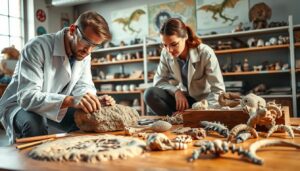
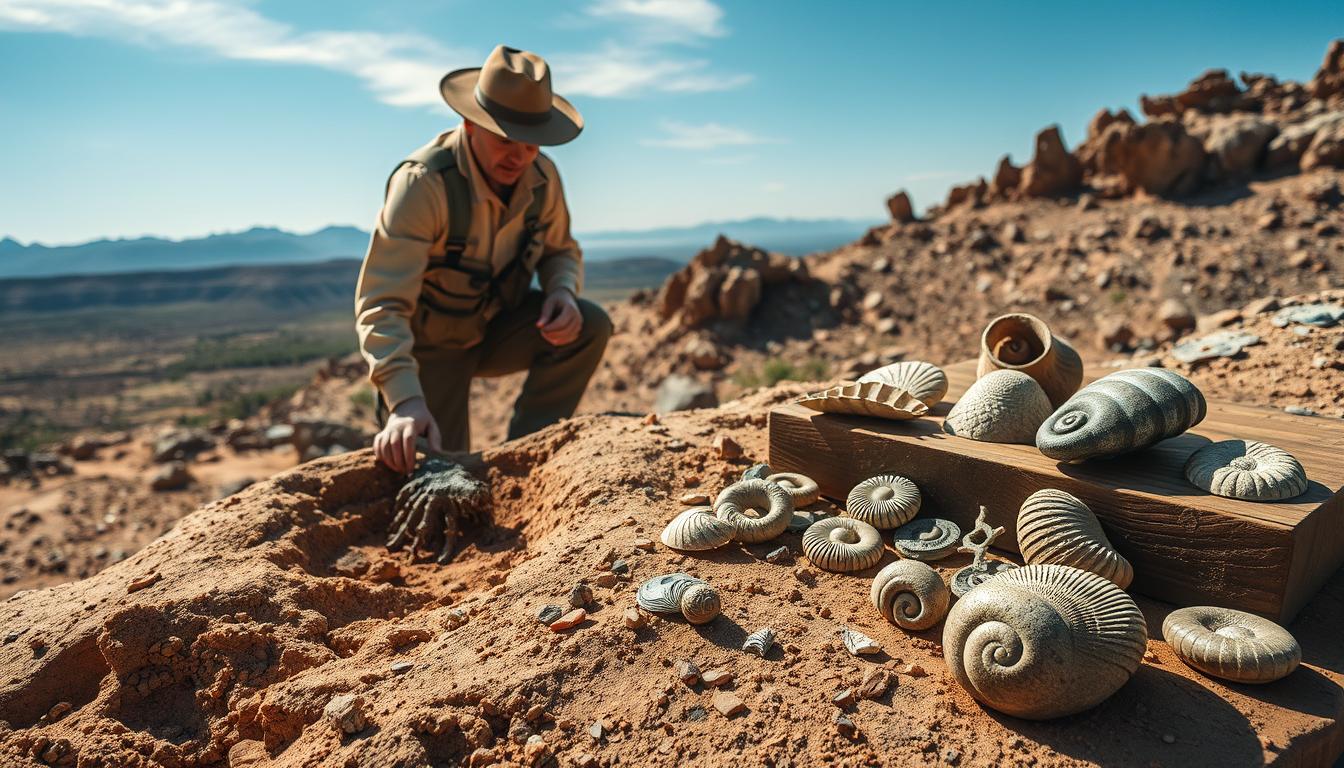
The remains of ancient plants and animals are found in sediments like sand and mud. They are buried under seas, lakes, and rivers. Fossils offer a peek into Earth’s past.
Fossils are made when the bodies of plants and animals are quickly buried. This protects them from scavengers and decay. As more sediment piles up, the pressure and conditions help turn them into fossils.
Studying fossils has helped us learn a lot about Earth’s history. It shows us how environments have changed and how life has evolved. By looking at fossils, scientists can build pictures of ancient worlds and understand past climates.
Key Takeaways
- Fossils are the preserved remains of ancient plants and animals.
- They provide evidence for evolution and environmental changes.
- Fossils are formed through a process of rapid burial and sedimentation.
- The study of fossils helps scientists understand Earth’s history.
- Fossils offer insights into ancient ecosystems and past climates.
The Fascinating World of Fossils
Fossils are like windows into the past. They show us what life was like long ago. These ancient remains help us learn about Earth’s history.
What Are Fossils?
Fossils are what’s left of old plants and animals. They can be parts of bodies or marks left behind. These marks tell us about life long ago.
Types of Fossils Found on Earth
Fossils are divided into two main types. Body fossils are parts of old bodies. Trace fossils are marks left by living things, like footprints.
| Type of Fossil | Description | Examples |
|---|---|---|
| Body Fossils | Preserved remains of body parts | Bones, leaves, shells |
| Trace Fossils | Evidence left by organisms in sediment | Footprints, burrows, plant roots |
The Significance of Fossil Discoveries
Fossils have changed how we see Earth’s history. They show us what life was like before. They help scientists understand how our planet changed over time.
Fossils are also key to understanding the fossil record. This record helps us learn about Earth’s past.
The Process of Fossilization
Fossilization is a complex process. It turns organic remains into fossils. This happens in several stages, from when an organism dies to when it’s preserved.
How Organic Remains Transform Into Fossils
Organic remains become fossils through permineralization or petrification. This is when minerals replace the original material.
Conditions Required for Fossil Formation
To form fossils, several conditions are needed. These include quick burial, protection from scavengers, and minerals to replace the original material.
Fossil Preservation Techniques
There are old and new ways to preserve fossils. Old methods include petrification. New ones use CT scans and other imaging.
Traditional Methods
Traditional methods use petrification. This is when minerals replace the original material.
Modern Technologies
Modern tech uses CT scans and other imaging. This lets us study fossils in detail without harming them. For more info, see this article.
Why Fossils Matter to Earth’s History
Fossils connect us to Earth’s past, showing how life evolved. They are remains or traces of old life forms preserved over time. This gives us a peek into the past.
Fossils as Time Capsules of Ancient Life
Fossils are like time capsules that tell us about ancient life. They help scientists see how life has changed over millions of years. For example, fossil discoveries have shown us how humans evolved.
The study of fossils, called paleontology, helps us understand Earth’s history. It shows how some species went extinct, while others evolved into new ones.
Reconstructing Ancient Ecosystems and Environments
Fossils also tell us about ancient environments. By studying the fossils in a rock layer, scientists can guess what the environment was like. For example, certain fossils might show that an area was once underwater.
This knowledge is key to understanding how ecosystems have changed. It helps scientists predict how they might change in the future. It also helps them spot patterns in Earth’s history.
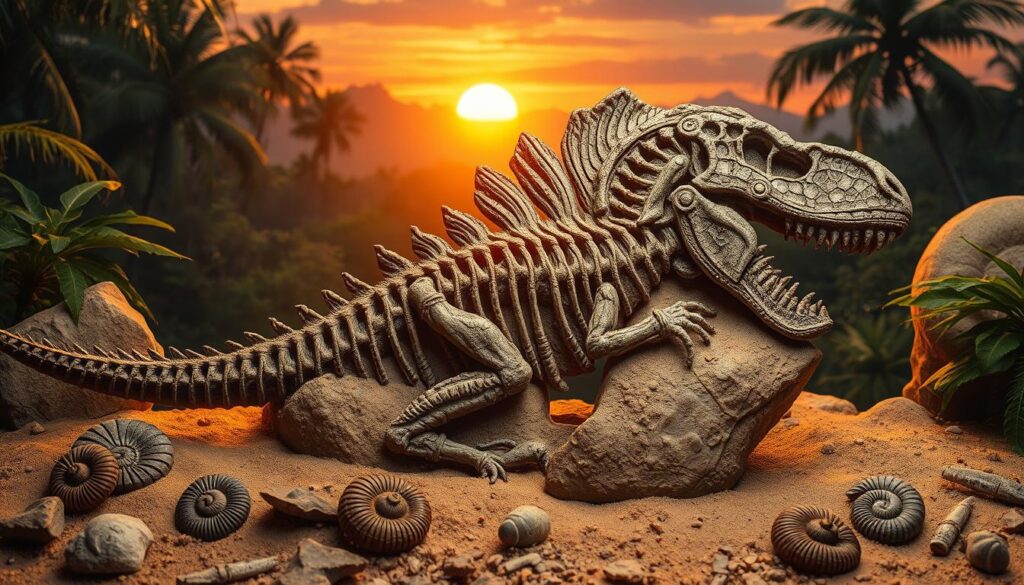
Tracking Climate Changes Through Geological Time
Fossils help track climate changes over time. Certain fossils, like coral reefs or plankton, tell us about past climates. For example, coral reefs suggest a warm climate, while certain plankton indicate cooler waters.
By studying these fossils, scientists can map out climate patterns over millions of years. This knowledge is vital for understanding current climate change. It helps predict future changes too.
Scientific Insights from the Fossil Record
The fossil record is key in Earth sciences. It shows evidence for evolution, ancient environments, and past climates. By studying fossils, scientists learn about Earth’s history and how it changed.
Evidence for Evolution and Natural Selection
The fossil record proves evolution and natural selection. Transitional fossils, like those in whale evolution studies, show gradual changes over time. This supports evolution theory. It also shows how species adapt to their environments, proving natural selection.
Understanding Mass Extinction Events
Fossils help us understand big extinction events, like the Permian-Triassic one. By studying fossils, researchers find patterns and causes of these events. This gives us insights into Earth’s history and future extinctions.
Paleontology: Unlocking Earth’s Past
Paleontology uses many methods to explore Earth’s past. This includes:
- Field research to find and collect fossils
- Laboratory analysis to study fossils in detail
- Dating fossils to know their age
Field Research Methods
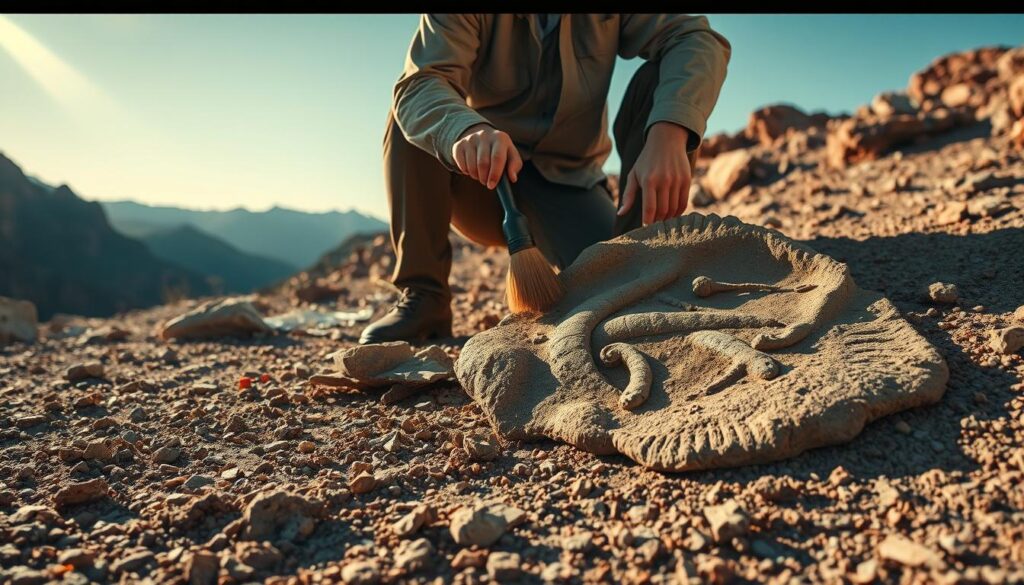
Field research is about finding and digging up fossils. It needs knowledge of geology and finding fossil sites.
Laboratory Analysis Techniques
In labs, fossils are studied with microscopy and chemical analysis. These methods reveal what ancient organisms were like.
Dating Fossil Specimens
Dating fossils is key to knowing their history. Radiometric dating helps scientists figure out when fossils lived. This is vital for understanding evolution.
| Technique | Description | Application |
|---|---|---|
| Field Research | Searching for and excavating fossils | Discovering new fossil species |
| Laboratory Analysis | Studying fossils using microscopy and chemical analysis | Understanding fossil composition and structure |
| Dating Techniques | Determining the age of fossils using radiometric dating | Reconstructing the timeline of evolutionary events |
Preserving Our Understanding of Earth’s History
Fossils give us a peek into Earth’s past. They help us build pictures of old ecosystems and track climate changes. The importance of fossils is huge. They let scientists see how life on Earth has changed over time.
Keeping our grasp on Earth’s history through fossils is key. It’s not just for scientists. It also helps us learn how to protect our planet. This knowledge is vital for saving our environment.
By studying and saving fossils, we learn more about life and Earth. This knowledge makes us appreciate the natural world even more.
FAQ
What is the significance of fossils in understanding Earth’s history?
Fossils give us a peek into the past. They show us what life was like long ago. This helps us understand how our planet has changed over time.
How are fossils formed, and what are the conditions required for fossilization?
Fossils form when remains are quickly buried. This protects them from being eaten or damaged by oxygen. Minerals then replace the original material, keeping its shape.
The right conditions for this to happen include little oxygen, fast burial, and minerals present.
What are the different types of fossils, and what do they tell us about Earth’s past?
There are two main types of fossils. Body fossils are the remains of old organisms. Trace fossils show signs of life long ago.
Both types help us learn about Earth’s history. They tell us about old ecosystems, environments, and life forms.
How do fossils provide evidence for evolution and natural selection?
Fossils show how life on Earth has changed over time. They show gradual changes in life forms. This supports the idea of evolution and natural selection.
What can fossils tell us about ancient climates and environmental conditions?
Fossils can tell us about old climates and environments. For example, coral reefs suggest warm, shallow waters. Plants and pollen tell us about old vegetation and climates.
How do paleontologists date fossil specimens, and what techniques do they use?
Paleontologists use different methods to date fossils. These include radiometric dating, biostratigraphy, and paleomagnetism. These methods help us understand when fossils were formed.
Why is it important to preserve fossils and our understanding of Earth’s history?
It’s vital to keep fossils and our knowledge of Earth’s history safe. Fossils are a unique way to learn from the past. Preserving them helps us understand our planet’s history and how it has changed.

Subscribe to Our Newsletter