
Identifying rocks can be a fun hobby. It’s easy to do with the right skills. The first step is to know the physical traits of rocks, like color, texture, and shine.
Rocks fall into three main types: igneous, sedimentary, and metamorphic. Each type has its own geological characteristics that are easy to spot. By learning to see these signs, anyone can get good at identifying rocks.
Key Takeaways
- Understanding the physical characteristics of rocks is key for identification.
- Rocks are mainly divided into igneous, sedimentary, and metamorphic types.
- Looking at color, texture, and shine helps identify rocks.
- Learning to spot visual clues is essential for rock identification.
- Rock identification can be a fun and rewarding hobby.
The Fundamentals of Rock Identification
Knowing how to identify rocks starts with seeing their looks. It’s a basic skill in geology. It helps both fans and experts to figure out what rocks are made of.
Why Visual Identification Skills Matter
Being good at seeing what rocks look like is very important. It lets people quickly tell what kind of rock they have. Good tips for identifying rocks often say to look closely.
Basic Tools for Field Identification
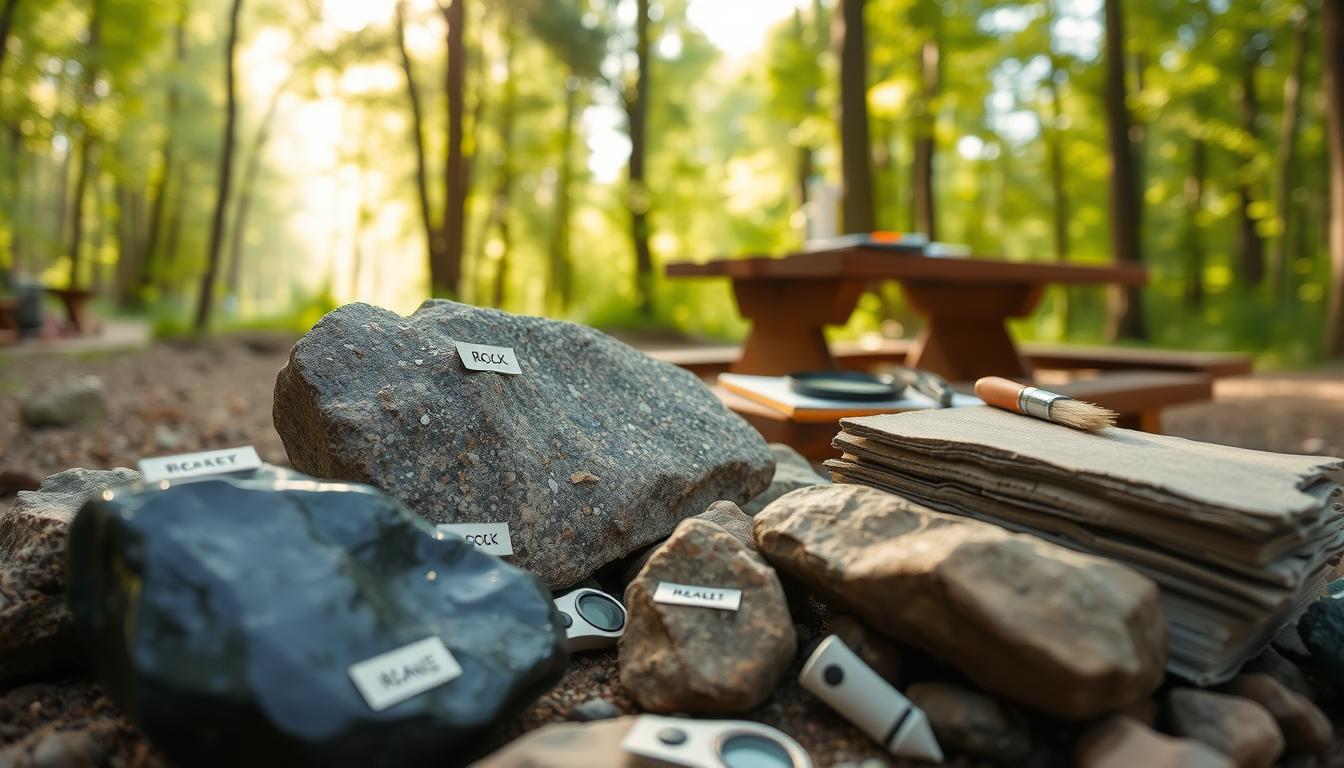
Even though looking is key, some tools can help too. A hand lens shows tiny details, and a geological hammer makes surfaces fresh. These simple tools are often used in classifying rocks.
Using what you see and these tools makes identifying rocks better. This basic knowledge is key for anyone wanting to learn more about rocks.
Color as a Primary Visual Clue
Starting to recognize rocks by their look begins with noticing their color. This is a key clue that shows which minerals are present. But, it’s important to know both the good and bad sides of using color to identify rocks.
Common Rock Colors and Their Mineral Indicators
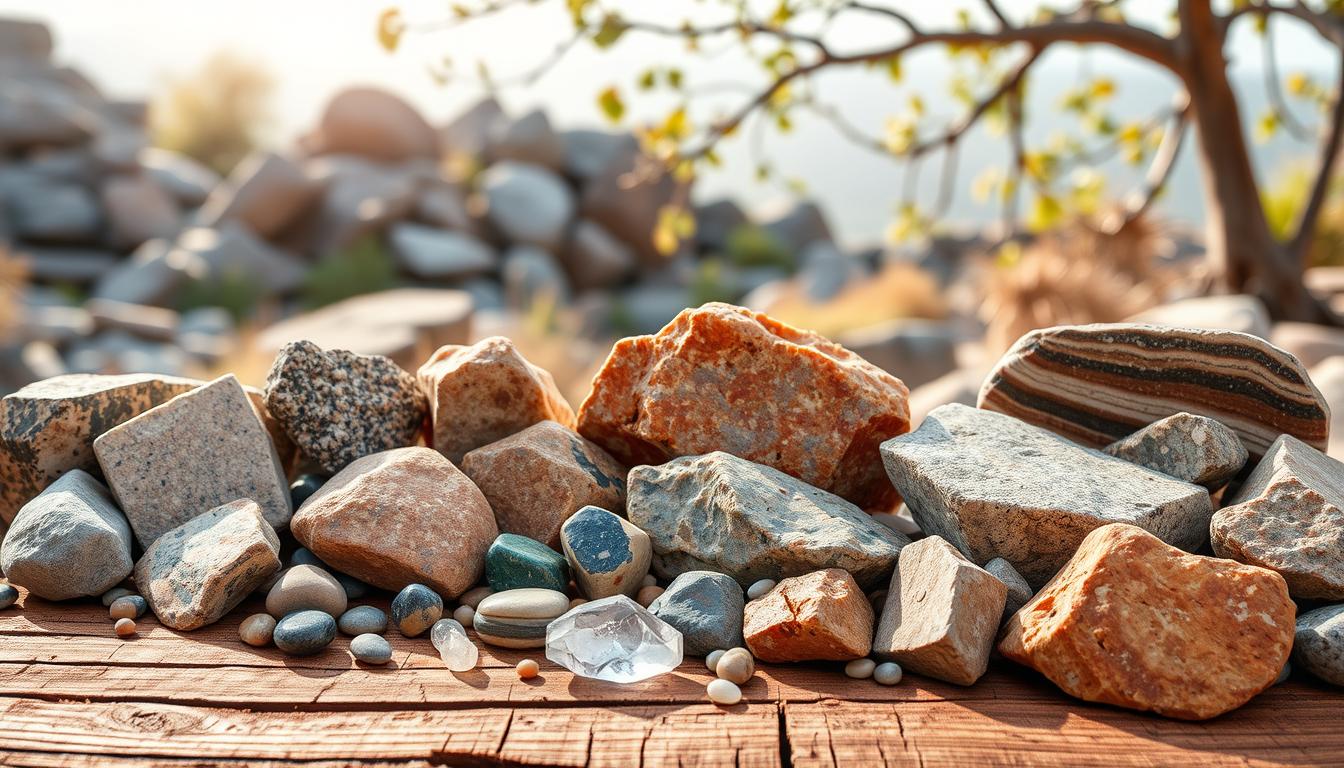
Different rocks show many colors because of their minerals. For example:
- Red or Pink: Shows iron oxide or feldspar minerals.
- Green: Comes from minerals like olivine, pyroxene, or chlorite.
- White or Gray: Means rocks with quartz, calcite, or feldspar.
Color Variations and Weathering Effects
Weathering can change a rock’s color over time. Air, water, and temperature changes can make rocks change color. For example, iron-rich rocks might turn reddish-brown as they rust.
When Color Can Be Misleading
Color is a good starting point, but it can also trick us. Weathering can change a rock’s color. Some minerals can hide the rock’s true color. So, we need to look at other geological characteristics of rocks too, not just color.
Texture and Surface Characteristics
Rock texture and surface features help geologists and rock lovers identify different types. The texture tells us about a rock’s origin, what it’s made of, and its history. It’s a key clue.
Smooth vs. Rough Textures
Rock texture can be smooth or rough. Smooth textures often mean the rock has weathered a lot or cooled from lava or magma. Rough textures suggest rocks with big minerals or tectonic forces that caused cracks.
Crystalline Structures
Rocks with crystalline structures form when magma cools and solidifies. The size and arrangement of crystals tell us about the rock’s cooling and what it’s made of. For example, granite’s big crystals show it cooled slowly deep in the Earth.
Foliated vs. Non-foliated Textures
Foliated and non-foliated textures are also important. Foliated textures have layers or bands from mineral alignment under pressure. This is seen in metamorphic rocks like gneiss and schist. Non-foliated textures don’t have layers and are found in rocks without much metamorphic pressure, like marble. For more on igneous rock textures, check this resource.
Looking at rock texture and surface features helps us understand their geological history and type. This is important for both geologists and rock fans.
Visual Clues That Help Identify Rocks Quickly
To identify rocks fast, knowing what to look for is key. Many features can help figure out a rock’s type. This makes rock identification easier.
Distinctive Patterns and Markings
Rocks often have unique patterns and markings. These are important for telling them apart. Look for banding patterns, foliation, and other special features.
Layering and Banding
Layering and banding are big clues. Layering shows a rock might be sedimentary. Banding hints at metamorphism or igneous processes. These signs help guess the rock’s type.

Inclusions and Visible Minerals
Inclusions and minerals in a rock tell a lot about it. Mineral inclusions show the rock’s past, like how it formed.
By noticing these clues—patterns, layering, and inclusions—you can quickly and accurately identify rocks.
Luster and Reflectivity
Understanding how rocks interact with light is key to recognizing their mineral composition. Luster, which refers to the way light is reflected from the surface of a rock, can be a significant identifier. It is categorized mainly into metallic and non-metallic luster.
Metallic vs. Non-metallic Luster
Metallic luster gives a rock a shiny, reflective appearance similar to metal, often indicating the presence of metallic minerals. Non-metallic luster, on the other hand, can appear glassy (vitreous), pearly, or resinous, and is associated with a wide range of minerals.
Vitreous, Pearly, and Resinous Appearances
Rocks with a vitreous luster appear glassy, while those with a pearly luster have a smooth, iridescent sheen. Resinous luster is characterized by a rich, resin-like appearance. These variations can provide clues about the rock’s mineral composition.
| Luster Type | Description | Associated Minerals |
|---|---|---|
| Metallic | Shiny, reflective | Metallic minerals like pyrite |
| Vitreous | Glassy appearance | Quartz, feldspar |
| Pearly | Smooth, iridescent sheen | Talc, gypsum |
| Resinous | Rich, resin-like | Some varieties of sphalerite |
The interaction between light and a rock’s surface can reveal its mineralogical characteristics. By observing how light reflects off a rock, one can infer the presence of certain minerals or mineral groups. For more detailed information on optical mineralogy, visit optical mineralogy resources.
In conclusion, luster and reflectivity are vital characteristics for identifying rocks. By understanding and observing these properties, one can gain insights into a rock’s composition and potentially identify its mineral constituents.
Identifying Igneous Rocks by Sight
Geologists use what they see to tell igneous rocks apart. These rocks form when magma or lava cools and solidifies. They can be either coarse-grained or fine-grained.
Coarse-grained vs. Fine-grained Igneous Rocks
The texture of an igneous rock is very important. Coarse-grained rocks have big crystals, showing they cooled slowly deep in the Earth. Fine-grained rocks have small crystals, meaning they cooled fast on the surface.
Common Igneous Rock Visual Identifiers
Many types of igneous rocks can be identified by how they look. These include granite, basalt, obsidian, and pumice.
Granite
Granite is a coarse-grained rock with a speckled look. It’s made of quartz, feldspar, and mica minerals.
Basalt
Basalt is a fine-grained rock that’s usually dark. It forms when lava cools down.
Obsidian and Pumice
Obsidian is a shiny, volcanic glass that forms fast. Pumice is a light, porous rock that also forms quickly with lots of gas bubbles.
| Rock Type | Texture | Common Colors |
|---|---|---|
| Granite | Coarse-grained | Varied, often speckled |
| Basalt | Fine-grained | Dark gray to black |
| Obsidian | Glassy | Black, dark brown |
| Pumice | Porous, vesicular | Light gray to white |

Knowing these visual clues helps geologists quickly spot igneous rocks. This makes rock classification easier and helps us learn more about the Earth’s geology.
Recognizing Sedimentary Rocks Visually
Sedimentary rocks form from sediments like erosion, organic decay, and chemical reactions. Knowing how to spot them visually means understanding their unique traits. These traits change based on the rock type.
Clastic Sedimentary Rock Features
Clastic rocks come from sand, silt, and clay. They can be fine-grained or coarse. For example, conglomerate has big gravel pieces. Shale has tiny clay particles.
Chemical and Organic Sedimentary Rock Characteristics
Chemical rocks form from chemical reactions, like limestone from calcium carbonate. Organic rocks come from plant and animal parts. They show features like fossils.
Limestone and Chalk
Limestone is mostly calcium carbonate. It fizzes with acid. Chalk is soft, white, and full of tiny marine plankton skeletons.
Sandstone and Conglomerate
Sandstone has grains like sand. It can be fine or coarse. Conglomerate has big gravel and pebbles.
Shale and Siltstone
Shale is made of clay and looks smooth. Siltstone is coarser than shale but finer than sandstone.
Learning about sedimentary rocks helps us identify them. This knowledge tells us about their makeup and where they come from.
[link-whisper-related-posts]Conclusion: Building Your Rock Identification Skills
Learning to identify rocks takes time and practice. By noticing Visual Clues That Help Identify Rocks Quickly, like color and texture, you get better. This helps you tell different rocks apart.
To get better at identifying rocks, keep practicing and looking at many rock samples. Use the rock identification tips from this article. This will help you understand geology rock identification clues better. You’ll feel more sure about identifying rocks.
Being good at identifying rocks means practicing a lot and wanting to learn. Mix learning with doing to improve your skills. Soon, you’ll be able to spot rocks easily and learn about the earth’s secrets.
FAQ
What are the main categories of rocks and how can they be identified?
Rocks are divided into three main types: igneous, sedimentary, and metamorphic. You can tell them apart by looking at their texture, what they’re made of, and their color and patterns.
How does color help in identifying rocks?
Color is a big clue for identifying rocks. Different minerals and rocks have their own colors. But, remember, color can change due to weathering or minerals.
What is the significance of texture in rock identification?
Texture is key in identifying rocks. It tells you about the rock’s type and history. For example, smooth or rough textures can help you figure out what kind of rock it is.
How do luster and reflectivity aid in rock identification?
Luster and reflectivity are important clues. They show what minerals are in the rock. For instance, a shiny luster might mean it’s metallic.
What are some common visual identifiers for igneous rocks?
Igneous rocks have distinct textures and compositions. Look for minerals like quartz or feldspar. Also, check for textures like porphyritic or glassy.
How can sedimentary rocks be recognized visually?
Sedimentary rocks have unique features. Look for layering, bedding planes, and fossils. These clues help identify different types of sedimentary rocks.
What are some key features to look for when identifying rocks in the field?
When identifying rocks outdoors, look at color, texture, and patterns. Also, check for layering and inclusions. Basic tools like a hand lens or rock hammer can help too.
Can rock identification be done without specialized equipment?
Yes, you can identify rocks without special tools. Just use your eyes and basic tools like a hand lens or rock hammer. This way, you can identify rocks in the field.

Subscribe to Our Newsletter