The world of geology and gemology uses magnifying tools a lot. A geologist’s loupe is key for spotting minerals and their makeup. We’ll look at why magnifiers and loupes are vital, their history, and their role in the field.
Knowing about rocks and gemstones is important for many. Magnifying tools help see details that are hard to spot without them.
Key Takeaways
- The significance of loupes in geology and gemology.
- Different types of magnifying tools used for rock identification.
- The history and evolution of geologist loupes.
- How to choose the right loupe for rock examination.
- Tips for using magnifiers effectively in the field.
The Importance of Magnification in Geology
In geology, looking closely at rocks and minerals is key. This helps us learn about their makeup and past. Tools like rock magnifying glasses and geologist loupes are vital for this.
Why Visual Examination Matters for Rock Identification
Looking closely at rocks is a must for identifying them. Geologists use tools to see details like inclusions, fractures, and cleavage patterns. These details help figure out what mineral it is.
- Observe external features, such as crystal shape and luster
- Examine internal features, such as inclusions and fractures
- Analyze the mineral’s optical properties, such as birefringence and pleochroism
How Magnification Reveals Critical Mineral Details
Magnification shows important details about minerals. It helps geologists understand their makeup, structure, and how they act. For example, it helps spot mineral identification tools that are key to knowing a mineral’s identity.
Using magnification in geology is more than just looking. It’s a complex skill that needs knowledge, skill, and the right tools. With mineral identification tools and magnification, geologists can uncover the secrets of minerals. This helps us learn more about our planet.
Types of Magnifiers and Loupes for Rock Identification
Identifying rocks and minerals needs the right tool. A good magnifier or loupe is key. It helps reveal details that show what rock you have. We’ll look at hand-held magnifiers, folding pocket loupes, and digital microscopes for this.
Hand-Held Magnifiers
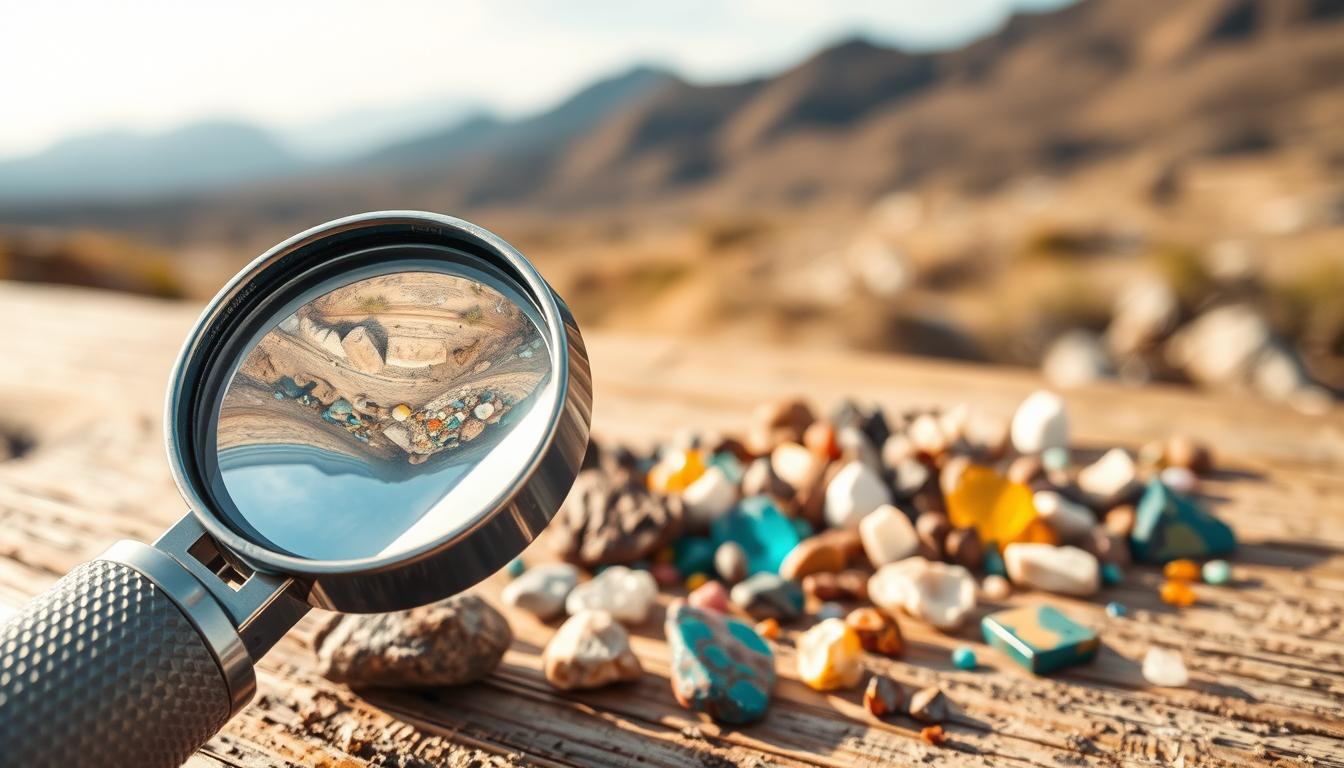
Hand-held magnifiers are loved by rock fans. They’re easy to carry and use. You can find them in powers from 2x to 10x, great for first looks.
Key Features: Portable, easy to use, various magnification powers
Folding Pocket Loupes
Folding pocket loupes are handy for rock ID. They’re small and fold up, easy to stash in a pocket. They have different lenses for more zoom.
Key Features: Compact, foldable, multiple lenses
Triplet vs. Doublet Loupes
Choosing a loupe means picking lens type. Triplet loupes have three lenses for better images. Doublet loupes have two lenses and cost less. Both can help with rock ID, but triplets are better.
| Loupe Type | Image Quality | Price |
|---|---|---|
| Triplet Loupe | Superior | Higher |
| Doublet Loupe | Good | Lower |
Digital Microscopes for Advanced Analysis
Digital microscopes are great for detailed study. They use a camera to show your samples on a screen. You can zoom in and adjust light, perfect for rock and mineral study.
Key Features: Adjustable magnification, digital imaging, lighting options
Key Features to Consider When Choosing a Geological Loupe
Choosing the right geological loupe is key. It must have features that make it useful and easy to use. When picking a loupe for studying rocks, think about what makes it work well.

Magnification Power: Finding the Right Balance
The magnification of a loupe is very important. A handheld magnifying lens with 10x to 20x is usually enough. But, higher magnification might make things smaller and harder to see.
Lens Quality and Coatings
The quality of the lens matters a lot. Look for loupes with clear, distortion-free glass lenses. Anti-reflective coatings help by cutting down on glare. For more tips on picking a good hand lens, check out The NHBS Guide to Hand Lenses.
Durability and Field-Readiness
A geological loupe needs to be tough for outdoor use. Look for ones that are rugged, come with a protective case, and can handle water. It should also be easy to hold and use for a long time.
Lighting Options: LED and Natural Light
Lighting is very important for studying rocks. Some loupes have built-in LED lights for dark places. But, they should also work well in natural light. A good loupe should show clear images in different light conditions.
| Feature | Importance | Options |
|---|---|---|
| Magnification Power | High | 10x to 20x |
| Lens Quality | High | High-quality glass, anti-reflective coatings |
| Durability | High | Rugged design, protective case, water resistance |
| Lighting Options | Medium | Built-in LED, natural light performance |
Recommended Magnifiers and Loupes for Rock Identification
Choosing the right magnifier or loupe is key for rock identification. Whether you’re new or experienced, many options fit your needs and budget. We’ll look at top magnifiers and loupes for rock identification, from affordable to professional-grade.
Budget-Friendly Options for Beginners
Beginners can find many affordable magnifiers and loupes. A good start is a hand-held magnifier with 10x to 15x magnification. These are cheap and introduce you to rock identification. The 10x Magnifier Pocket Loupe is a great, portable choice.
Mid-Range Tools for Serious Hobbyists
For serious hobbyists, mid-range magnifiers and loupes are better. They have higher magnification, better lenses, and last longer. A triplet loupe gives clear images with little distortion. Eschenbach and OptiVisor make quality mid-range options.
Professional-Grade Loupes for Geologists
Geologists need top-quality tools for precision. Professional loupes offer high magnification, clear images, and are built to last. They’re used with other tools for detailed fieldwork. Zeiss and Leica are known for their high-quality optical tools.
Maintenance and Care for Your Optical Tools
Keep your magnifier or loupe in good shape with proper care. Store them in a case when not using and clean lenses with a soft cloth. Don’t expose them to extreme temperatures or harsh chemicals.

By picking the right magnifier or loupe and caring for it, you’ll improve your rock identification skills. This makes your hobby or profession more rewarding.
[link-whisper-related-posts]Conclusion: Enhancing Your Rock Collecting Experience with Quality Optics
Getting good magnifiers and loupes is key for finding out what rocks are. It makes collecting rocks better. Knowing how to pick the right tools helps you spot minerals and rocks correctly.
The right magnifying glass shows details you can’t see with your eyes. It’s a must-have for serious rock hunters. Whether you’re new or experienced, the right tools make your studies and finds better.
Choosing top-notch optics means a more fun and precise rock collecting journey. With the right gear, you’ll see and love the special traits of your rocks more. This makes your geology studies even more rewarding.
FAQ
What is the importance of magnification in geology?
Magnification is key in geology. It lets us see details in rocks and minerals that we can’t see with our eyes.
What type of loupe is best for rock identification?
The best loupe for rock identification depends on what you need. But, triplet loupes are often better because they have clear images and little distortion.
How do I choose the right magnification power for my loupe?
Choosing the right magnification power is about what you need to see. Higher powers are good for small details.
What are the benefits of using a digital microscope for rock identification?
Digital microscopes are great for rock identification. They let you take high-quality pictures and videos, which is useful for studying rocks.
How do I maintain and care for my optical tools?
To keep your optical tools in good shape, store them safely. Clean the lenses with a soft cloth. Don’t let them get too hot or wet.
What are the advantages of hand-held magnifiers for rock identification?
Hand-held magnifiers are easy to carry and use. They’re perfect for looking at rocks in the field.
Can I use a loupe to examine internal features of gemstones?
Yes, you can use a loupe to look at gemstones’ inside parts. This helps with identifying and checking if they’re real.
What is the difference between a triplet and doublet loupe?
A triplet loupe has three lenses for better clarity and less distortion. A doublet loupe has two lenses and might not be as clear.
Are there any budget-friendly options for rock identification loupes?
Yes, there are affordable rock identification loupes. They’re great for beginners or those just starting out.
How does lens quality affect the performance of a loupe?
Lens quality is very important for a loupe’s performance. Good lenses give clear, distortion-free images. This is key for accurate rock identification.

Subscribe to Our Newsletter