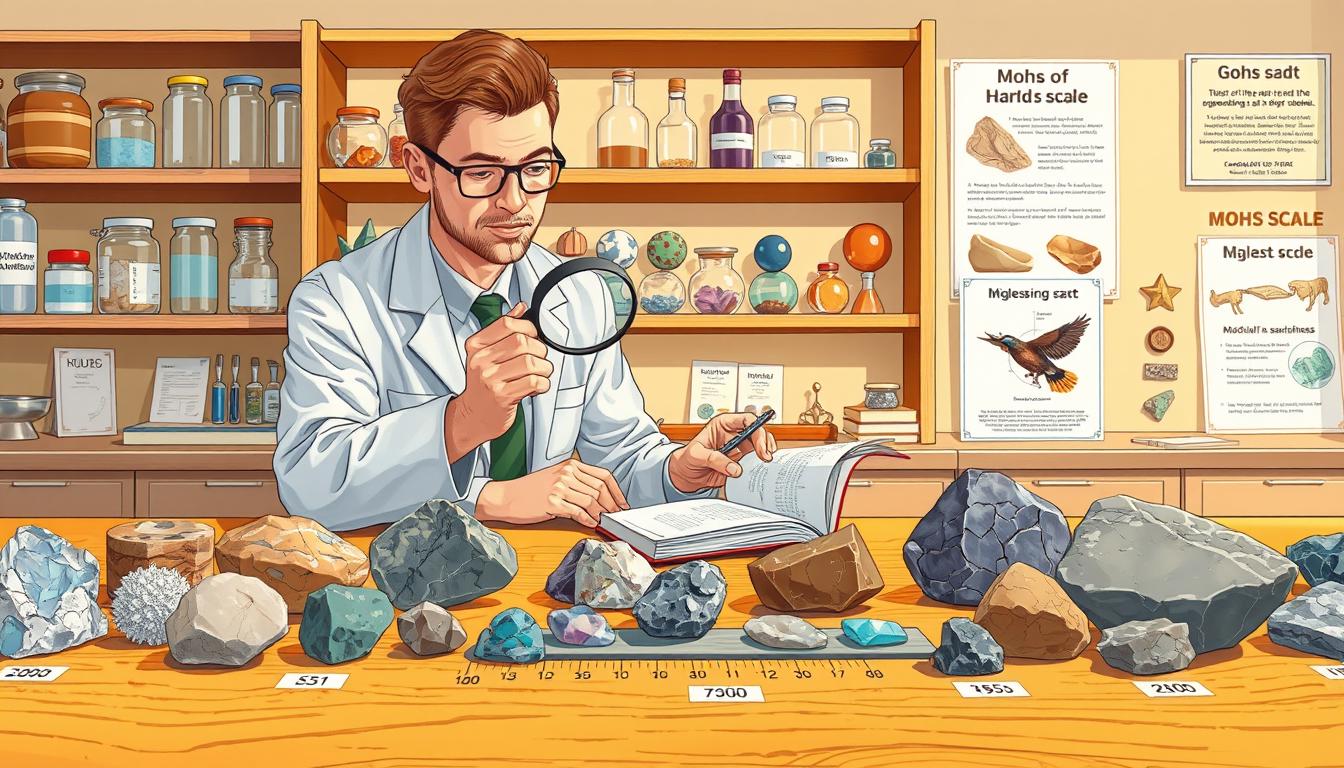
Finding out the hardness of an unknown rock or mineral is key to knowing what it is. The hardness shows how well a mineral can resist scratches. It’s usually checked using the Mohs hardness scale. This scale lists minerals from softest to hardest.
The Mohs scale was made by Frederick Mohs. It has 10 minerals, from talc (1) to diamond (10). A simple scratch test can tell you a mineral’s hardness. This helps narrow down what it might be.
Key Takeaways
- Hardness is a key property in identifying rocks and minerals.
- The Mohs hardness scale is a widely used standard for measuring mineral hardness.
- A scratch test can be used to determine the relative hardness of an unknown mineral.
- Common objects, such as a fingernail or a steel knife blade, can be used to estimate a mineral’s hardness.
- Combining hardness with other mineral properties can aid in identification.
Understanding Rock Hardness and Its Importance
Rock hardness is key in geology for identifying minerals and rocks. It shows how well a mineral can resist scratching and abrasion. Knowing rock hardness helps geologists classify and identify minerals correctly.
What Is Rock Hardness?
Rock hardness is about how well a mineral can stand up to scratching and abrasion. It’s measured on the Mohs hardness scale, from 1 (softest) to 10 (hardest). Friedrich Mohs created this scale in 1812, and it’s used a lot today.
Why Hardness Testing Matters in Geology
Hardness testing is very important in geology. It helps figure out what minerals and rocks are. By knowing a mineral’s hardness, geologists can guess its identity. This is key to understanding what rocks and minerals are made of.
The Science Behind Mineral Resistance
How well a mineral resists scratching and abrasion depends on its crystal structure and chemical makeup. Minerals with strong crystal structures and tightly bound atoms are harder and more resistant. Knowing this science helps geologists understand hardness testing results.
The Mohs Hardness Scale Explained
The Mohs scale was made by Friedrich Mohs. It’s a simple way to figure out how hard minerals are. It’s key in geology for classifying rocks by hardness.
The 10-Point Hardness Scale
The Mohs scale has 10 points. It shows how minerals go from softest to hardest. It works by seeing if one mineral can scratch another.
From Talc to Diamond
The scale starts with talc, the softest, at 1. It ends with diamond, the hardest, at 10. Each mineral can scratch the ones below it.
Relative vs. Absolute Hardness
The Mohs scale shows relative hardness, not absolute. The difference in hardness between minerals isn’t always the same.
Common Reference Minerals
The Mohs scale uses common minerals as references. For example, quartz, ranked 7, is often used. It’s common and easy to spot.

| Mohs Hardness | Mineral |
|---|---|
| 1 | Talc |
| 2 | Gypsum |
| 3 | Calcite |
| 4 | Fluorite |
| 5 | Apatite |
| 6 | Orthoclase |
| 7 | Quartz |
| 8 | Topaz |
| 9 | Corundum |
| 10 | Diamond |
Modern Adaptations of the Scale
Even though the Mohs scale is old, it’s not outdated. New versions have been made to give more exact hardness measurements.
Essential Tools for Hardness Testing
Identifying rocks often involves assessing their hardness. This is done using various tools. Hardness testing is key in geology to figure out minerals and rocks.
Basic Field Testing Kit
A basic field testing kit is a must for geologists and rock lovers. It has hardness test picks and a reference mineral set.
Hardness Test Picks
Hardness test picks are sharp tools with known hardness levels. They are used to scratch the rock’s surface.
Reference Mineral Set
A reference mineral set has minerals with known hardness. They are used for comparison during testing.
Household Items for Improvised Tests
Without special tools, some household items can help. A copper penny (hardness of about 3) or a steel file (hardness of about 6.5) can be useful.

Professional Equipment Options
For precise measurements, use professional tools like durometers or sclerometers. These give accurate readings and are used in labs.
How to Use Hardness Tests to Identify Rocks
To find out what a rock is, a good way is to do a hardness test. This method works because different minerals are harder or softer. This helps us figure out what they are.
Preparing Your Rock Sample
First, get your rock ready for testing. Pick a clean spot on the rock. Make sure it’s free from dirt and stuff that can mess up the test.
Performing a Scratch Test
A scratch test is simple. Try to scratch the rock with something hard. It’s a basic way to see how hard a mineral is.
Step-by-Step Testing Procedure
- Hold the rock specimen firmly.
- Try to scratch the specimen with something hard.
- See if it gets scratched or not.
- Write down what happens.
Testing Crystals vs. Matrix Material
When testing rocks with crystals, know the difference. Crystals can be much harder than the rock they’re in.
Recording and Interpreting Results
After the test, write down what you find. Compare it to the Mohs Hardness Scale. This will help you figure out what mineral it is.
Common Testing Mistakes to Avoid
Don’t make common mistakes. Avoid dirty or uneven surfaces, too much pressure, and wrong results. These errors can lead to wrong answers.
Common Rocks and Their Hardness Values
Knowing the hardness of common rocks is key for geology. Rocks are made of minerals, and their hardness comes from these minerals.
Igneous Rocks
Igneous rocks form from cooled magma or lava. They have different hardness levels.
Granite, Basalt, and Obsidian
Granite is hard, with a Mohs scale value of 6-7. Basalt is a bit softer. Obsidian, a volcanic glass, is as hard as granite.
Sedimentary Rocks
Sedimentary rocks are made from compressed sediments. They also have different hardness levels.
Limestone, Sandstone, and Shale
Limestone and sandstone are about 3-4 on the Mohs scale. Shale is softer.
Metamorphic Rocks
Metamorphic rocks change due to heat and pressure. They can be very hard or soft.
Marble, Quartzite, and Slate
Marble, from limestone, is relatively soft. Quartzite is very hard. Slate, from shale, is dense and hard.
Practical Identification Examples
Using the Mohs hardness scale, you can identify rocks easily. For example, if a rock is scratched by quartz but not by apatite, it’s likely granite or quartzite.
Additional Rock Identification Methods
To accurately identify rocks, geologists often use more than one method. They combine hardness testing with other methods. This way, they get a more precise idea of what the rock is made of.
Combining Hardness with Other Tests
Hardness testing is often paired with other tests. This combination helps geologists understand the rock better. They get a fuller picture of its properties.
Color, Streak, and Luster Tests
Looking at a rock’s color, streak, and luster is very helpful. The color is what we see, the streak is the powder color, and luster is how light bounces off.
| Property | Description |
|---|---|
| Color | Visible hue of the rock |
| Streak | Color of the rock when powdered |
| Luster | How light reflects off the rock’s surface |
Specific Gravity Testing
Specific gravity is the rock’s density compared to water’s. This test helps find minerals in the rock.
When to Use Advanced Testing Methods
When first tests don’t give clear answers, advanced methods are used. These include chemical tests or lab analyses.
Hardness Testing: A Cornerstone of Rock Identification
Knowing the hardness of rocks and minerals is key in geology. The Mohs hardness scale is a basic tool for identifying rocks. It helps geologists guess what a mineral might be by its hardness.
The geology hardness scale is simple but effective. It sorts minerals by how well they resist scratches. Studies, like one on granite minerals available here, show how minerals like quartz and feldspar can be measured. This gives clues about their makeup and structure.
Using hardness tests with other methods helps geologists understand rocks better. Whether you’re a pro or new to rocks and minerals, learning about hardness tests is vital. It makes you better at seeing the geological world.
FAQ
What is the Mohs hardness scale, and how is it used in geology?
The Mohs hardness scale is a 10-point scale. It measures how well minerals resist scratches. Geologists use it to identify minerals and rocks by their hardness.
How do I perform a hardness test on a rock?
First, prepare your rock sample. Then, use a scratch test to find its hardness. You can use a field testing kit or items like a copper penny or steel file.
What are some common reference minerals used on the Mohs hardness scale?
The scale uses 10 common minerals. These range from talc (1) to diamond (10). They help determine the hardness of other minerals and rocks.
Can I use hardness tests alone to identify rocks and minerals?
Hardness tests are useful but not enough. Use them with color, streak, and luster tests, and specific gravity testing. This ensures accurate identification.
What are some common mistakes to avoid when performing hardness tests?
Avoid using the wrong tools and not preparing the rock sample well. Also, don’t misread the results. Remember, hardness testing has limits. Use it with other methods for best results.
How do I determine the hardness of a rock that is too hard to scratch with common objects?
For very hard rocks, use professional tools like a diamond scratch tester. Or, ask a geologist or expert for help.
Can hardness tests be used to identify metamorphic rocks?
Yes, hardness tests can help identify metamorphic rocks. Their hardness varies based on their minerals and history.
How does the hardness of a rock relate to its geological history?
A rock’s hardness can tell us about its past. It shows how it formed and any changes it went through.

Subscribe to Our Newsletter