Knowing the difference between rocks and minerals is key to understanding geology basics. These terms are often mixed up, but they mean different things in the world of geology.
A mineral is a naturally occurring substance without life. It has a specific structure and chemical makeup. A rock, on the other hand, is made of one or more minerals. It can also be a mix of mineral matter without clear parts.
It’s important to know the difference between rocks and minerals. This is true for anyone who loves geology. It doesn’t matter if you’re a student, a collector, or just someone who enjoys nature.
Key Takeaways
- Understanding the definitions of rocks and minerals is essential for geology enthusiasts.
- Minerals have a specific chemical composition and internal structure.
- Rocks are composed of one or more minerals.
- Distinguishing between rocks and minerals is a fundamental skill in geology.
- Geology basics include understanding the characteristics of rocks and minerals.
Understanding the Basics of Rocks and Minerals
It’s key to know the basics of rocks and minerals to identify them right. First, we must understand what makes a mineral and a rock different. These terms are often mixed up, but they mean different things.
Minerals are naturally occurring, inorganic substances with set chemical makeup and structure. For example, quartz has a certain chemical formula (SiO2) and a specific crystal shape.
What Are Minerals?
Minerals form through geological processes and have unique physical traits. The USGS says a mineral is defined by its chemical makeup and crystal structure. Common minerals include quartz, feldspar, and mica.
Key characteristics of minerals include:
- Specific chemical composition
- Crystalline structure
- Unique physical properties
| Mineral | Chemical Composition | Crystal Structure |
|---|---|---|
| Quartz | SiO2 | Hexagonal |
| Feldspar | KAlSi3O8 – NaAlSi3O8 – CaAlSi3O8 | Triclinic or Monoclinic |
What Are Rocks?
Rocks are made of one or more minerals and are divided into three main types: igneous, sedimentary, and metamorphic. These types are based on how they form.
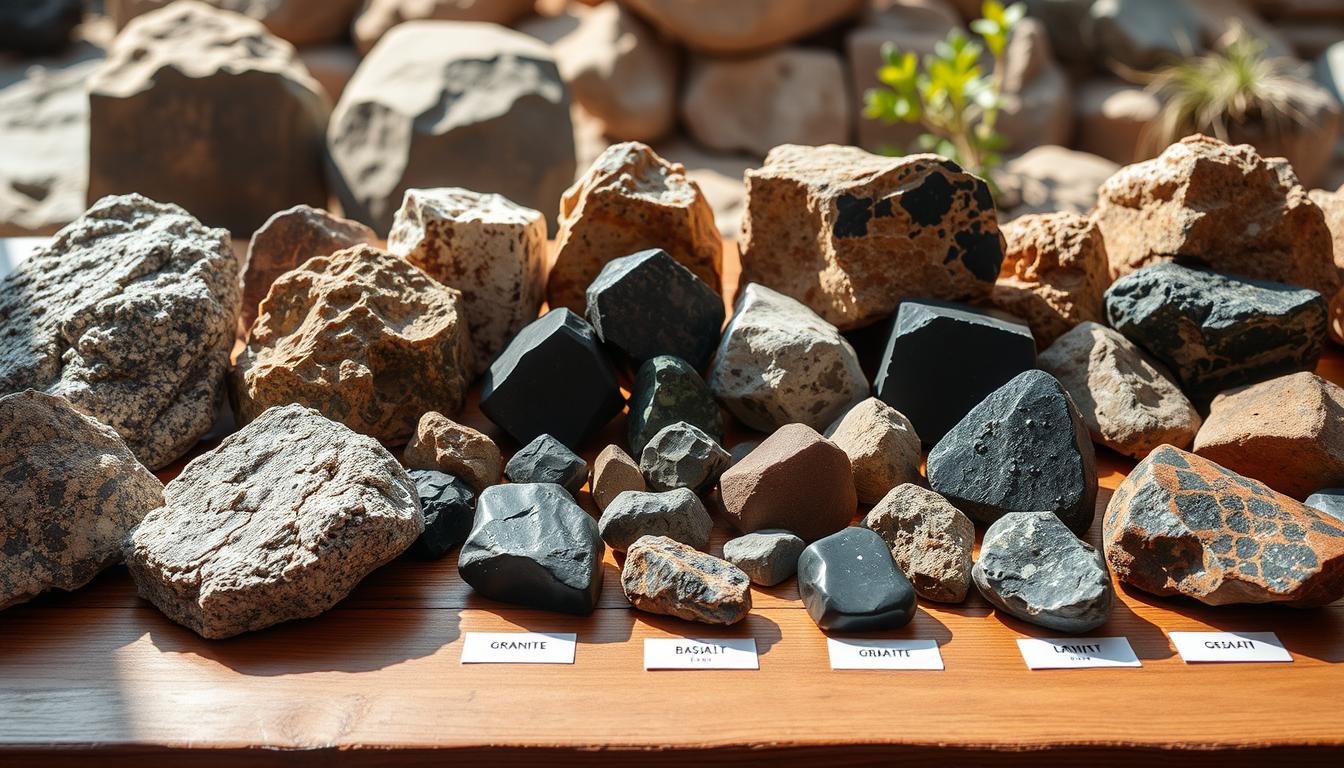
Rocks can look and be made of different things. For example, granite is an igneous rock with minerals like quartz and feldspar. Limestone, on the other hand, is a sedimentary rock mostly made of calcium carbonate.
The main types of rocks are:
- Igneous
- Sedimentary
- Metamorphic
Key Characteristics of Minerals
Minerals are identified by their unique properties. We look at their chemical makeup, crystal structure, and physical traits.
Chemical Composition
Minerals have special chemical makeup. For example, quartz is made of silicon and oxygen atoms. Its chemical formula, SiO2, shows one silicon atom with two oxygen atoms.
This unique mix is what makes quartz different from other minerals.
Crystal Structure
The way atoms are arranged in a mineral is key. This structure affects many of its physical traits. For instance, quartz’s structure makes it hard and resistant to weathering.

Physical Properties
Physical traits are important for identifying minerals. These include hardness, luster, color, streak, cleavage, and fracture.
Hardness and the Mohs Scale
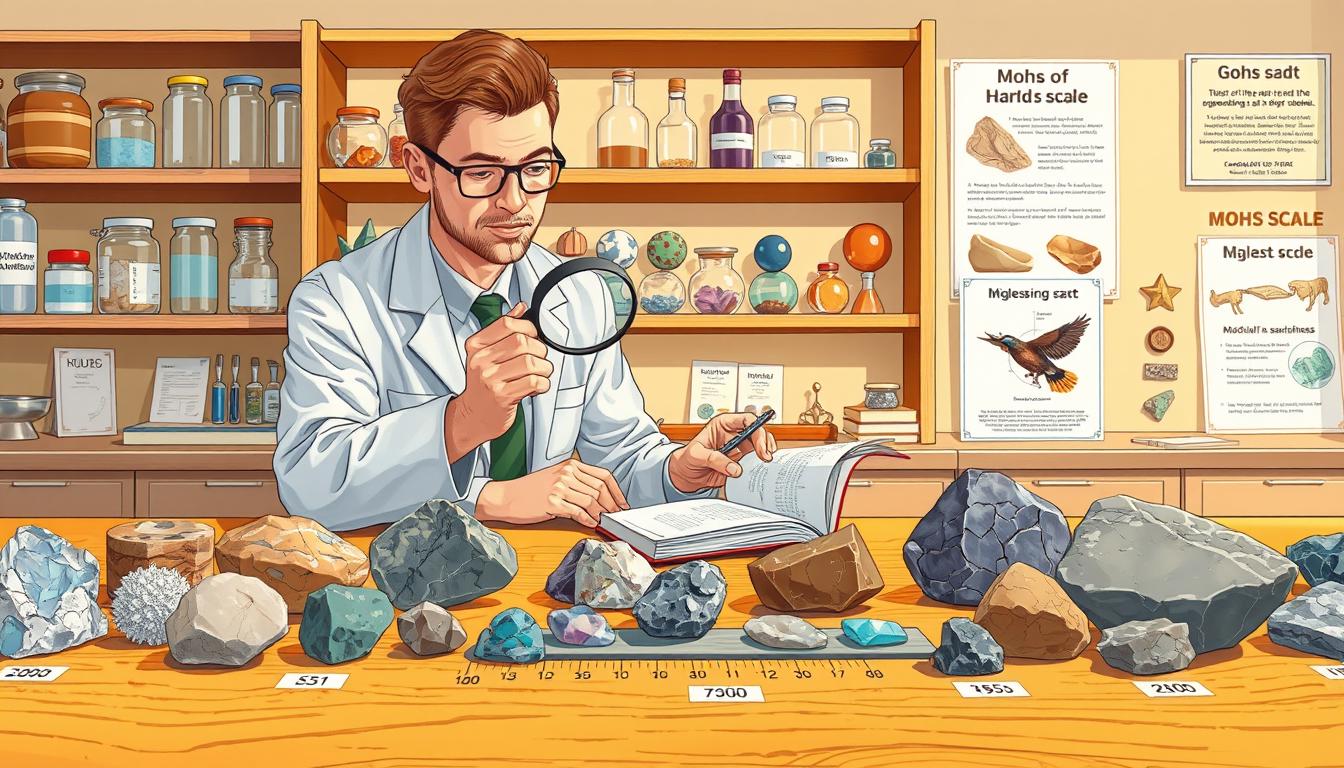
Hardness shows how well a mineral resists scratching. The Mohs scale ranks minerals from 1 (softest) to 10 (hardest). Talc is a 1, while diamond is a 10.
Luster and Transparency
Luster is how light reflects off a mineral’s surface. It can be metallic or non-metallic. Transparency shows if light can pass through the mineral. Some are transparent, others are not.
Color and Streak
Color can help identify a mineral, but it’s not always reliable. The streak, or the color of its powder, is more consistent and useful.
Cleavage and Fracture
Cleavage is how a mineral breaks along flat surfaces. Fracture is how it breaks if it doesn’t follow cleavage. For example, mica breaks into thin sheets because of its perfect cleavage.
| Property | Description | Example |
|---|---|---|
| Hardness | Resistance to scratching | Diamond (Hardness: 10) |
| Luster | How light reflects off the surface | Pyrite (Metallic luster) |
| Color | Visible color of the mineral | Emerald (Green) |
| Streak | Color of the mineral’s powder | Magnetite (Black streak) |
| Cleavage | How a mineral breaks along flat surfaces | Mica (Perfect cleavage) |
Key Characteristics of Rocks
It’s important to know the key traits of rocks to tell them apart from minerals. Rocks are solid masses made of minerals. They come in many different kinds.
Formation Processes
Rocks are divided into three main types based on how they form. These are igneous, sedimentary, and metamorphic. Each type has its own special features.
Igneous Rocks
Igneous rocks form when magma or lava cools and solidifies. They can look glassy or have crystals.
Sedimentary Rocks
Sedimentary rocks are made from sediments that pile up and stick together. They often have fossils in them.
Metamorphic Rocks
Metamorphic rocks change when existing rocks are altered by heat and pressure. This changes their minerals and structure.
| Rock Type | Formation Process | Characteristics |
|---|---|---|
| Igneous | Cooling and solidification of magma or lava | Glassy or crystalline texture |
| Sedimentary | Accumulation and consolidation of sediments | Often contains fossils |
| Metamorphic | Transformation by heat and pressure | Changed mineral compositions and structures |
Texture and Mineral Composition
The texture and minerals in rocks change a lot. For example, igneous rocks can be coarse-grained if they cool slowly. Sedimentary rocks might look layered because of how sediments pile up.
Color and Appearance Variations
Rocks can look very different because of their minerals and texture. Rocks with lots of iron might look reddish. Those with a lot of quartz might look light.
Key characteristics like how they form, their texture, minerals, and color help us tell rocks from minerals.
How to Tell the Difference Between Rocks and Minerals
To figure out if you have a rock or a mineral, you can use several methods. This guide will help you tell them apart.
Visual Identification Techniques
Looking closely at the specimen is the first step. It helps you see if it’s a rock or a mineral.
Using a Hand Lens or Microscope
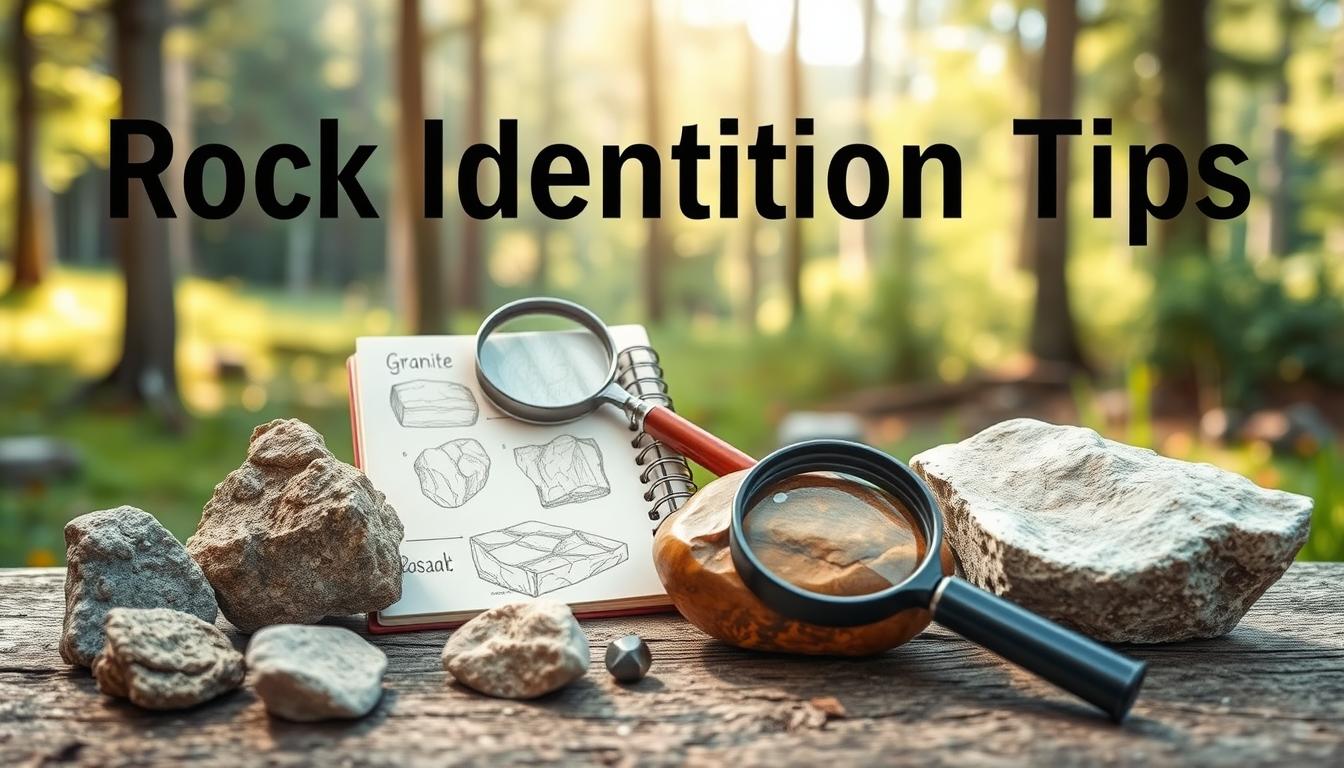
A hand lens or microscope shows details you can’t see with your eyes. This helps in figuring out what it is.
Examining Structure and Patterns
Looking at the structure and patterns can tell you a lot. Minerals often have a special crystalline structure.
Identifying Mineral Components
If it’s a rock, finding out what minerals it has is key. This helps you understand what it’s made of.

Simple Tests for Home Identification
There are simple tests you can do at home to identify rocks and minerals.
Streak Test
The streak test scratches the specimen on a porcelain plate. It shows the color of the powder made.
Hardness Test
The hardness test checks how well the specimen resists scratching. It uses the Mohs hardness scale.
Acid Test
The acid test adds a drop of acid to the specimen. It shows how it reacts, which can tell you about certain minerals.
Tools and Resources for Identification
Having the right tools and resources helps make identification more accurate. You’ll need hand lenses, microscopes, and chemical testing kits.
Common Examples for Practical Identification
Identifying rocks and minerals can be tough, but it gets easier with practice. Knowing common specimens helps you tell different rocks and minerals apart.
Frequently Misidentified Specimens
Quartz, pyrite, and granite are often mixed up. They look similar, making them hard to tell apart.
Quartz vs. Quartzite
Quartz and quartzite are not the same. Quartz is a mineral made of silicon and oxygen. Quartzite is a rock mostly made of quartz. They differ in what they are made of and how they form.
Pyrite vs. Gold
Pyrite, or fool’s gold, looks like gold but isn’t. It’s an iron sulfide mineral. Knowing the difference is key to correct identification.
Granite vs. Its Mineral Components
Granite is a rock with minerals like quartz, feldspar, and mica. These minerals can also be found alone. Knowing what makes up granite helps identify it.
Clear Examples of Minerals in Their Natural State
Minerals like quartz and amethyst can be found naturally. They have unique features that help identify them.
Distinctive Rock Specimens for Study
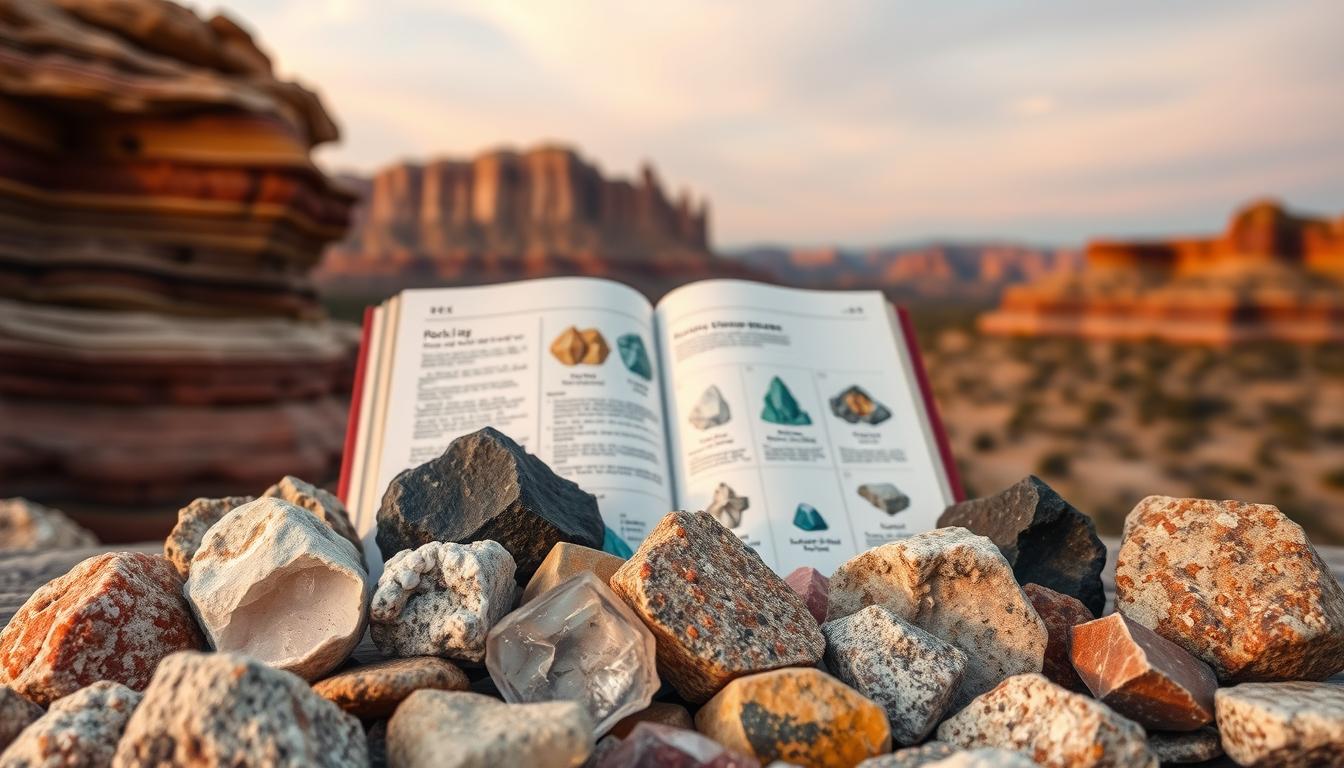
Studying unique rocks like conglomerate and obsidian is helpful. They show how the Earth changes. Their special features help us understand Earth’s history.
For more on rock classification, check out Rock Classification Tables.
[link-whisper-related-posts]Conclusion
Knowing the difference between rocks and minerals is key to understanding geology basics. We’ve looked at what makes rocks and minerals unique. This includes their makeup, structure, and how to tell them apart.
Learning about these topics helps us appreciate the world around us. It also makes us better at spotting rocks and minerals. Knowing the difference is important for many areas, like mining and building.
In short, learning about rocks and minerals helps us understand the Earth better. It connects us to nature and guides how we interact with it.
FAQ
What is the main difference between rocks and minerals?
Rocks are solid masses found in nature. Minerals are inorganic substances with a certain chemical makeup and crystal structure.
How can I identify a mineral?
Look at its physical traits like hardness, luster, and color. Compare these to known mineral features.
What are the three main types of rocks?
There are three main types: igneous, sedimentary, and metamorphic. Each forms through different geological processes.
What is the Mohs scale used for?
It measures mineral hardness. It ranks minerals from 1 (softest) to 10 (hardest).
How can I differentiate between quartz and calcite?
Quartz is harder than calcite. Quartz has a smooth fracture, while calcite has a rhombohedral cleavage.
What is the significance of a mineral’s streak?
A mineral’s streak is the powder color when scratched on a porcelain plate. It can differ from its outer color.
Can rocks be composed of multiple minerals?
Yes, rocks can have one or more minerals. The mix and amount of minerals affect the rock’s properties.
How do I identify rocks in the field?
Observe texture, mineral makeup, and other traits. Use tests like the acid test for limestone.
What is the difference between quartz and quartzite?
Quartz is a mineral. Quartzite is a rock mostly made of quartz. It forms from sandstone rich in quartz.
How can I distinguish between pyrite and gold?
Pyrite is harder and more brittle than gold. It’s brassy yellow. Gold is softer and more golden yellow.

Subscribe to Our Newsletter