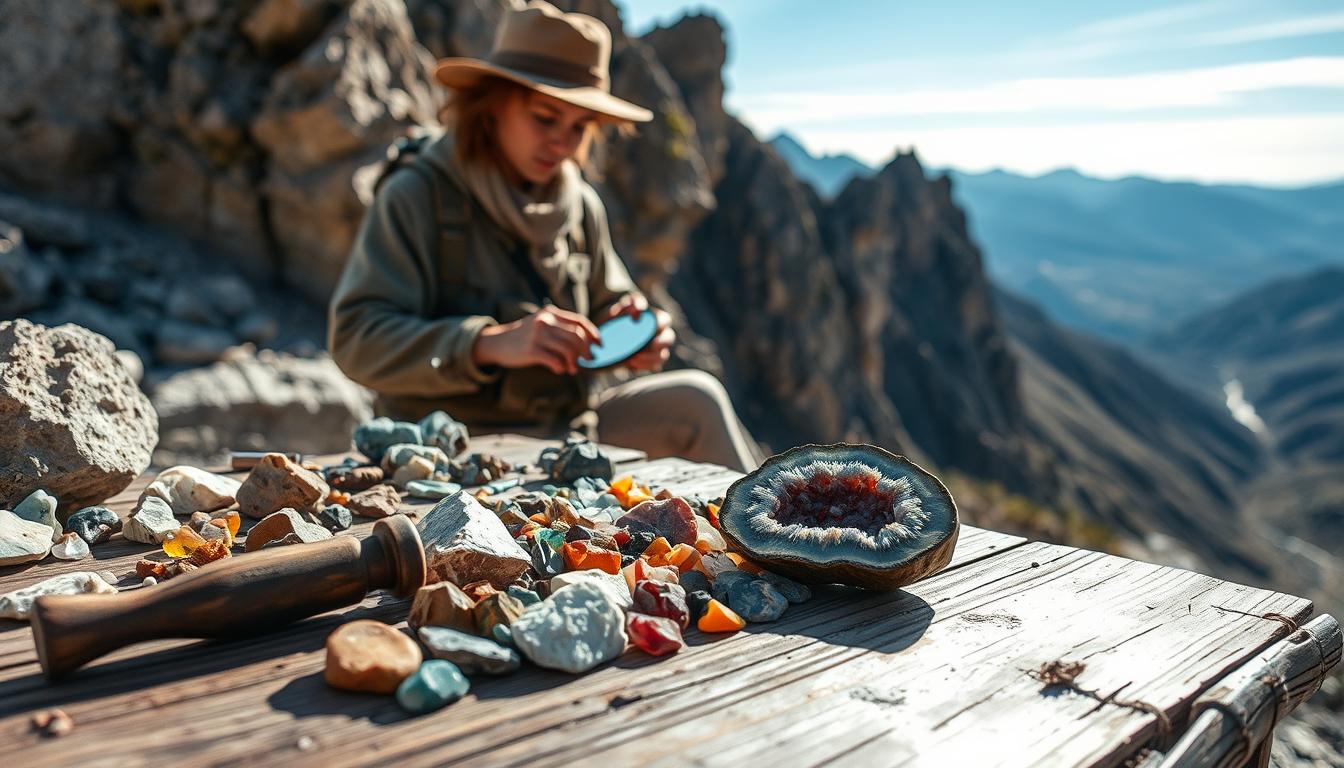
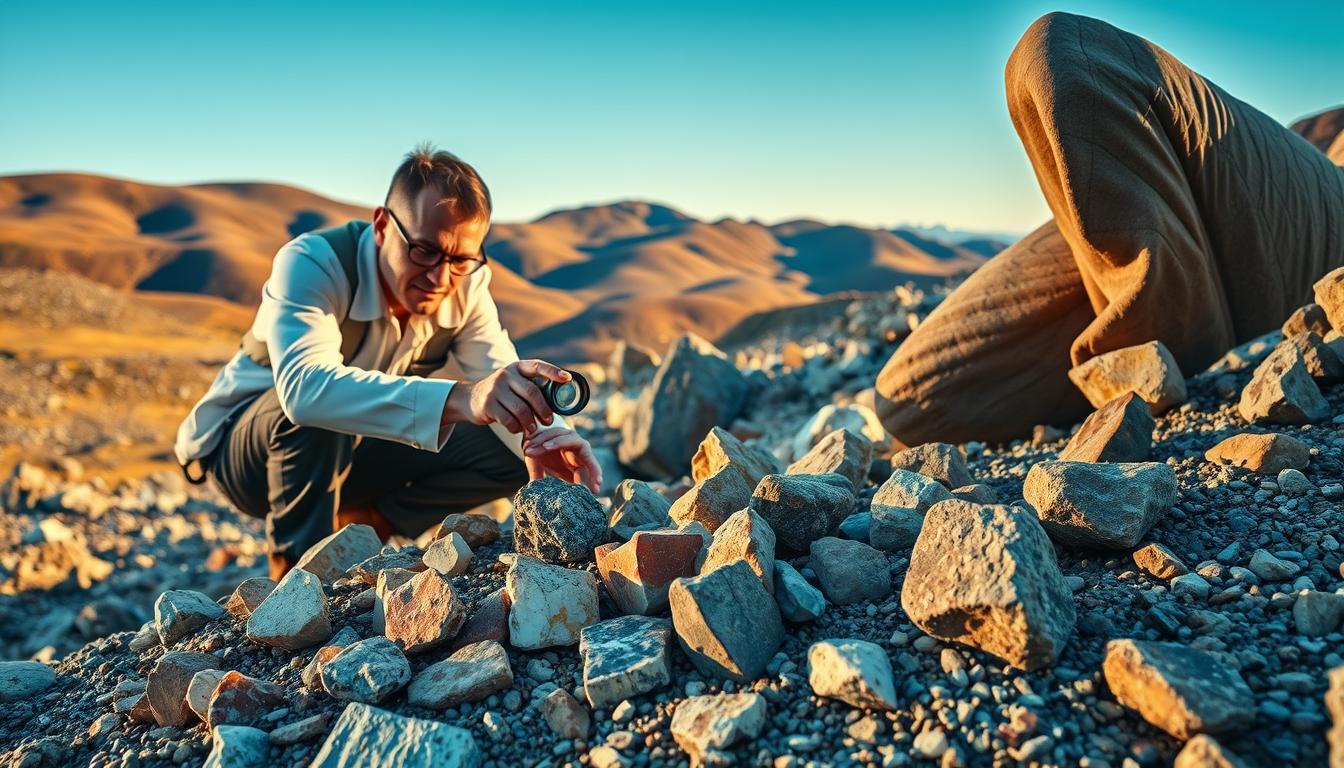
It’s important to know the difference between natural rocks and man-made materials. This is true in fields like geology, archaeology, and construction.
A new way to tell them apart has been found. It uses calcite as a test case. Researchers like Christine Poduska and Stefano Curtarolo say it works by grinding a sample, mixing it, and then checking infrared light absorption.
This shows molecular vibrations, like a fingerprint. For more on this cool method, check out The Naked Scientists.
Key Takeaways
- Differentiating between natural rocks and man-made materials is essential in various fields.
- A new infrared spectroscopy method can be used in the field to distinguish between natural and man-made materials.
- The technique involves measuring absorbed frequencies to reveal molecular vibrations.
- The method has been demonstrated onsite at archaeological sites with a portable instrument.
- The approach is predictive and extensible, allowing for the identification of other materials.
The Basics of Natural Rock Formation
The formation of natural rocks is a fascinating process. It involves igneous, sedimentary, and metamorphic activities. These processes have shaped the Earth’s crust over millions of years. They have created the diverse range of rocks we see today.
Igneous, Sedimentary, and Metamorphic Processes
Natural rocks are formed through three main geological processes. Igneous rocks are made when magma or lava cools and solidifies. Sedimentary rocks are formed by the accumulation and compression of sediments, like sand or mineral particles. Metamorphic rocks are created by transforming existing rocks under high pressure and temperature.
- Igneous rocks can be either intrusive (formed below the Earth’s surface) or extrusive (formed above the Earth’s surface).
- Sedimentary rocks often contain fossils and provide valuable information about the Earth’s history.
- Metamorphic rocks can have unique textures and mineral compositions due to the intense pressure and heat they undergo.
Geological Timeframes and Natural Patterns
The formation of natural rocks takes place over vast geological timeframes. It can take thousands to millions of years. This slow process results in rocks with distinct patterns and characteristics, like banding in metamorphic rocks or layering in sedimentary rocks.
Common Man-Made Materials That Resemble Rocks
Distinguishing between natural rocks and man-made materials is tricky. This is because man-made materials are made to look like natural rocks. This makes it hard to tell them apart.
Concrete and Its Variations
Concrete is often mistaken for natural rocks. It can look different because of its mix. This mix can change its texture and color to look like stone.
Key characteristics:
- Often has a uniform color and texture
- May contain visible aggregate particles
- Can have a rough or smooth finish
Brick, Ceramic, and Glass Products
Bricks, ceramics, and glass can also look like natural rocks. They are used in many ways, like in building and for decoration.
Synthetic Stones and Composites
Synthetic stones and composites are made to look like natural rocks. They are strong and look good, used in landscaping and buildings.
Knowing about these man-made materials is key. It helps us distinguish between natural and man-made materials. By knowing what to look for, we can tell if a rock is real or not.
Visual Identification Techniques
Distinguishing between natural rocks and man-made materials needs a sharp eye. Visual inspection shows big differences in how they look.
Color Patterns and Natural Variations
Natural rocks have unique color patterns and variations hard to fake. These can include detailed veining, banding, or mottling.
Natural rocks show a wide range of colors because of different minerals. Man-made materials usually have the same color all over.
Texture and Surface Characteristics
Natural rocks have rough, uneven surfaces. Man-made materials are smoother and more even.
Weathering Patterns
Natural rocks have weathering patterns like erosion, pitting, or cracking. These come from being outside for a long time.
Manufacturing Marks
Man-made materials have manufacturing marks like mold lines or machining marks. These show they were made in a factory.
Looking closely at these signs helps tell natural rocks from man-made materials.
Physical Testing Methods
Testing rocks is key to knowing if they’re real or made. By using different tests, we can learn about a rock’s makeup and traits.
Hardness Testing Using the Mohs Scale
The Mohs hardness test is easy and works well. It scratches the rock with known materials to find its hardness. For example, if a rock scratches quartz but not feldspar, it’s between 6 and 7 on the Mohs scale.
Density and Weight Comparisons
Density helps tell real rocks from fake ones. Real rocks have unique densities based on their minerals. By weighing and measuring a rock, we can figure out its density and compare it to known values.

Reaction to Heat, Water, and Chemicals
Materials react differently to heat, water, and chemicals. For instance, rocks with carbonates might fizz with acid. Knowing these reactions can tell us about a rock’s makeup.
Acid Tests for Carbonates
The acid test uses hydrochloric acid on the rock. If it has carbonates, it will fizz. This is a quick way to spot rocks like limestone or marble.
Heat Response Differences
Natural rocks and fake ones react differently to heat. Some rocks might crack or change color at high temperatures. Watching these changes can help us know if a rock is real. For more on geology, check out Backyard Geology: A Guide for Homeowners and Families.
How to Tell Natural Rocks From Man-Made Materials
It can be hard to tell if something is a natural rock or made by humans. But, with the right tools and skills, you can learn to spot the differences.
Step-by-Step Examination Process
First, look at the specimen closely. Natural rocks have special patterns and textures that fake ones can’t match. Then, use the Mohs scale to see how hard it is to scratch.
For a deeper look, check the density of the specimen against known rocks. Man-made stuff often has the same density everywhere.
Essential Tools for Amateur Geologists
To do these tests, you’ll need some key tools. These include:
- A magnifying glass to see small details.
- A Mohs hardness scale to check hardness.
- A density kit to compare density with known rocks.
For more tips on polishing stones, check out https://rocktumbler.com/polished-stones/.
Common Natural Rocks and Their Identifying Features
Natural rocks come in many forms. Each has its own special features. Knowing these helps us tell different rocks apart.
Granite, Limestone, and Sandstone
Granite is a coarse-grained rock with visible minerals. It’s hard and durable, making it great for building. Limestone is mostly calcium carbonate, with fossils often seen. Sandstone has grains of sand, showing layers or cross-bedding.

Marble, Slate, and Quartzite
Marble is a metamorphic rock with beautiful veining. It’s often used for sculptures. Slate is fine-grained and splits into thin sheets, perfect for roofs and writing.
Quartzite is mostly quartz, very hard and weather-resistant.
Identifying Gemstones in Their Natural State
Gemstones like diamonds, rubies, and emeralds have unique signs. Looking at their color, clarity, and crystal shape is key. Knowing these helps spot real gemstones from fakes.
Frequently Misidentified Materials
Natural rocks and some made materials look alike. It’s important to know the signs of each to tell them apart.
Slag and Industrial Byproducts
Slag looks like natural rocks but comes from factories. It has a glassy or porous texture and might have metal bits. These signs help spot slag.
Manufactured Stone Veneer
Manufactured stone veneer looks like real stone but isn’t. It’s made from concrete or other materials. Its even texture and color are key signs.
Artificial Landscaping Stones
Artificial stones are used for looks and can be mistaken for real ones. They have smooth, uniform surfaces and lack natural patterns. Knowing these traits helps identify them correctly.
Learning about these materials helps us tell real stones from fake ones.
[link-whisper-related-posts]Conclusion
Knowing the difference between natural rocks and man-made materials is key. It takes observation, testing, and knowledge. By learning about natural rocks, we can better understand and enjoy them.
Techniques like looking closely, testing, and using tools help us tell them apart. This lets amateur geologists make smart choices.
To learn more, check out the Beyond Penguins site. It has lots of info on identifying natural rocks and telling them apart from man-made ones. It helps us see the beauty of geological materials.
By using these methods and learning more, we can get better at spotting natural rocks. This not only deepens our knowledge of Earth’s history. It also makes us appreciate nature more.
FAQ
What are the main differences between natural rocks and man-made materials?
Natural rocks form through geological processes. Man-made materials are made by humans. Natural rocks have unique features like natural variations and weathering patterns.
How can I identify natural rocks using visual inspection?
Look for natural variations and weathering patterns. Natural rocks show a range of colors and textures. Man-made materials look more uniform.
What are some common man-made materials that are often mistaken for natural rocks?
Concrete, brick, and ceramic are often mistaken for natural rocks. They lack natural variations and have manufacturing marks.
How can I use physical testing methods to distinguish between natural rocks and man-made materials?
Use the Mohs scale for hardness testing. Compare density and weight. Test reactions to heat, water, and chemicals.
What are some essential tools for amateur geologists to identify natural rocks?
Amateur geologists need a hand lens, rock hammer, and Mohs hardness scale. A geologist’s pick is also important.
How can I differentiate between granite, limestone, and sandstone?
Granite has a speckled appearance. Limestone has fossils and reacts with acid. Sandstone is made of sand-sized grains.
What are some common gemstones and how can I identify them in their natural state?
Quartz, amethyst, and garnet are common gemstones. Use a hand lens or microscope to see their inclusions and crystal structure.
How can I distinguish between natural rocks and manufactured stone veneer?
Manufactured stone veneer looks like natural stone but lacks natural variations. Natural rocks have unique features like weathering patterns.
What is the importance of distinguishing between natural rocks and man-made materials in geology and archaeology?
Distinguishing between natural rocks and man-made materials is key in geology and archaeology. It affects data interpretation and conclusion accuracy. In geology, it helps identify rock origins. In archaeology, it aids in artifact identification and past culture reconstruction.

Subscribe to Our Newsletter