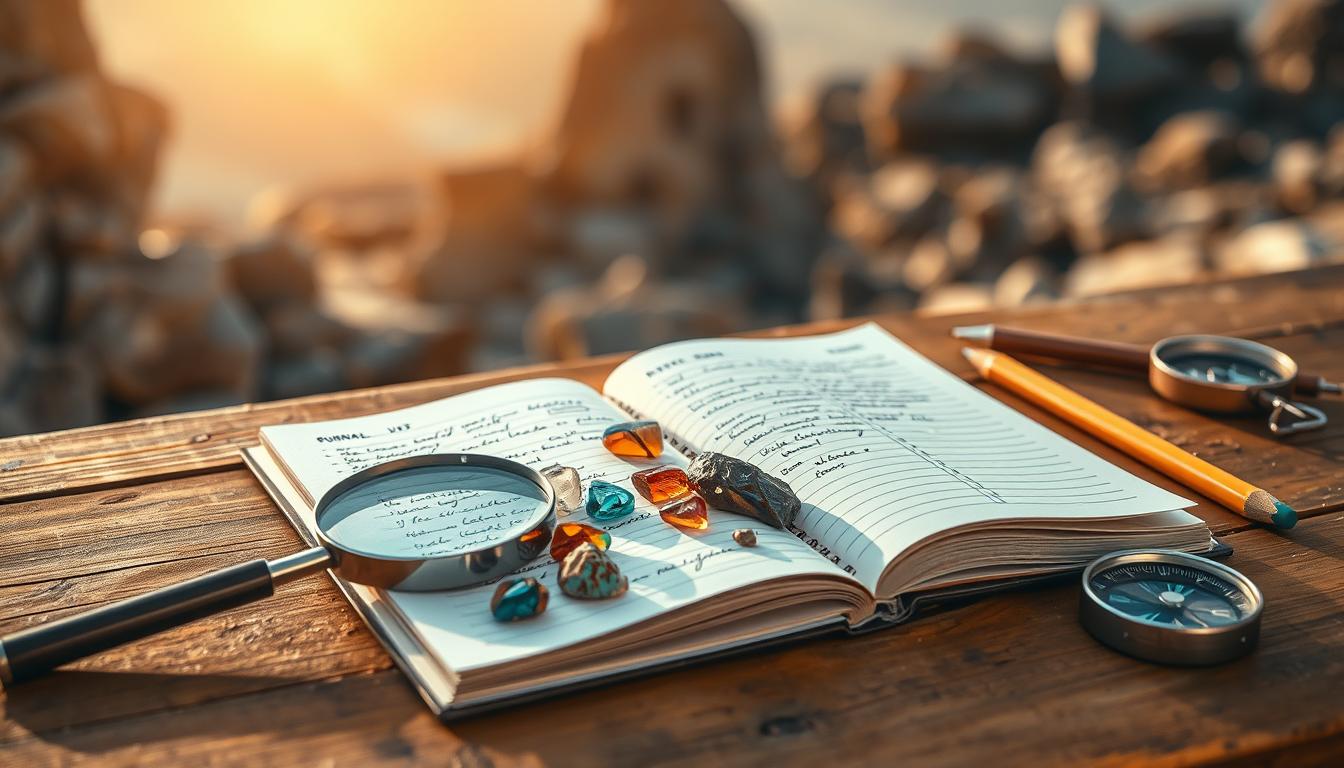
Keeping a rockhounding journal is a great way to save memories and see how you’ve grown. It’s useful for both new and experienced rockhounds.
Writing down each find in your journal is key. You can note where you found it, when, and what the conditions were like. This info is super helpful for looking back and learning more about your finds.
Also, a good journal lets you think about your adventures. You can note what went right and what didn’t. This helps you get better at rockhounding with each trip.
Key Takeaways
- Documenting your rockhounding journey preserves memories and tracks progress.
- A rockhounding logbook is a valuable resource for enthusiasts of all levels.
- Recording specimen details enhances understanding and future reference.
- Reflecting on experiences improves rockhounding skills over time.
- Maintaining a field journal is a simple yet effective practice.
The Value of Documenting Your Rockhounding Adventures
Keeping notes on rockhounding adventures is very important. It helps rockhounds learn more and enjoy their hobby even more. By writing down mineral collecting notes and rock specimen documentation, they can get insights they wouldn’t have found elsewhere.
Scientific Benefits of Detailed Documentation
Writing down what you see is very helpful for science. It lets rockhounds note down things about the earth’s layers and minerals. This info is key for understanding their finds and for future studies.
For example, knowing where and how a rock was found can be very useful. It can help scientists learn more about the earth. You can find more about this at this link.
Personal Growth as a Rockhound Through Journaling
Journaling also helps rockhounds grow personally. It lets them look back on their adventures and see how they’ve improved. This way, they can learn more about geology and minerals.
Building a Knowledge Base for Future Expeditions
Keeping a field journal also prepares you for future trips. By writing about past adventures, rockhounds can plan better. They can find the best places to go and increase their chances of finding cool rocks.
Essential Supplies for Your Rockhounding Field Journal
To make the most of your rockhounding trips, you need the right stuff. A good field journal is key for keeping track of your finds. It makes your adventures even better.
Choosing the Right Journal Type
Choosing the right journal is important. Look for one that’s tough, the right size, and has good paper. A journal that can handle the weather is a must. Look for one with waterproof paper and a strong cover to keep your work safe.
Writing and Drawing Tools
Good tools are needed to write and draw well. Use a pencil and a fine-tip pen for writing. For drawing, colored pencils or markers work best. For more tips, check out this resource.
Measurement and Documentation Equipment
Measuring and documenting accurately is key in rockhounding. Carry a compass, clinometer, and magnifying glass. A camera is also good for taking pictures of your finds.
Field-Friendly Storage Solutions
Keeping your journal safe is important. Use a cover or bag to protect it. Organizing it with tabs or dividers makes it easier to use.
| Supply | Description | Importance |
|---|---|---|
| Durable Journal | Waterproof and sturdy | High |
| Pencils and Pens | Variety of writing tools | High |
| Compass and Clinometer | Measurement tools | Medium |
| Storage Bag | Protective storage | Medium |
Setting Up Your Field Journal Structure
To make your rockhounding field journal useful, setting up a good structure is key. It has several important parts that help you organize your notes.
Creating an Effective Table of Contents
A good table of contents is essential. It lets you find entries, specimens, and notes quickly. Start by setting aside a few pages at the beginning. Update this section with page numbers as you fill your journal.
Numbering Systems for Specimens
Using a numbering system for your specimens is helpful. You can use simple numbers or a more detailed system with date and location. For example, “2023-01-001” could be the first specimen on January 1, 2023.
Reference Pages and Quick Guides
Reference pages and quick guides are very useful. They can include mineral charts, geological time scales, or common rock types. These references help with quick identification and documentation.
Pre-Trip Planning Pages
Pre-trip planning pages are key for getting ready for rockhounding trips. They can have equipment checklists, maps, and notes on sites to visit. Keeping this info in your journal makes sure you’re ready for your adventures.
| Component | Purpose | Benefits |
|---|---|---|
| Table of Contents | Navigation | Quick location of entries |
| Numbering System | Specimen tracking | Organized record-keeping |
| Reference Pages | Quick identification | Aids in documentation |
| Pre-Trip Planning | Expedition preparation | Ensures readiness for adventures |
By adding these elements, your rockhounding field journal will be well-organized. It will help you document your finds and keep a diary.
Recording Location Data Accurately
It’s key to record location data well when rockhounding. This helps rockhounds go back to sites, share with others, and learn more about rocks.
GPS Coordinates and Mapping Techniques
GPS is a must for recording location data. Rockhounds should use GPS devices or apps to get exact coordinates. Mapping techniques like drawing maps or using digital tools also help.
When using GPS, take many readings at different times. This makes your data more accurate. Also, remember to note what GPS device or app you used.
Describing Access Routes and Landmarks
It’s also important to describe how to get there and what landmarks are nearby. This helps others find the site. Include trail names, directions, and unique rock features.
Legal Considerations for Site Documentation
Rockhounds need to know the law when documenting sites. They must understand privacy laws and rules for sensitive areas. It’s important to record details without breaking the law.
Noting Land Ownership and Permissions
It’s vital to document who owns the land and if you got permission. This keeps rockhounding ethical and helps plan future trips. Note if the land is public or private and any permission details.
By following these tips, rockhounds can keep a detailed and accurate logbook. This improves their field journal and helps the community learn more.
How to Keep a Rockhounding Field Journal That Stands the Test of Time
To keep your rockhounding field journal in great shape, use weather-resistant methods and digital backups. A tough journal is key for rockhounds who want to keep their finds safe for years.
Weather-Resistant Documentation Methods
It’s important to use materials that can stand up to the weather. Try waterproof pens, laminated pages, or waterproof paper. These will keep your notes safe from rain and snow.
Digital Backups of Your Field Notes
Make digital copies of your field notes to keep them safe. Scan or take photos of your journal pages and save them online. This way, your notes are safe even if your journal gets damaged.
Archival-Quality Materials and Practices
Choose materials for your journal that last a long time, like acid-free paper and strong binding. These choices help your journal stay in good shape for a long time.
Protecting Your Journal in the Field
When you’re out collecting, keep your journal safe from the weather. Use a cover or store it in a waterproof bag. This keeps it from getting damaged or wet.
| Method | Description | Benefits |
|---|---|---|
| Weather-resistant materials | Using waterproof pens and paper | Protects against water and moisture |
| Digital backups | Scanning or photographing journal pages | Ensures data safety even if physical journal is damaged |
| Archival-quality materials | Using acid-free paper and durable binding | Extends the lifespan of the journal |
By using these tips, your rockhounding field journal will stay useful for many years.
Documenting Geological Context and Formation Types
It’s important to document the geological context and formation types when rockhounding. This helps make your finds more valuable. You need to follow a few steps to understand and record where your specimens were found.
Recording Surrounding Rock Types
When you find something, note the rocks around it. This info helps you learn about the history and formation of your specimens. Here’s how to record the surrounding rock types:
- Note the lithology (rock type) and texture
- Describe the color and any visible mineralization
- Record any notable features, such as fractures or folds
Noting Geological Formations and Structures
Geological formations and structures are key to understanding your specimens. Think about these when noting them:
- Identify the type of formation (e.g., sedimentary, igneous, metamorphic)
- Describe the structure (e.g., bedding planes, faults, folds)
- Record any observations about the orientation or dip of these structures

Sketching Stratigraphic Columns
Sketching stratigraphic columns helps you see and document rock layering. To make a good stratigraphic column:
- Measure and record the thickness of each layer
- Describe the lithology and any notable features of each layer
- Include a scale and orientation indicator
Documenting Evidence of Mineralization
Recording mineralization evidence is important. It shows the economic and geological value of your finds. Here’s what to note:
- The type of minerals present
- The form of mineralization (e.g., disseminated, vein-type)
- Any observations about the mineralization’s relationship to the surrounding rocks
By following these steps, you can make your rockhounding finds more valuable. You’ll also help us understand the geological world better.
Specimen Description Techniques for Accurate Records
Describing specimens well is key for good mineral collecting notes. It’s important for rockhounds to document their finds well.
Physical Characteristics Documentation
When documenting a specimen’s physical traits, focus on several important points. These include:
- Color, Luster, and Transparency: Record the specimen’s color, its shine (metallic or not), and how clear it is.
- Size, Weight, and Shape: Measure its size, weigh it, and describe its shape.
- Crystal Form and Habit: Find out the crystal shape (like cubic) and its overall look.
Color, Luster, and Transparency
These traits help identify a mineral. The color can change with light, so note it under different lights.
Size, Weight, and Shape
Recording size, weight, and shape is key for identification. Use exact measurements for size and weight.
Crystal Form and Habit
Knowing the crystal form and habit helps identify minerals. Check out the British Columbia Geological Survey for more info.
Mineral Identification Notes
Identifying minerals means noting hardness, cleavage, and other key traits. Use field guides or apps for help.
Photography Tips for Specimen Documentation
Photography is key for documenting specimens. Here are some tips:
- Use natural light for best photos.
- Include a scale or object in the photo.
- Take photos from different angles.
By using these techniques, rockhounds can keep a detailed field journal. This makes their mineral collecting better.
Digital Tools and Apps to Complement Your Field Journal
Digital apps and tools can make rockhounding better. They mix old ways with new tech. This helps rockhounds collect, organize, and analyze data better.
Mobile Apps for Rockhounds
There are apps just for rockhounds. They help identify rocks, track where you are, and take notes. Using these apps with a logbook makes your records more detailed.
Digital Mapping Resources
Digital maps help rockhounds find places, track paths, and see geological features clearly. Google Earth and special apps are great for planning and recording trips.
Cloud Storage for Field Data
Cloud storage keeps your digital field notes and photos safe. It lets you get your data from anywhere.
Creating Digital Backups of Physical Journals
If you like writing in a journal, make digital copies. Scan or take photos of your pages. Then, save them in the cloud.
| Tool/App | Purpose | Benefit |
|---|---|---|
| Rockhound Mobile Apps | Specimen identification, GPS tracking | Enhanced data collection |
| Digital Mapping Resources | Location pinpointing, route tracking | Improved navigation and planning |
| Cloud Storage | Data backup and storage | Secure and accessible data retrieval |

Analyzing and Reflecting on Your Findings
The real value of a rockhounding field journal is in the insights you gain. By analyzing and reflecting, you learn more about the rocks you find. This helps you get better at rockhounding.
Comparing Specimens Across Different Locations
Keeping a field journal lets you compare rocks from different places. This shows you how rocks change in different areas. By looking at your finds together, you learn more about how rocks are made and find patterns.
Tracking Your Growth as a Rockhound
Your journal is more than just a collection of rocks. It shows how you’ve grown as a rockhound. By looking back, you see how you’ve improved and what you need to work on.
Identifying Patterns in Your Discoveries
As your journal grows, you’ll see patterns in your finds. You might notice certain minerals in certain rocks or find the same types of rocks in the same places. Spotting these patterns helps you find rocks more easily.
Research Notes and Further Learning
Your journal should also have notes for more learning. When you find new rocks or places, you’ll have questions. By writing these down and looking for answers, you keep learning and growing.
[link-whisper-related-posts]Conclusion: Building a Legacy Through Your Rockhounding Journal
Keeping a rockhounding journal is more than a hobby. It’s a way to leave a lasting legacy. By documenting your adventures and finds, you create a treasure that will be cherished for years.
Effective journal organization is key to unlocking your journal’s full value. You’ve learned that it’s not just about recording data. It’s about sharing your experiences, observations, and discoveries in detail.
A well-kept journal makes your rockhounding journey even more special. It also becomes a valuable resource for future generations. By continuing to record and reflect, you’ll track your progress and gain insights into the geological world.
FAQ
What is the primary purpose of keeping a rockhounding field journal?
Keeping a rockhounding field journal helps you document your adventures. It tracks your progress and keeps memories alive. It also helps you grow as a rockhound and prepares you for future trips.
What are the essential supplies needed for a rockhounding field journal?
You’ll need a good journal, writing and drawing tools, and equipment for measuring and documenting. Also, field-friendly storage to keep your journal safe and organized.
How do I set up the structure of my rockhounding field journal?
Start with a table of contents and a numbering system for specimens. Add reference pages and quick guides. Prepare pre-trip planning pages for organization and ease.
Why is it important to record location data accurately in my rockhounding journal?
Accurate location data is key. It helps document your finds and lets you return to sites. It also ensures you follow land rules and get permission.
How can I keep my rockhounding field journal durable and long-lasting?
Use weather-resistant methods and create digital backups. Choose archival-quality materials and protect your journal in the field. This way, it will last a long time.
What techniques should I use to document the geological context and formation types in my rockhounding journal?
Record the rock types around your finds. Note geological formations and structures. Sketch stratigraphic columns and document mineralization evidence. This gives a full understanding of your finds.
How can I accurately describe specimens in my rockhounding journal?
Describe physical characteristics like color and crystal form. Take mineral identification notes. Use photography to create a detailed visual record.
What digital tools and apps can complement my rockhounding field journal?
Use mobile apps for rockhounds, digital mapping, and cloud storage. These tools help create digital backups of your journal.
Why is it important to analyze and reflect on my rockhounding findings?
Analyzing your findings helps you compare specimens and track your growth. It identifies patterns and prepares you for more research. This enhances your rockhounding experience.
How can I organize my rockhounding journal to make it easily accessible and useful?
Organize your journal with a table of contents, specimen numbering, and reference pages. This makes it easy to navigate and reference your documentation.

Subscribe to Our Newsletter