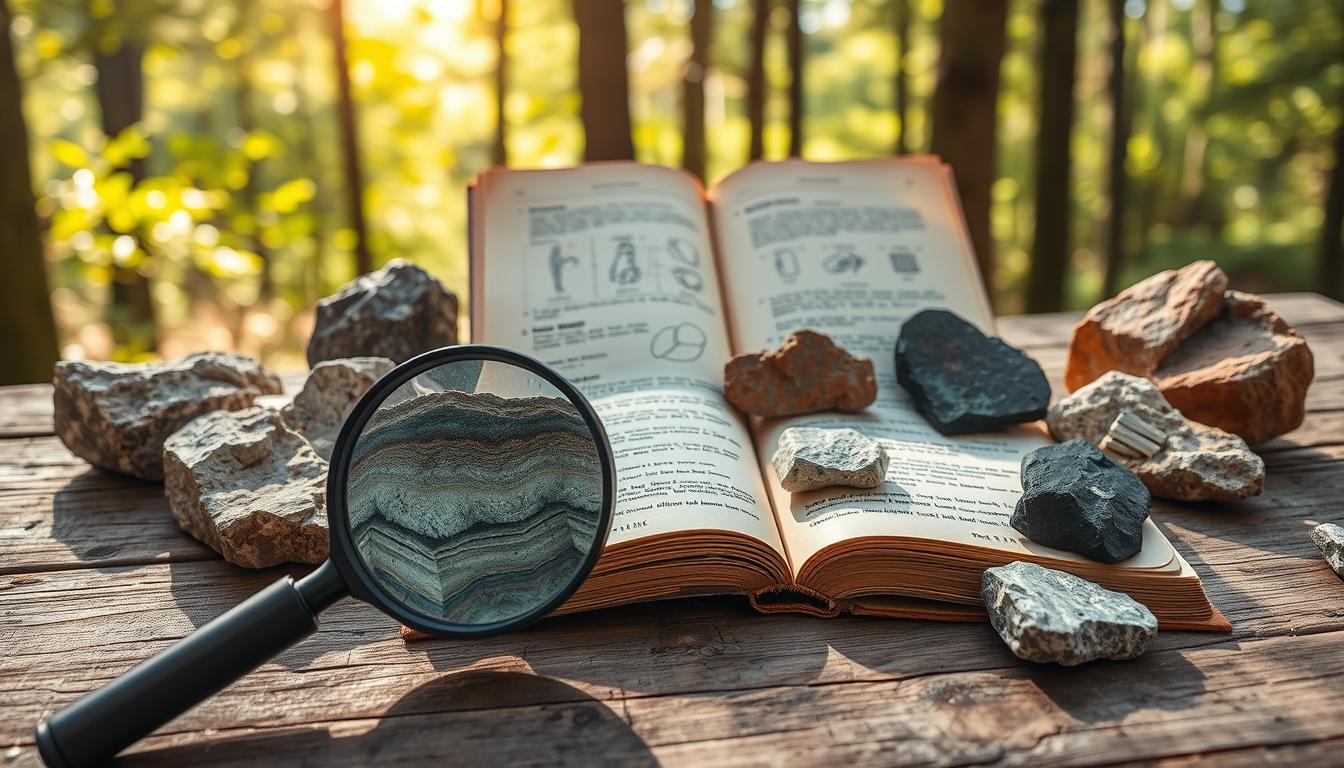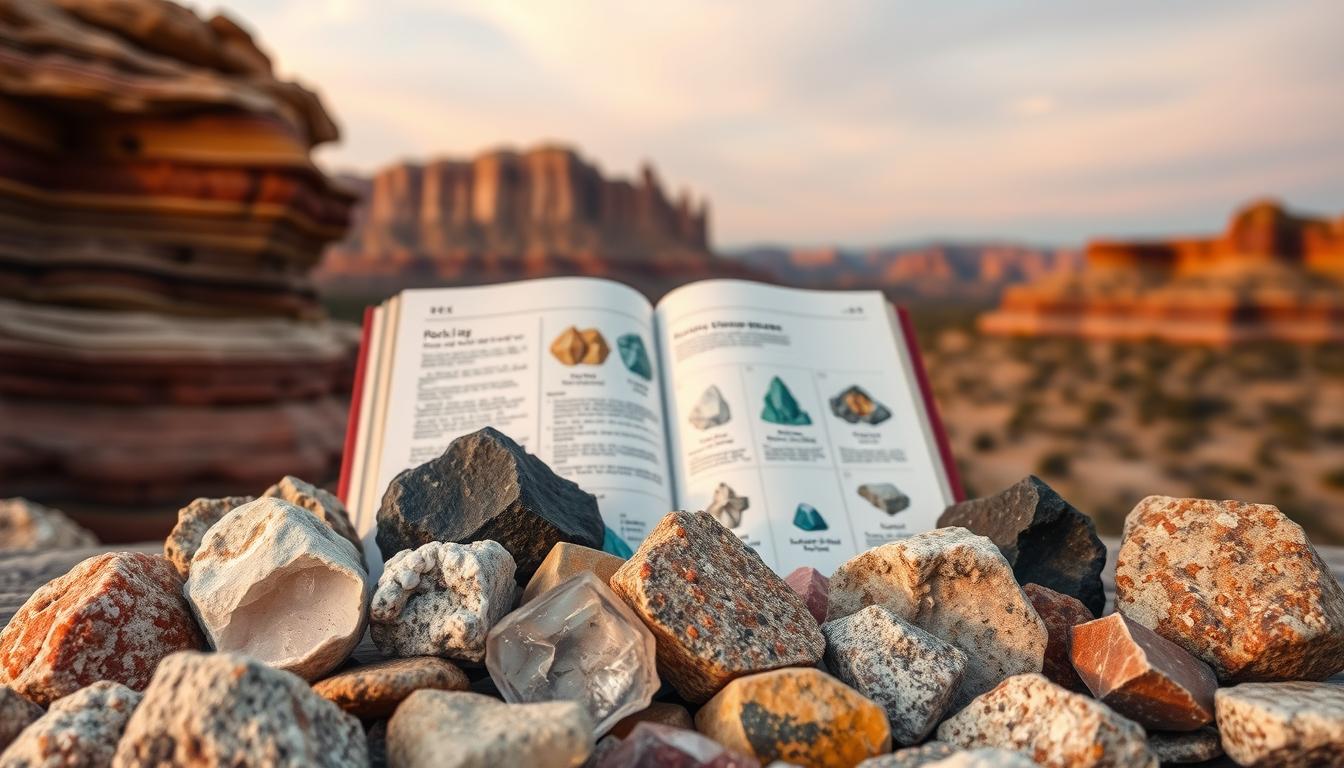
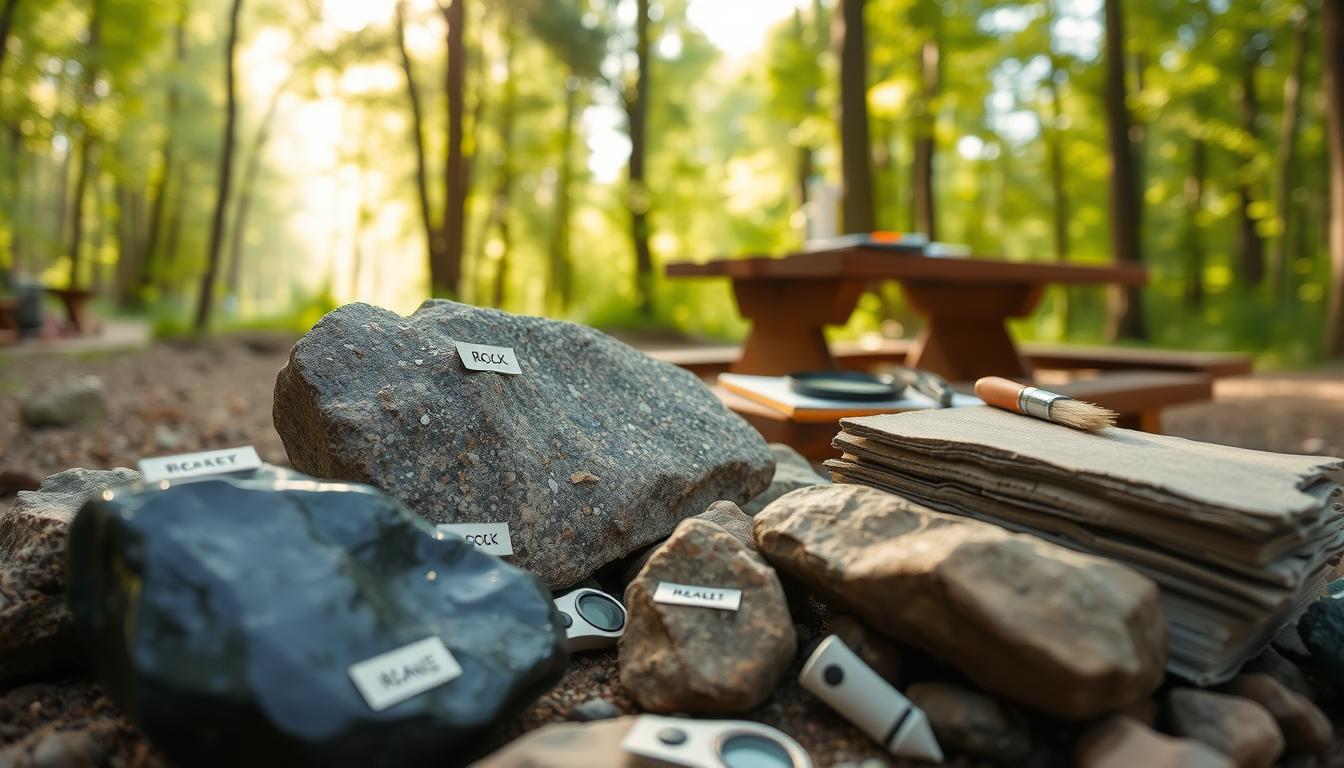
Identifying rocks can be a fun hobby. You can do it without any special tools. Learning the basics is the first step to exploring geology.
Rocks come in three main types: igneous, sedimentary, and metamorphic. Each has its own look and feel. You can learn about these by observing and testing rocks. For more info, check out Tessa Stones’ guide.
Learning about rocks can make you appreciate nature more. It also makes outdoor adventures more interesting.
Key Takeaways
- Understand the three main categories of rocks: igneous, sedimentary, and metamorphic.
- Learn simple tests to identify rock characteristics, such as color, texture, and hardness.
- Discover how to use everyday objects to perform basic at-home tests.
- Explore the importance of knowing the local geology for rock identification.
- Find out how to keep a rock journal to track your progress.
The Fundamentals of Rock Classification
To identify rocks well, you need to know the basics of rock classification. This process helps us understand the different types of rocks. It’s important for many uses, like building, gardening, and making jewelry.
Rocks are mainly split into three groups: igneous, sedimentary, and metamorphic. Each group has its own special features.
Understanding Igneous, Sedimentary, and Metamorphic Rocks
Igneous rocks come from magma or lava cooling down. They can form below or above the ground. Sedimentary rocks are made from sand, silt, and clay that settle and stick together. Metamorphic rocks change when rocks are pressed and heated, changing their look and feel.
Key characteristics of the three main rock types:
| Rock Type | Formation Process | Examples |
|---|---|---|
| Igneous | Cooling and solidification of magma or lava | Granite, Basalt |
| Sedimentary | Accumulation and consolidation of sediments | Sandstone, Limestone |
| Metamorphic | Transformation under high pressure and temperature | Marble, Slate |
Why Rock Identification Matters in Everyday Life
Rock identification is more than just a hobby. It’s useful in many parts of our lives. Knowing the rock type in buildings helps us see if it’s strong enough. It helps in designing gardens and outdoor areas too. Also, in jewelry, knowing the rock’s makeup can affect its value.
Learning about rock classification helps us make better choices. It’s useful for building, gardening, or just enjoying rocks. Rock identification is a skill that makes us appreciate nature more.
Visual Identification Techniques
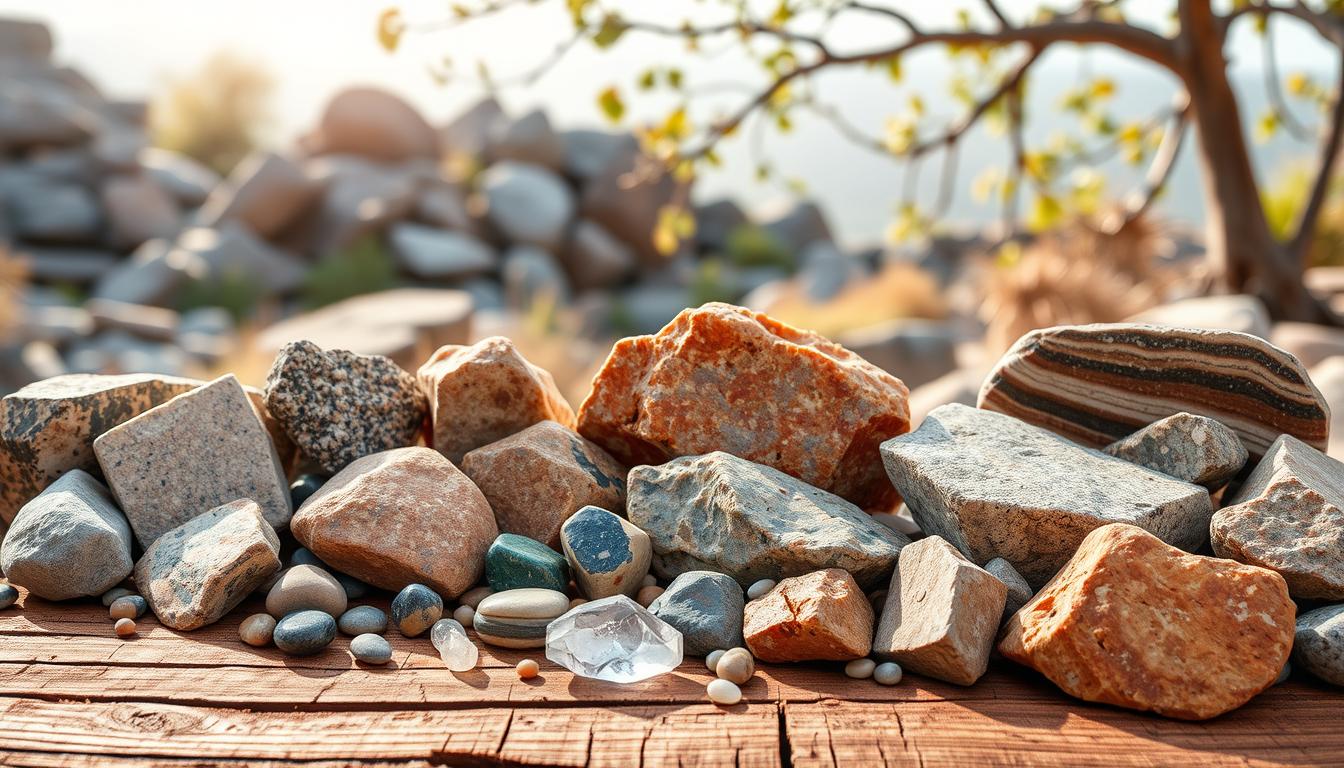
Visual techniques are key for identifying rocks without tools. By looking at a rock’s color, pattern, texture, and grain size, you can learn about its makeup. Identifying rocks by sight needs a sharp eye and careful observation.
Color and Pattern Observation
The color and pattern of a rock can tell you a lot. Different minerals and rocks show unique colors and patterns. Check out our rock identification guide to see more about rock types and their features.
Texture and Grain Size Assessment
Looking at a rock’s texture and grain size can reveal its origin and makeup. Rocks can have coarse, fine, or glassy textures. Their grain size can vary from tiny to large. By checking these, you can spot special features like mineral inclusions or air pockets.
Identifying Distinctive Features
Mineral inclusions like quartz or mica can be spotted by their unique looks. By noticing these, you can guess what rock it might be.
Using Natural Light to Enhance Observation
Using natural light helps see a rock’s color, texture, and shine better. By looking at the rock in different lights, you can understand its features and figure out its type.
| Rock Type | Color | Texture | Grain Size |
|---|---|---|---|
| Granite | Coarse-grained, pink to gray | Phaneritic | Coarse |
| Limestone | White to gray | Fine-grained | Fine |
| Sandstone | Red to yellow | Clastic | Medium |
Simple Physical Tests for Rock Identification
Simple tests can help identify rocks without special tools. These tests check the rock’s physical properties. This way, you can figure out what kind of rock it is.
The Scratch Test Using Household Items
The scratch test is easy to do. It checks a rock’s hardness. Use items like a copper penny or a steel nail to see if it scratches.
If a rock is scratched by a copper penny but not by a fingernail, it has a certain hardness. This test helps guess the rock’s type by comparing it to known materials.
To do the scratch test, start with soft items and move to harder ones. Note when the rock is scratched. This method is a simple way to guess a rock’s hardness without special tools.
Testing for Luster and Reflectivity
Looking at a rock’s luster and reflectivity can tell you about its makeup. Luster is how light reflects off the rock’s surface. A rock with a shiny luster might have minerals like quartz or mica. To check luster, hold the rock under a light and see how it reflects.

Checking Relative Weight and Density
The weight and density of a rock can also give clues. By comparing the rock’s weight to its size, you can guess its density. Rocks with heavy minerals like iron or copper feel heavier. By comparing two rocks of the same size but different weights, you can tell they have different densities.
Breaking Patterns and Fracture Types
Looking at how a rock breaks can tell you about its minerals and structure. Different rocks break in different ways. For example, obsidian breaks in smooth, curved surfaces. By looking at the break, you can guess the rock’s structure and minerals.
How to Identify Rocks Without Special Tools in Different Environments
Learning about local geology makes identifying rocks easier. Places like beaches, mountains, deserts, and cities have unique rocks. You can spot them by looking closely and doing simple tests.

Beach and Coastal Rock Formations
Beaches have rocks smoothed by waves. You’ll find basalt, granite, and sandstone there. Granite, for example, has big grains and quartz and feldspar minerals.
Mountain and Highland Geological Features
Mountains have many rock types. A field guide to rocks helps identify them. Look for foliation in metamorphic rocks or fossils in sedimentary rocks.
Desert and Arid Region Specimens
Deserts have exposed rocks because of little vegetation. You’ll see limestone, sandstone, and quartzite there. Quartzite is very hard and doesn’t erode easily.
Urban and Construction Site Rocks
Urban areas and construction sites show different rocks. Look at the rock’s texture and minerals. For example, slate is used in buildings because it’s fine-grained.
Knowing common rocks in different places helps you identify them without tools. Just observe and use simple methods to get better at it.
Step-by-Step Guide to Identifying Common American Rocks
Identifying common American rocks is easy with a few steps. This guide will show you how. We’ll focus on key traits and simple tests to figure out the rock type.
Recognizing Granite, Limestone, and Sandstone
Granite, limestone, and sandstone are common in America. Granite is a coarse-grained rock with visible minerals. Limestone is made of calcium carbonate and often has fossils. Sandstone is made of sand grains cemented together.
- Granite: Look for a coarse grain and a mix of minerals like quartz and feldspar.
- Limestone: Check for fossils and a reaction with acid, indicating calcium carbonate.
- Sandstone: Identify by its sandy texture and the presence of cemented sand grains.
Distinguishing Between Quartz, Feldspar, and Mica
Quartz, feldspar, and mica are common in many American rocks. Quartz is very hard and looks like glass. Feldspar is duller than quartz. Mica has thin, flaky layers.
| Mineral | Hardness | Luster |
|---|---|---|
| Quartz | Very hard | Glassy |
| Feldspar | Hard | Dull |
| Mica | Soft | Shiny, flaky |
Identifying Metamorphic Rocks Like Slate and Marble
Metamorphic rocks like slate and marble have special traits. Slate is fine-grained and splits easily. Marble is a metamorphosed limestone with veining and reacts to acid.
- Slate: Check for its fine grain and ability to split into thin layers.
- Marble: Look for veining and a reaction with acid, similar to limestone.
Conclusion
Learning to identify rocks without special tools takes patience and practice. It also needs a sharp eye for detail. By knowing the basics of rock types and using simple tests, anyone can get good at it.
Rock identification is about noticing things like color, texture, and minerals. You can use these skills in many places, like beaches or mountains. This way, you’ll grow to love the earth’s geology more.
Want to get better at identifying rocks? Join rock collecting groups or clubs. They have lots of knowledge and hands-on learning. This will make you more sure of yourself when identifying rocks.
Follow the tips in this article on How to Identify Rocks Without Special Tools. You’ll soon be able to spot rocks easily. And you’ll dive into the exciting world of geology.
FAQ
What are the three main categories of rocks?
The main types of rocks are igneous, sedimentary, and metamorphic. Knowing these categories helps you identify rocks.
How can I identify rocks without special tools?
You can spot rocks without tools by looking at their color, pattern, and texture. Also, try simple tests like the scratch test.
What is the scratch test, and how do I perform it?
The scratch test uses a copper penny or steel file to check a rock’s hardness. It helps identify the rock.
How does the environment affect the types of rocks I can find?
The environment shapes the rocks you find. Beaches have sedimentary rocks like sandstone. Mountains have metamorphic rocks like slate.
What are some common rocks found in America, and how can I identify them?
In America, you’ll find rocks like granite, limestone, and marble. Identify them by their textures, colors, and patterns.
How can I distinguish between common minerals like quartz, feldspar, and mica?
Distinguish minerals by their hardness, luster, and cleavage. Quartz is hard and glassy, while mica is soft and flaky.
Why is understanding local geology important for rock identification?
Knowing local geology helps you find the right rocks. It guides your search and improves your identification skills.
Can I identify rocks by their color alone?
Color is useful but not always enough. Many rocks share colors. Look at texture and pattern too.

Subscribe to Our Newsletter