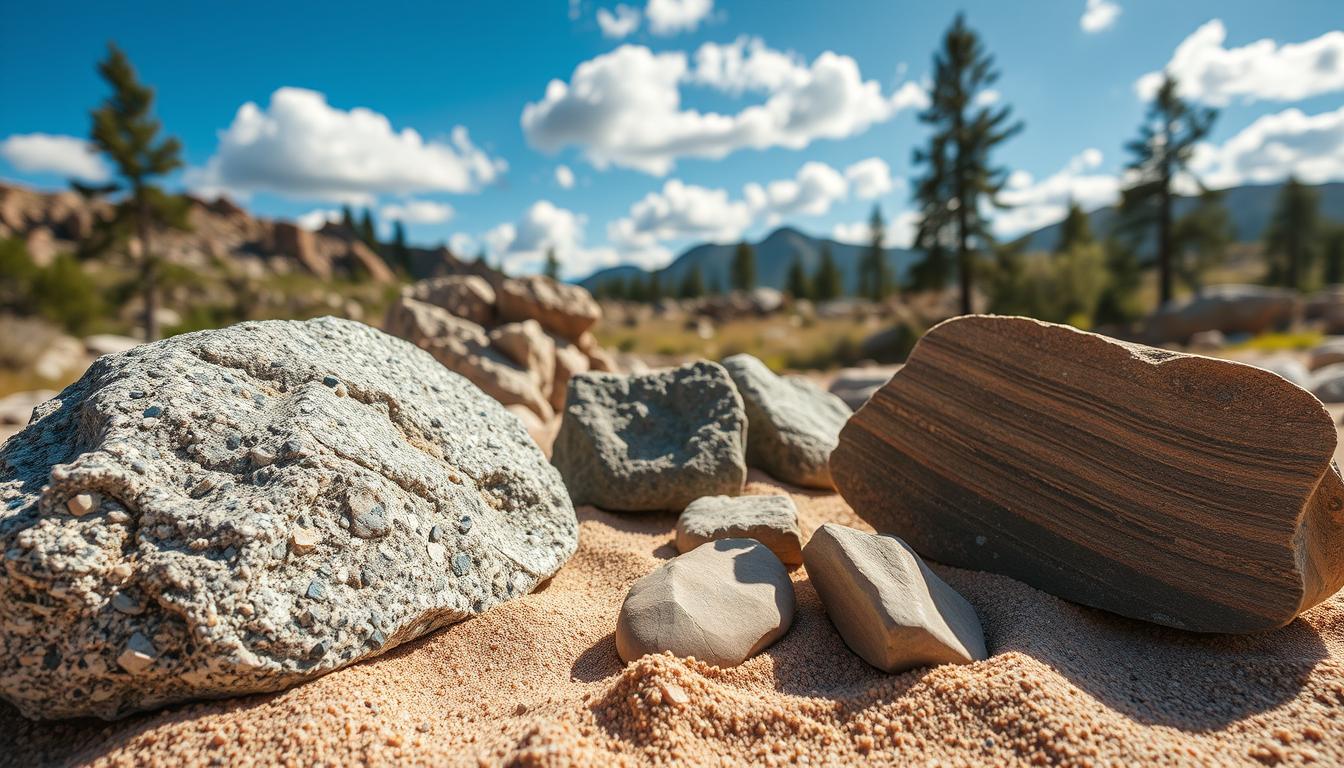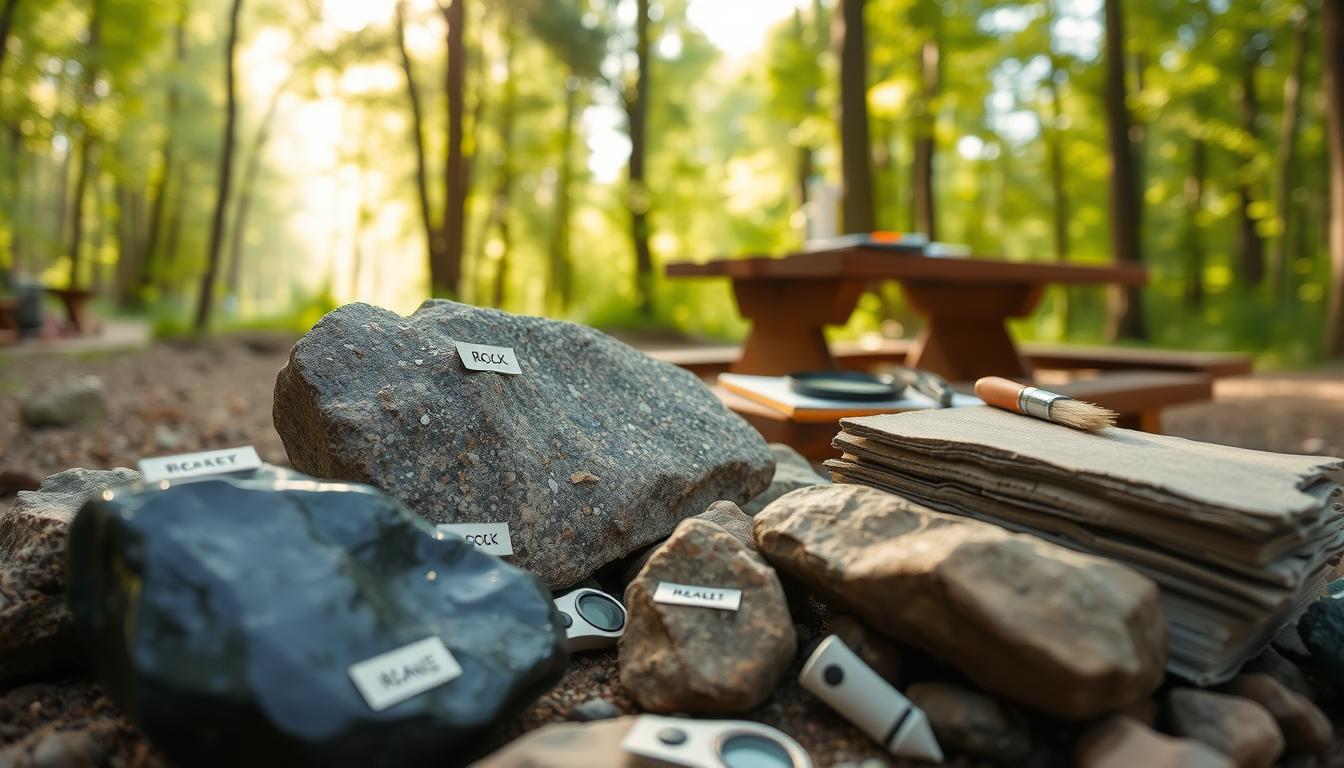
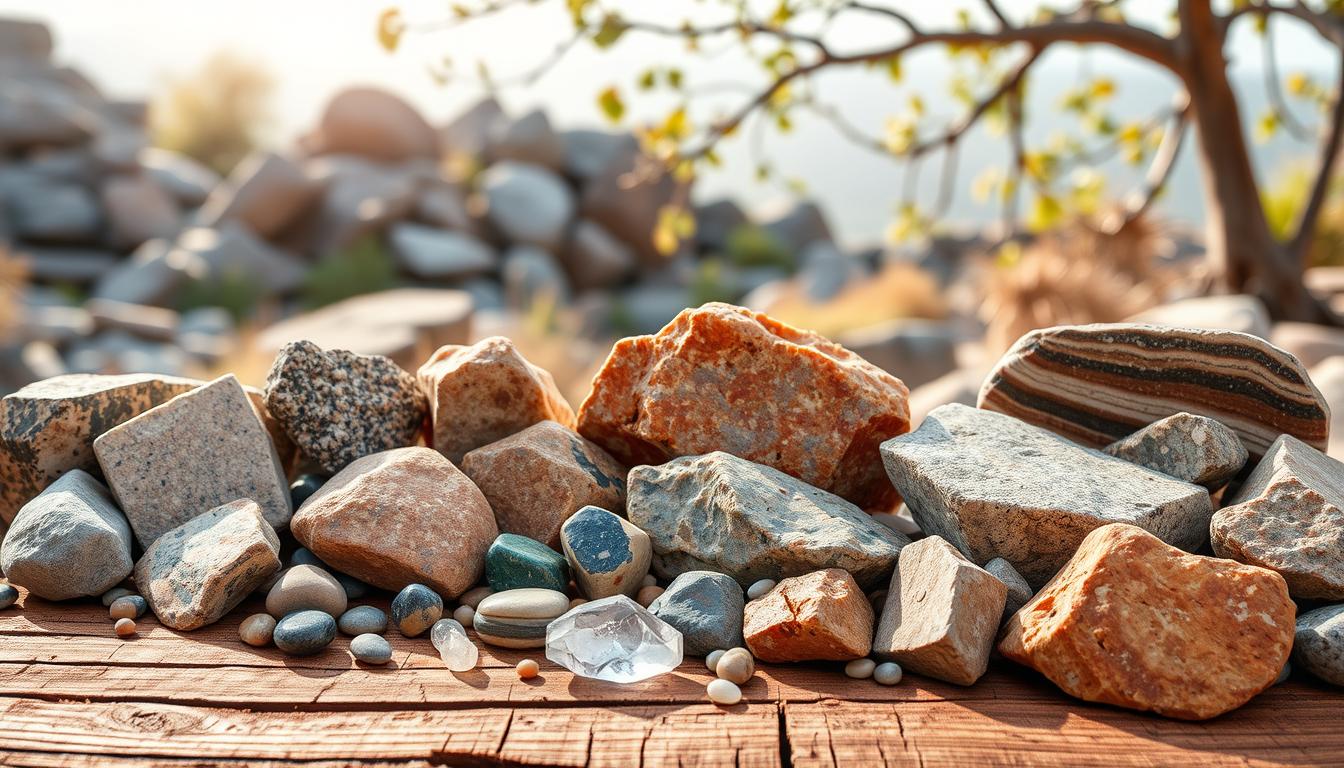
Rock identification is really cool. It’s about knowing the different types of rocks. Looking at their color and texture is a big part of rock identification guides.
By checking these details, people can learn about rocks’ makeup and where they come from. This info is key for geologists, rock fans, and anyone curious about Earth’s past.
Key Takeaways
- Color and texture are key to identifying rocks.
- Knowing rock features helps figure out what they’re made of and where they come from.
- Rock identification guides are super helpful for geologists and rock lovers.
- Studying rock features is vital for understanding Earth’s history.
- Getting good at rock identification takes practice and learning.
The Basics of Rock Identification
Learning about rock identification is key for both hobbyists and experts. It’s about looking at different physical traits to figure out what kind of rock it is.
Why Color and Texture Matter
Color and texture are the first hints at what a rock might be. Each rock has its own color and texture. These tell us about its makeup and where it comes from.
Other Important Physical Properties
Hardness and Streak
Hardness shows how well a rock can resist scratches. Streak is what happens when you powder the rock. These help us guess what the rock could be.
Luster and Fracture
Luster is how light bounces off the rock’s surface. Fracture is how the rock breaks when hit. These details give us more hints about the rock’s identity.
For more info on rocks and minerals, check out British Geological Survey.
Understanding the Three Main Rock Types
The Earth’s geology is made up of three main rock types: igneous, sedimentary, and metamorphic rocks. Each type forms differently and has unique features.
Igneous Rocks: Formation and Characteristics
Igneous rocks come from magma or lava cooling and solidifying. They can form below or above the Earth’s surface. These rocks can be glassy or have crystals and vary in what they’re made of.
Sedimentary Rocks: Formation and Characteristics
Sedimentary rocks are made from sediments like mineral particles or organic matter. They tell us about the Earth’s past, like what the climate was like.
Metamorphic Rocks: Formation and Characteristics
Metamorphic rocks happen when existing rocks face high heat and pressure. This changes their minerals and structure. It can create new minerals and textures, like foliation.
| Rock Type | Formation Process | Characteristics |
|---|---|---|
| Igneous | Cooling and solidification of magma or lava | Glassy or crystalline texture, varied composition |
| Sedimentary | Accumulation and consolidation of sediments | Layered structure, contains fossils or mineral particles |
| Metamorphic | High temperatures and pressures altering existing rocks | Foliated or non-foliated texture, new minerals formed |
How to Identify Rocks Using Color and Texture
Understanding color and texture helps a lot in identifying rocks. These features tell us a lot about what a rock is made of and where it comes from.
Color as an Identification Tool
The color of a rock can tell us its type. Different minerals make rocks different colors.
Primary Colors and What They Indicate
For example, rocks with lots of quartz are light-colored. Rocks with mafic minerals are darker. Learn more about minerals and their colors here: resource.
Color Variations and Mineral Content
Changes in color can show us certain minerals are present. Iron oxide, for instance, makes rocks look reddish.
Texture as an Identification Tool
Texture tells us about the size, shape, and how minerals are arranged in a rock. It helps us understand how the rock was formed.
Grain Size and Formation Conditions
The size of the grains in a rock can tell us how it cooled. Big grains mean it cooled slowly underground.
Surface Feel and Internal Structure
The feel and inside of a rock can also give clues. A smooth rock might be sedimentary. A rock with a foliated structure is likely metamorphic.
| Characteristic | Indication |
|---|---|
| Light Color | High quartz content |
| Dark Color | Rich in mafic minerals |
| Coarse Grain | Slow cooling process |
| Smooth Surface | Possibly sedimentary |
Essential Tools for Rock Identification
To identify rocks, you need basic tools. Rock identification is about looking at and testing rock properties.
Basic Field Equipment
You’ll need a hand lens, rock hammer, and streak plate. A hand lens lets you see the rock’s details closely. A rock hammer helps break the rock to see inside. A streak plate shows the rock’s color when powdered.
Simple Tests You Can Perform
There are simple tests for rock identification. These include the scratch test and acid test.
The Scratch Test
The scratch test scratches the rock with a known material. It shows the rock’s hardness. This helps guess what kind of rock it is.
The Acid Test
The acid test uses acid on the rock. It’s good for finding rocks with calcium carbonate, like limestone. These rocks fizz when acid is applied.

Step-by-Step Rock Identification Process
To identify rocks, follow a systematic approach. This method considers various physical properties. It involves several key steps to narrow down possibilities and confirm the rock type.
Initial Observation and Documentation
The first step is to observe and document the rock’s characteristics. Note its color, texture, and any visible features. Careful documentation is key for further analysis.
- Observe the rock’s color and texture.
- Note any visible features, such as layering or mineral deposits.
- Record your observations for future reference.
Testing Physical Properties
After initial observations, test the rock’s physical properties. This includes determining its hardness, density, and other characteristics. Simple tests can provide valuable information about the rock’s composition and structure.
- Perform a hardness test using the Mohs scale.
- Measure the rock’s density by calculating its mass per unit volume.
- Conduct other relevant tests, such as a streak test or acid test.
Narrowing Down Rock Type
Use the data from observations and tests to narrow down the rock type. Compare the rock’s characteristics with known types of rocks. Reference guides and charts can be helpful in this process, providing a framework for classification.
- Compare the rock’s characteristics with those of known rock types.
- Use reference guides and charts to aid in classification.
- Narrow down the possibilities based on the rock’s properties.
Confirming Your Identification
The final step is to confirm the rock’s identification. This can involve further testing or consulting experts. Verification is important to ensure accuracy and reliability.
By following these steps, anyone can identify rocks with confidence. The key is to be thorough and systematic. Use observation, testing, and reference to guide your identification.
Identifying Common Igneous Rocks
Igneous rocks form when magma or lava cools and solidifies. They are divided into two main types: light-colored and dark-colored. Knowing how to tell them apart is key.
Light-Colored Igneous Rocks
Light-colored rocks like granite and pumice have lots of silica. Granite is coarse, while pumice is very porous. This is because it cools down fast.
Dark-Colored Igneous Rocks
Dark rocks, like basalt and obsidian, have more iron and magnesium. Basalt is fine-grained and found near volcanoes. Obsidian is glassy and forms quickly when lava cools.

Distinctive Textures in Igneous Rocks
The texture of an igneous rock tells us a lot. For example, porphyritic texture shows large crystals in a finer matrix. This means it cooled in a complex way. More research helps us understand how these rocks are made.
Identifying Common Sedimentary and Metamorphic Rocks
To find out what kind of rock you have, look at how it was made and what it looks like. Sedimentary rocks come from old sediments that got stuck together. Metamorphic rocks happen when rocks change shape because of heat and pressure.
Layered Sedimentary Rocks
Look at rocks like sandstone and limestone. They show layers because of how they were made. Sandstone can be yellow, brown, or red. Limestone is usually gray or white.
Foliated Metamorphic Rocks
Foliated rocks, like slate and schist, have layers because of pressure. Slate is dark gray to black. Schist can be many colors because of its minerals.
Non-Foliated Metamorphic Rocks
Non-foliated rocks, like marble and quartzite, don’t have layers. Marble can be white or colored. Quartzite is white or light, made mostly of quartz.
Mastering Rock Identification
Learning to identify rocks by color and texture is key in geology. By looking at color, texture, and other features, you can tell what a rock is. Techniques like checking streak, luster, hardness, and cleavage help a lot.
For more learning, check out the Physical Geography Lab Manual. It’s full of tips on identifying rocks.
Using these methods, you’ll understand the Earth’s history better. It’s great for students, collectors, or anyone who loves nature. Learning to identify rocks is exciting and opens up new discoveries.
FAQ
What are the main characteristics used to identify rocks?
To identify rocks, look at their color, texture, hardness, streak, luster, and fracture. Knowing these physical properties is key.
How do I distinguish between igneous, sedimentary, and metamorphic rocks?
Igneous rocks cool and solidify from magma or lava. Sedimentary rocks form from compressed sediments. Metamorphic rocks change under high pressure and temperature. Each type has unique features.
What is the significance of color in rock identification?
Color hints at minerals and formation conditions. Certain colors suggest minerals like iron oxide or copper.
How does texture help in identifying rocks?
Texture shows how minerals are arranged. Coarse or fine textures reveal formation and mineral makeup.
What are some essential tools for rock identification?
Key tools include a hand lens, rock hammer, streak plate, and acid test kit. They help examine and test rock properties.
How do I perform a scratch test on a rock?
Use a rock hammer to scratch the rock. Harder rocks won’t scratch softer ones.
What is the acid test, and how is it used in rock identification?
The acid test uses weak acid on the rock. It shows minerals like calcite by producing bubbles.
How do I identify common igneous rocks like granite and basalt?
Granite is light-colored with coarse texture. Basalt is dark with fine texture. Knowing these helps identify them.
What are the characteristics of layered sedimentary rocks like sandstone and limestone?
Sandstone and limestone have visible layers from sediment compression. They may have fossils or other features.
How do I distinguish between foliated and non-foliated metamorphic rocks?
Foliated rocks like slate have layered structures. Non-foliated rocks like marble don’t. This shows mineral alignment under pressure.

Subscribe to Our Newsletter