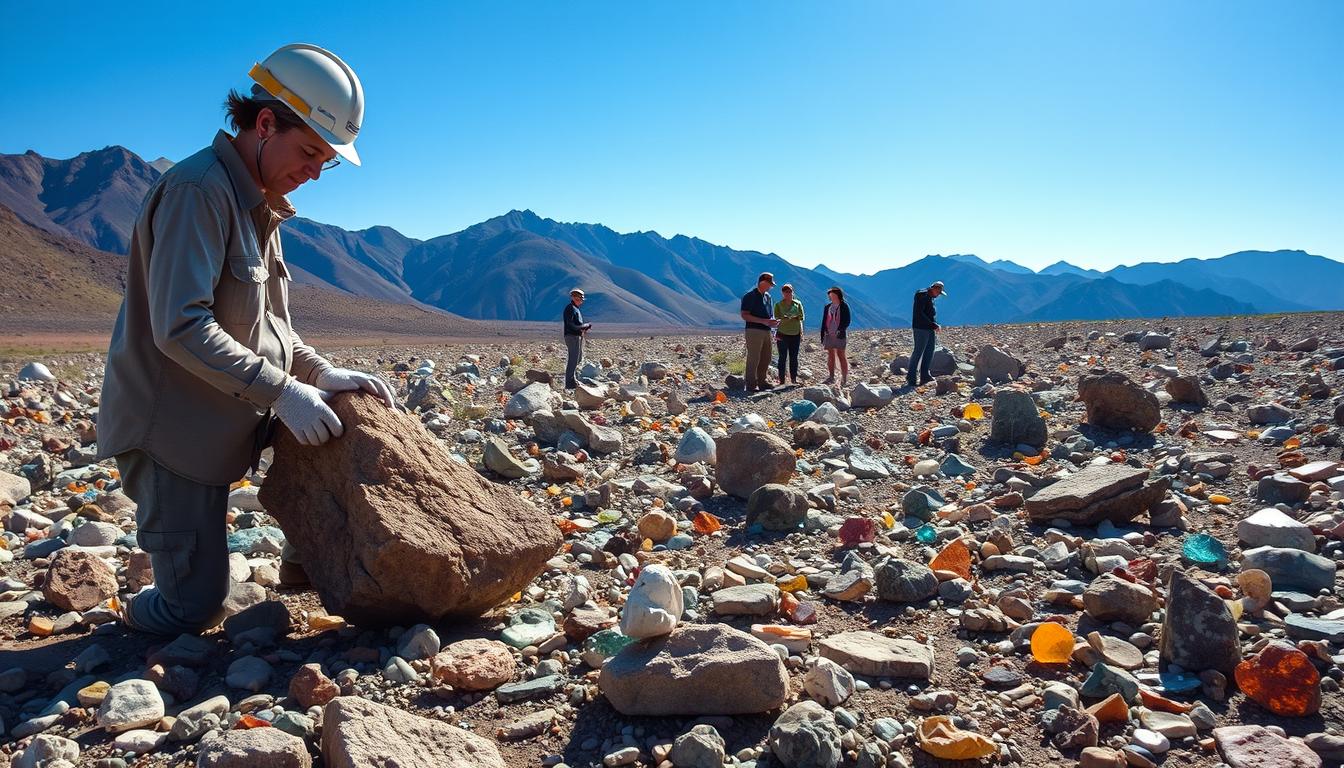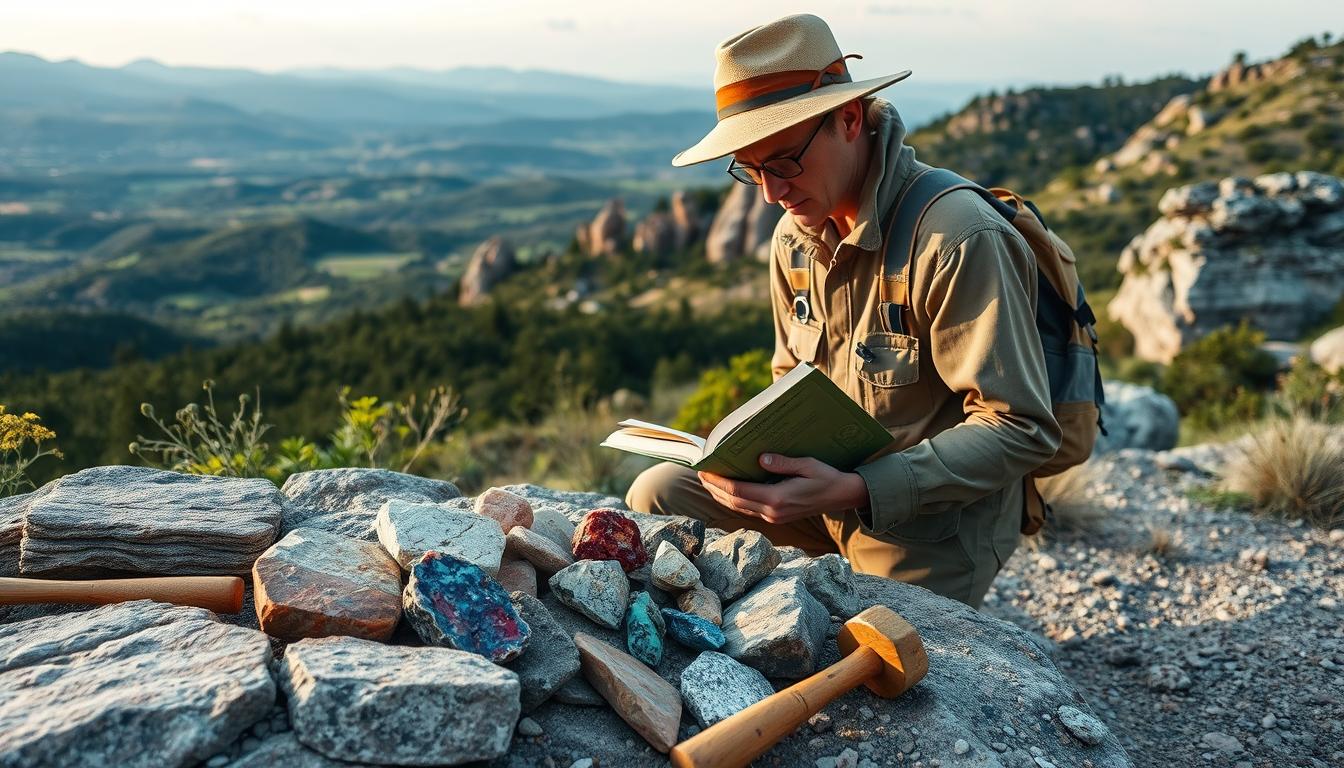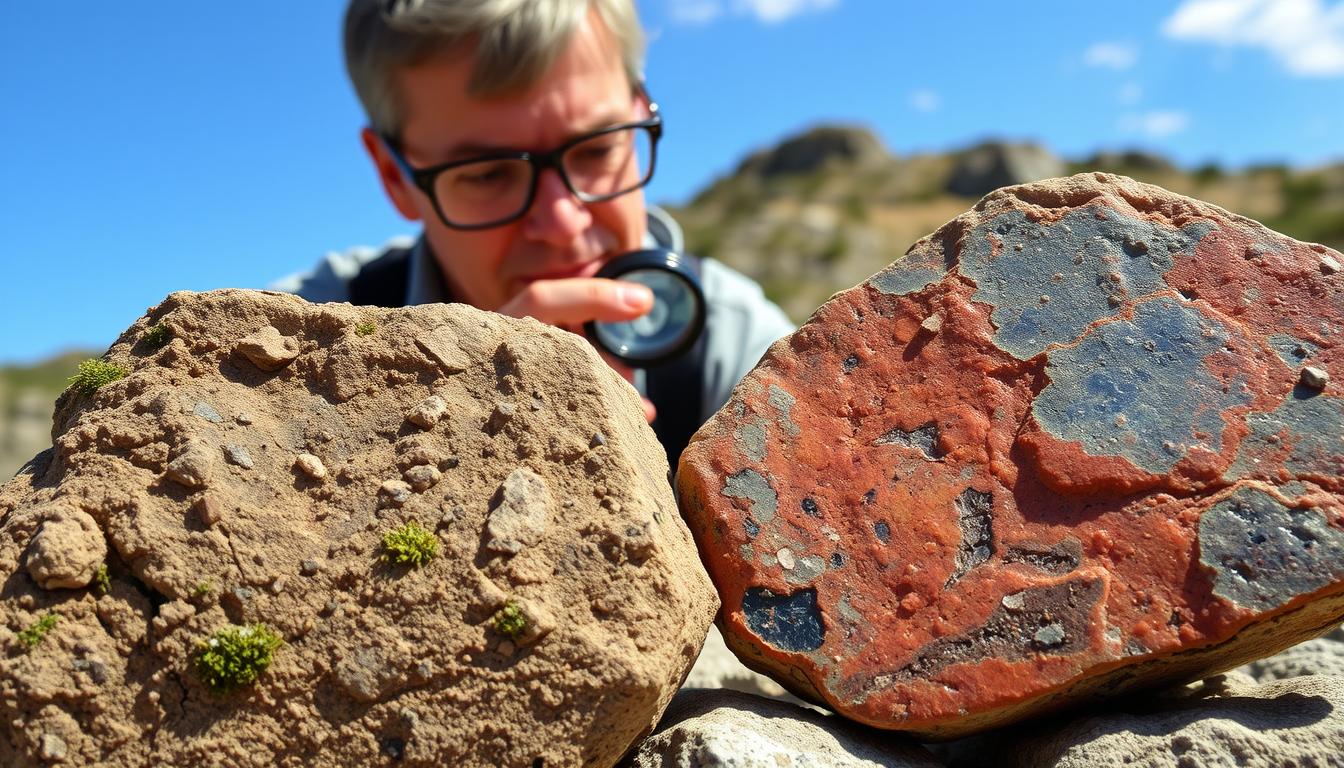
Learning about the earth’s surface is fun for everyone. It’s great for geologists, rock fans, and nature lovers. Being able to identify rocks in the field makes them feel closer to nature.
To identify rocks without tools, you need to know where they are and what they look like. Simple steps can help you figure out what rock you’re seeing. This makes outdoor adventures even better.
This article will show you how to identify rocks in the field without tools. You’ll get step-by-step guides and useful tips.
Key Takeaways
- Understanding the context of the rock is key for identification.
- Looking at the rock’s physical features helps find out what it is.
- Simple methods can help identify rocks without tools.
- Knowing how to identify rocks deepens your connection with nature.
- Practical tips and step-by-step guides are given for identifying rocks in the field.
The Fundamentals of Rock Identification
Rock identification starts with knowing the three main rock types: igneous, sedimentary, and metamorphic. These types are key to understanding geology. They help us identify rocks when we’re out in the field.
The Three Main Rock Types
The three main rock types are based on how they form. Igneous rocks come from magma or lava cooling down. Sedimentary rocks are made from compressed sediments. Metamorphic rocks change from heat and pressure on existing rocks.
| Rock Type | Formation Process | Examples |
|---|---|---|
| Igneous | Cooling and solidification of magma or lava | Granite, Basalt |
| Sedimentary | Accumulation and compression of sediments | Sandstone, Limestone |
| Metamorphic | Transformation by heat and pressure | Marble, Slate |
Why Visual Identification Matters
Seeing a rock is key to identifying it. By looking at its color, texture, and other features, we can guess its type. This skill takes practice and knowing what to look for.
Setting Realistic Expectations
It’s important to know what we can do without tools. While looking at a rock can help, it’s not always enough. Sometimes, we need more tests to be sure.
Learning about rock types and their limits helps us get better at identifying them. This way, we can be more sure of ourselves when we’re out in the field.
Understanding Rock Formation Processes
To identify rocks well, knowing how they form is key. Rocks fall into three main types: igneous, sedimentary, and metamorphic. Each type shows unique traits based on how it forms.
Igneous Rock Formation
Igneous rocks come from magma or lava cooling and solidifying. This can happen underground (intrusive rocks) or when lava flows out (extrusive rocks). The cooling speed shapes the rock’s texture, with slower cooling making bigger crystals.
Sedimentary Rock Formation
Sedimentary rocks form from gathered and pressed sediments. These can be rock pieces, minerals, or organic stuff. Over time, these sediments get compressed and stuck together, making a new rock. The look of sedimentary rocks shows what they were made from and where they were formed.
Metamorphic Rock Formation
Metamorphic rocks change from existing rocks through heat, pressure, or chemicals. This change can happen due to mountain building or being near hot rocks. The new rocks have different textures and minerals than before.
How Formation Affects Appearance
The way a rock forms greatly changes its look, like texture, color, and minerals. Knowing these processes helps in identifying rocks outdoors.
| Rock Type | Formation Process | Characteristics |
|---|---|---|
| Igneous | Cooling and solidification of magma or lava | Varied texture, often with visible crystals |
| Sedimentary | Accumulation and consolidation of sediments | Often layered, may contain fossils |
| Metamorphic | Transformation by heat, pressure, or chemical processes | Foliated or banded texture, changed mineral composition |
https://www.youtube.com/watch?v=K9Kcaoc8A0Q
Key Visual Characteristics for Identification
Looking at rocks can tell you a lot without special tools. You can spot several key features. These include color and shine, texture and grain size, patterns, and crystal structure.
Color and Luster
The rock’s color can hint at its type. But, weathering can change it. Luster is how light bounces off the rock’s surface. Together, color and luster give clues about the rock.
Texture and Grain Size
The rock’s texture comes from its mineral grains’ size, shape, and how they’re arranged. Grain size can be big, like in granite, or small, like in basalt. Knowing this helps guess the rock’s identity.
Patterns and Banding
Many rocks show patterns or banding. Sedimentary rocks might have layers, while metamorphic rocks have foliation. Spotting these patterns is key to identifying rock types.
Crystal Structure
The rock’s crystal structure shows how its minerals are arranged. Some rocks have big crystals, while others have tiny ones. Looking at the crystal structure can tell you a lot about the rock’s origin and type.
By studying these visual clues, you can identify rocks without tools. Each clue helps solve the puzzle of what rock it is.
Using Physical Properties Without Tools
Physical properties are key to identifying rocks. Many can be checked without tools. By looking at these traits, you can guess a rock’s type more easily.
Relative Weight Assessment
Checking a rock’s weight is simple. Compare it to similar-sized rocks. If it’s very heavy or light, it might tell you something.
Heavy rocks often have high mineral density. This can hint at what they’re made of.

Hardness Estimation Techniques
Guessing a rock’s hardness is easy with everyday items. If a copper penny scratches it but not your fingernail, it’s between 3 and 4 on the Mohs scale. This method is quick and doesn’t need special tools.
Fracture and Cleavage Patterns
How a rock breaks can show its inside structure. If it breaks flat, it has cleavage. If not, it has fracture patterns.
Understanding these patterns can help identify the rock’s mineral composition.
Surface Feel and Texture
The rock’s surface can also give clues. Smooth rocks might be sedimentary or metamorphic. Rough textures could mean igneous origins or weathering.
By noting these traits, you can guess the rock’s identity better.
By using these methods, you can identify rocks without special equipment. This method needs careful observation and basic knowledge of rock traits.
How to Identify Rocks in the Field Without Tools
Identifying rocks without tools needs careful observation, patience, and practice. You can get better at it by following a step-by-step method.
Systematic Observation Method
Start by looking closely at the rock’s color, texture, and pattern. First, notice the rock’s color and any patterns. Then, check the texture for clues like grain size or fossils.
Comparative Analysis Techniques
Compare the rock to known types or descriptions. This helps if you’re unsure about a rock. Use rock identification guides for help.
Environmental Context Clues
The rock’s environment can tell you a lot. For example, volcanic areas have igneous rocks. Sedimentary rocks are found in areas with lots of sediment.
Creating Mental Reference Points
Remember the looks of different rocks by observing them often. This builds a mental library of rock types. You’ll learn to identify rocks quickly.
| Rock Type | Common Characteristics | Environmental Clues |
|---|---|---|
| Igneous | Coarse-grained, dark color | Found in areas with volcanic history |
| Sedimentary | Layered, contains fossils | Found in sedimentary basins |
| Metamorphic | Foliated, changed mineral composition | Found in areas with tectonic activity |
By using these methods, you can identify rocks without tools. With more practice, you’ll get better at recognizing different rock types.
Identifying Common Igneous Rocks
Igneous rocks come from magma or lava cooling and solidifying. They are key to the Earth’s geology. Knowing the types helps with rock identification outdoors.
Granite and Rhyolite
Granite and rhyolite are common igneous rocks. Granite cools below the Earth’s surface and has a coarse texture. It’s made mostly of quartz and feldspar. Rhyolite cools above the surface and has a fine texture. It looks similar to granite but is lighter.
Basalt and Gabbro
Basalt and gabbro are dark rocks. Basalt cools quickly and has a fine texture. It’s found where volcanoes have been active. Gabbro cools slowly and has a coarse texture. It’s darker and has more iron and magnesium than basalt.

Obsidian and Pumice
Obsidian is a volcanic glass that’s usually black. It has a smooth look. It forms when lava cools fast. Pumice is a light, porous rock. It forms when lava cools quickly and gas escapes.
Andesite and Diorite
Andesite is an extrusive rock with a fine texture. It’s often gray or greenish. Diorite is its intrusive version, with a coarse texture. Both are in between in mineral mix.
| Rock Type | Texture | Color | Composition |
|---|---|---|---|
| Granite | Coarse-grained | Light | Quartz, Feldspar |
| Rhyolite | Fine-grained | Light | Quartz, Feldspar |
| Basalt | Fine-grained | Dark | Iron, Magnesium rich |
| Gabbro | Coarse-grained | Dark | Iron, Magnesium rich |
Looking at texture, color, and composition helps identify igneous rocks. This skill is key for geology field identification. It helps us understand the Earth’s geology better.
Recognizing Sedimentary Rocks in Nature
Spotting sedimentary rocks in nature needs a sharp eye and knowledge of how they form. These rocks are made from sediments that pile up and harden. Sediments can come from old rocks, organic matter, or chemical reactions.
Sandstone and Conglomerate
Sandstone and conglomerate are clastic sedimentary rocks. Sandstone has grains like quartz or feldspar, ranging from small to large. Conglomerate is made of big gravel and pebbles stuck together. Both tell us about where they were formed.
- Sandstone often forms in places like beaches, rivers, and deserts.
- Conglomerate usually forms in places with lots of water flow, like fast rivers or coastlines.
Limestone and Chalk
Limestone is mostly calcium carbonate, from marine life remains. Chalk is also calcium carbonate but from tiny marine plankton. For more on sedimentary minerals and rocks, check Open Geology.
- Limestone fizzes with acid because of its calcium carbonate.
- Chalk is softer and more porous than limestone.
Shale and Siltstone
Shale comes from compacted silt and clay. Siltstone is similar but with silt-sized particles. Both show layers and tell us about ancient places.
Coal and Fossil-Bearing Rocks
Coal is made from ancient plants under pressure and heat. Fossil-bearing rocks have ancient life remains. These rocks help us understand Earth’s history and life’s evolution.
Knowing about these rocks helps us find them in nature. It also tells us about an area’s geological past.
Spotting Metamorphic Rocks in the Wild
Looking for metamorphic rocks in nature needs a sharp eye. These rocks change due to heat and pressure. They look different from igneous and sedimentary rocks.
Slate and Phyllite
Slate is a fine-grained rock that looks dark and smooth. It comes from shale under low heat and pressure. Phyllite looks similar but has a shiny look. Both rocks get their looks from being pressed and heated.
Schist and Gneiss
Schist is a rock with a medium to coarse texture. It has minerals like mica and talc. It forms under high pressure and heat.
Gneiss is a rock with a banded look. It’s made of quartz, feldspar, and mica. Its look changes based on the rock it comes from.
Marble and Quartzite
Marble comes from changing limestone or dolostone. It has unique veins and colors. Quartzite is made from sandstone rich in quartz. It’s very hard and mostly made of quartz.
Serpentinite and Soapstone
Serpentinite is a rock with a green color. It’s made from ultramafic rocks that have been hydrated. Soapstone is rich in talc. It feels soft and is used for carving.
Knowing these signs helps people spot metamorphic rocks without special tools. It deepens their understanding of the earth and nature.
Regional Rock Variations in the United States
The U.S. has many different types of rocks. This is because of its long and complex geological history. Each region has its own unique rocks.
Eastern U.S. Rock Formations
The East has older rocks like igneous and metamorphic rocks. The Appalachian Mountains have granite and schist. These rocks were formed by ancient mountains.
- Common rocks include granite, schist, and gneiss.
- The region’s geological history is marked by tectonic activity and erosion.
Western U.S. Rock Formations
The West is known for younger volcanic rocks and many sedimentary formations. The Sierra Nevada mountains are mostly granite. Oregon and Washington have volcanic rocks like basalt.
- Notable rocks include basalt, obsidian, and pumice.
- Volcanic activity has played a significant role in shaping the region.
Midwest and Plains Region Rocks
The Midwest and Plains have sedimentary rocks like limestone, sandstone, and shale. These rocks show the area’s history of seas and rivers.
Coastal and Mountain Variations
Coastal areas, like California, have a mix of sedimentary and metamorphic rocks. Mountainous places, like the Rockies, have many types of rocks. Knowing these differences helps in identifying rocks in the field without tools.
[link-whisper-related-posts]Conclusion
Learning to identify rocks without tools takes time and effort. You need to practice and understand what makes rocks different. By following the tips in this article, you can get better at rock identification and learn more about nature.
To get good at identifying rocks, keep practicing. Look at rocks in different places and use a method to notice their details.
Knowing how rocks are made, what they look like, and how they feel helps you identify them. Always be curious and keep learning about rocks.
As you keep practicing, you’ll feel more sure about identifying rocks. You’ll understand the many types of rocks on our planet.
FAQ
What are the three main categories of rocks?
The three main types of rocks are igneous, sedimentary, and metamorphic. Each has its own way of forming and looks different.
How can I identify rocks without any tools?
You can spot rocks without tools by looking at their color, shine, texture, and pattern. Also, check their weight and how hard they are.
What is the importance of understanding rock formation processes?
Knowing how rocks form helps you identify them. It tells you about their look and what they’re made of.
How do I assess the hardness of a rock without tools?
To guess a rock’s hardness, compare it to things you know, like your fingernail or a coin. This shows how hard it is.
What are some common igneous rocks and their characteristics?
Igneous rocks like granite, basalt, obsidian, and pumice have unique looks and textures. You can tell them apart by these features.
How can I recognize sedimentary rocks in nature?
Look for sedimentary rocks by their layered look and texture. They’re made of things like sand, limestone, and shale.
What are the characteristic features of metamorphic rocks?
Metamorphic rocks, like slate, schist, and gneiss, have a special texture. They’re made under high pressure and heat.
How do regional variations affect rock formations?
Different places have different rocks because of their geology. For example, the Eastern U.S. and Western U.S. have unique rock types.
Can I identify rocks by their color alone?
Color is helpful but not always enough. Many rocks look similar but are different inside.
How can I improve my rock identification skills?
Get better at identifying rocks by observing carefully, comparing, and using clues from where you find them. Also, learn about different rock types.

Subscribe to Our Newsletter