Quartz is very common on Earth. It’s found in almost every rock and in many forms. Knowing how to spot it is key in geology and rock collecting. Quartz identification methods help us understand its physical traits and where it’s found.
Quartz stands out because of its hardness, shine, and crystal shape. It’s found in many types of rocks. Learning to identify quartz is important for both geologists and rock lovers.
Key Takeaways
- Quartz is a ubiquitous mineral in various rock types.
- Its identification involves understanding its physical properties.
- Quartz is significant in geology and rock collecting.
- Identification methods include examining hardness and crystal structure.
- Quartz occurs in igneous, sedimentary, and metamorphic rocks.
Understanding Quartz and Its Properties
Quartz is very common on Earth. Knowing how to identify it is important for many reasons. We need to learn about its chemical makeup, crystal shape, and types.
What Is Quartz?
Quartz is made of silicon and oxygen atoms. Its formula is SiO2. It’s found in many rocks and is quite hard, with a Mohs hardness of 7.
Chemical Composition and Crystal Structure
Quartz is just silicon dioxide (SiO2). Its crystal shape is hexagonal. This shape helps us spot quartz in the field.
Common Varieties of Quartz
Quartz comes in many types, each with its own look. You might see amethyst, rose quartz, and smoky quartz. These colors tell us about where quartz comes from.
For more info on quartz, check outhttp://www.quartzpage.de/gro_text.html.
Physical Characteristics for How to Identify Quartz in the Field
Identifying quartz in the field needs a sharp eye for its unique features. Quartz is very common on Earth. Knowing how to spot it is key for many fields.
Hardness and Scratch Test
Quartz is very hard, with a Mohs scale rating of 7. This makes it hard to scratch with most minerals. You can use a copper penny or a steel file to check if it’s quartz.
The scratch test is a reliable method for identifying quartz, as it is relatively hard compared to other minerals.
Luster and Transparency
Quartz usually has a glassy look. Its transparency can change. Some quartz is clear, while others are more cloudy due to inside imperfections.
https://www.youtube.com/watch?v=Z2wTIggh1to
Fracture Patterns and Cleavage
Quartz breaks in a smooth, curved way. It doesn’t split easily like some minerals do. This makes its break pattern a big clue for identifying it.
Color Variations and What They Indicate
Quartz comes in many colors, like clear, white, pink, purple, and smoky. These colors come from different things inside it. For example, amethyst is purple quartz, and rose quartz gets its color from certain minerals.
| Physical Characteristic | Description |
|---|---|
| Hardness | Ranks 7 on the Mohs scale |
| Luster | Typically glassy |
| Fracture Pattern | Conchoidal, no cleavage |
| Color | Varied, due to impurities or radiation |
Field Tests and Tools for Quartz Identification
Identifying quartz in the field needs good observation and the right tools. Geologists and rock fans use many tests and tools to see if a rock is quartz.
Using a Hand Lens or Loupe
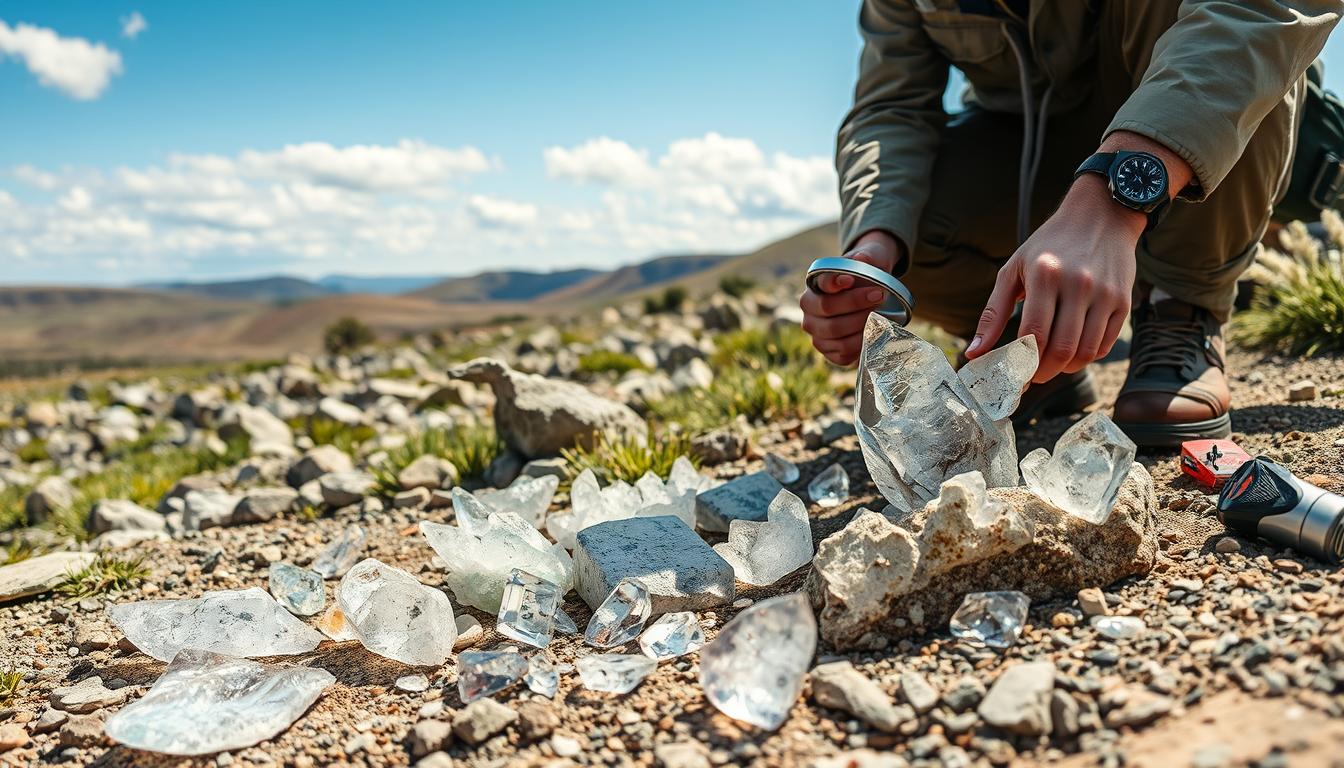
A hand lens or loupe is key for looking at quartz’s crystal structure and inclusions. It lets you see the crystal’s clarity, inclusions, and special features up close.
Streak Test
The streak test scratches the rock on a porcelain plate to find its streak color. Quartz usually has a white or colorless streak. But, this test can be tricky because the streak color can change with impurities or other minerals.
Acid Test Considerations
The acid test uses dilute hydrochloric acid (HCl) on the rock to check for calcite or other minerals. Quartz usually doesn’t react to acid, which might mean it’s quartz. But, be careful because some minerals also don’t react to acid.
Essential Field Equipment
For identifying quartz, you’ll also need a steel knife or file, a magnet, and a glass plate or porcelain streak plate. These tools help with scratch tests, checking for magnetism, and more detailed examination.
| Field Test | Description | Quartz Characteristics |
|---|---|---|
| Hand Lens Examination | Examine crystal structure and inclusions | Clear or white, often with inclusions |
| Streak Test | Scratch specimen on porcelain plate | White or colorless streak |
| Acid Test | Apply dilute HCl to specimen | No reaction (resistant to acid) |
| Scratch Test | Scratch specimen with steel knife or file | Hardness of 7 on Mohs scale |
By using these field tests and tools, you can spot quartz in the field. Always be careful with your specimens and tools to get accurate results and stay safe.

Distinguishing Quartz from Look-Alike Minerals
To tell quartz apart from similar minerals, you need to know its unique traits. Quartz is often mixed up with minerals like calcite, feldspar, and glass. But, you can tell them apart with the right tests and observations.

Quartz vs. Calcite
One key way to spot the difference between quartz and calcite is the hardness test. Quartz is much harder than calcite, with a Mohs hardness of 7. Calcite has a hardness of 3. So, quartz won’t scratch with a copper penny, but calcite will.
Quartz vs. Feldspar
Feldspar is often mistaken for quartz. But, feldspar has a distinct cleavage pattern. Quartz, on the other hand, has a conchoidal fracture. For more details on mineral properties, check out Ontario Geoscience.
Quartz vs. Glass and Other Silicates
Quartz can be told apart from glass by its crystalline structure. This is visible with a hand lens or loupe. Glass, being amorphous, doesn’t have this structure. Other silicates might have similar hardness but differ in luster or fracture patterns.
Common Misidentification Pitfalls
A common mistake is not using multiple tests to identify quartz. Relying on just one trait can lead to mistakes. It’s important to look at hardness, luster, and fracture together to correctly identify quartz.
[link-whisper-related-posts]Conclusion
Learning to spot quartz in the field is all about knowing its physical traits and using simple tests. Quartz is everywhere and can be found by looking at its hardness, shine, break patterns, and colors. With a hand lens or loupe, a streak test, and acid test results, you can tell it apart from other minerals.
For more details on quartz and its types, check out the Mineralogical Society of America website. It has lots of info on identifying quartz and what makes it special.
Knowing how to identify quartz is key for geologists, mineral experts, and collectors. By using what you know about quartz and doing field tests, you can find it in different places. This skill helps both experts and hobbyists learn more about our planet and how it was made.
FAQ
What is the best way to identify quartz in the field?
To identify quartz, look at its hardness, luster, and how it breaks. You can also do a scratch test.
How can I distinguish quartz from other minerals?
Quartz stands out because of its hardness and crystal shape. It also has special optical properties. Look-alike minerals like calcite and feldspar can be compared to help tell them apart.
What is the significance of quartz in geology and rock collecting?
Quartz is key in geology and rock collecting. It’s common, has unique traits, and is used in many fields like electronics and optics.
Can I identify quartz using a hand lens or loupe?
Yes, a hand lens or loupe helps see quartz’s crystal structure and inclusions. This makes it easier to identify.
What are some common look-alike minerals that can be mistaken for quartz?
Calcite, feldspar, and glass often look like quartz. Knowing their differences is important for correct identification.
How do I perform a streak test on a suspected quartz sample?
Rub the sample on a porcelain plate to see the powder color. Quartz usually leaves a white or colorless streak.
What are the limitations of the acid test for quartz identification?
The acid test isn’t used for quartz because it doesn’t react with acid. But, it can tell quartz from calcite, which does react.
Can quartz be identified by its color alone?
No, quartz comes in many colors. So, color alone isn’t reliable for identification. Hardness and crystal structure are better signs.

Subscribe to Our Newsletter