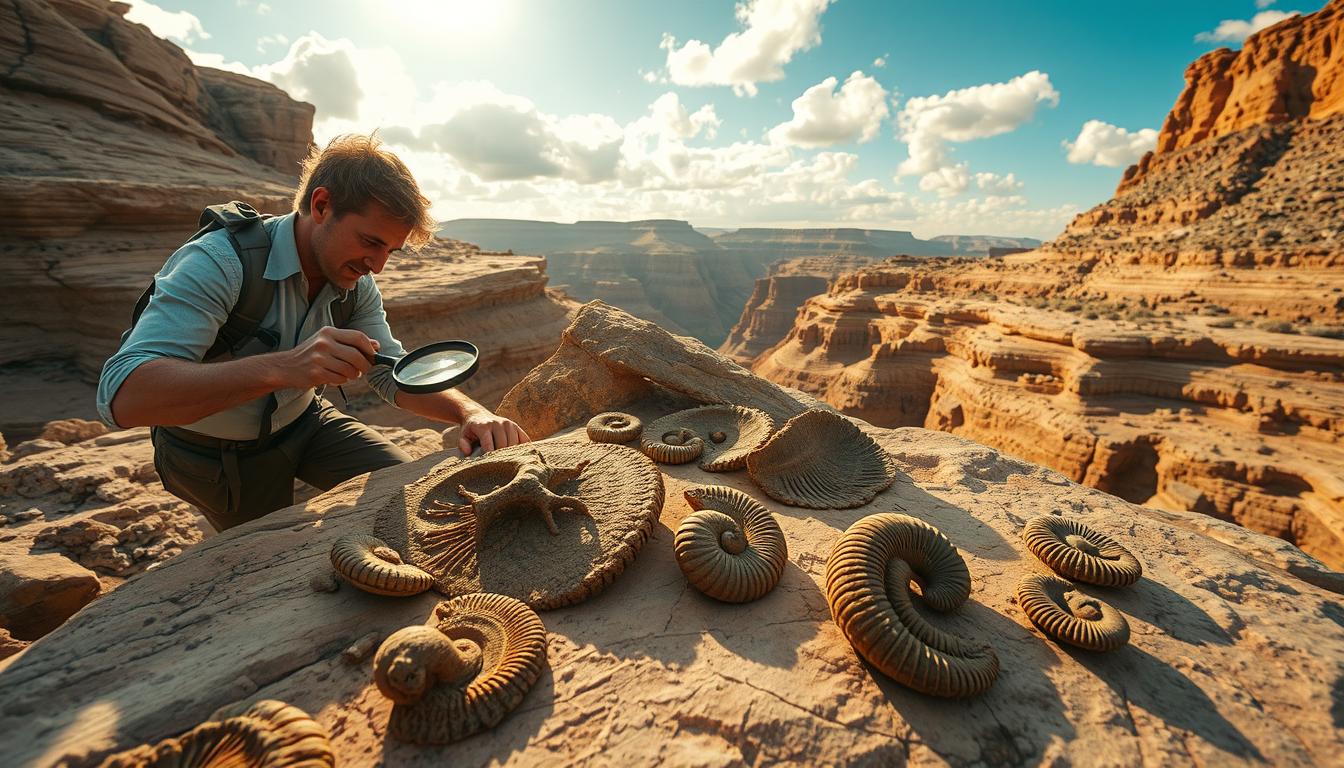
Fossil identification is key to understanding Earth’s history. By studying fossils found in the field, scientists learn about the planet’s past. This includes how different species evolved and their environments.
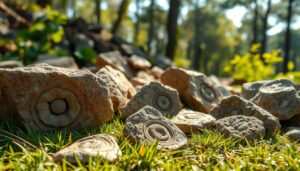
Fossils can be identified by their shapes and features. For example, circular fossils might be from crinoid columnals or horn corals. More details on identifying fossils by shape are in geological resources.
This article will explore field fossil hunting techniques. It will also guide you on recognizing common fossils.
Key Takeaways
- Understanding fossil shapes is key for identification.
- Different fossils have unique features, like circular or spiral shapes.
- Field fossil hunting needs knowledge of common fossil types.
- Fossil identification sheds light on Earth’s history.
- Many techniques help identify fossils in the field.
Understanding Fossils: What to Look For
To find fossils, you need to know what they look like. Fossils are the remains or traces of life from long ago.
Fossils come in many forms, each telling a story of Earth’s past. Knowing these types helps with fossil recognition.
Common Types of Fossils
Fossils are mainly two types: body fossils and trace fossils.
Body Fossils
Body fossils are parts of the organism, like bones or leaves. They show what the organism looked like.
Trace Fossils
Trace fossils are marks left by organisms, like footprints. They tell us about the organism’s life.
| Fossil Type | Description | Examples |
|---|---|---|
| Body Fossils | Remains of the organism | Bones, leaves, shells |
| Trace Fossils | Impressions or tracks left by organisms | Footprints, burrows, feces |
The Fossilization Process
Fossilization is a long process. It includes being buried, compacted, and mineralized. Knowing this helps in identifying fossils tips.
Distinguishing Fossils from Rocks
Finding fossils can be hard because they look like rocks. But, fossils have special textures or patterns.
Learning about fossils and how they form helps you find them. This knowledge, with practice, increases your chances of finding important fossils.
Essential Tools for Fossil Identification
Finding fossils needs the right tools and skills. Fossil hunting is fun, mixing adventure, science, and history. To enjoy your fossil hunt, you need the right gear.
Basic Field Equipment
The right tools help you find and identify fossils. You’ll need both tools for collecting and for looking at fossils.
Collection Tools
Collection tools help you get fossils from the ground safely. You’ll need:
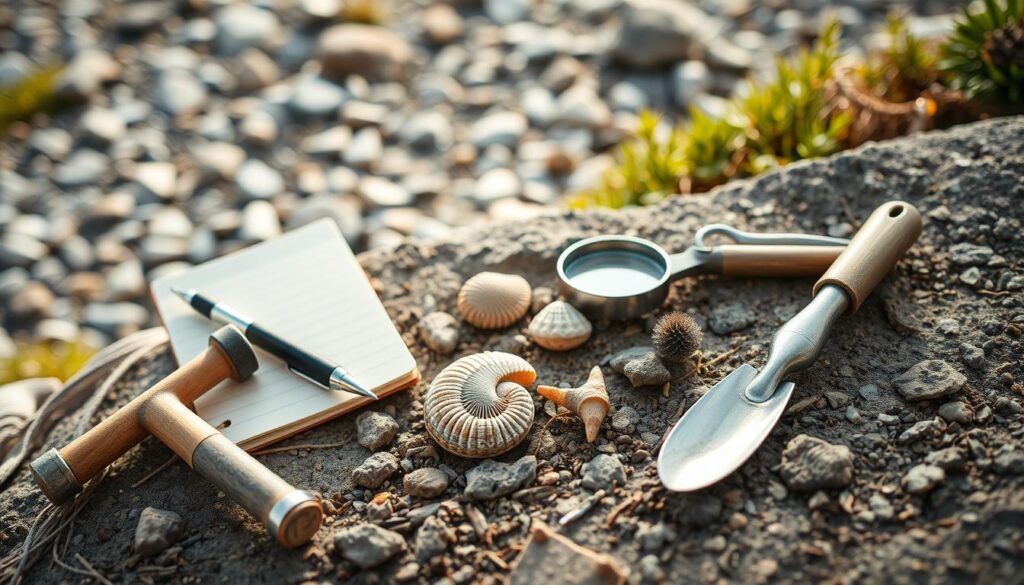
- Rock hammer or geologist’s hammer
- Chisels
- Brushes
- Sample bags
For more info on collecting fossils, check this guide on fossil collection and identification.
Examination Tools
Examination tools let you look closely at your fossils. You’ll need:
- Hand lens or magnifying glass
- Measuring tape or calipers
- Field guide or reference books
Documentation and Recording Methods
Keeping records is key for tracking your finds and studying them. This includes field notes and photos.
Field Notes and Measurements
Writing down field notes and measurements is important. Note the location, date, and any observations about the fossil.
Photography Techniques
Photography is vital for documenting fossils. It helps capture detailed images for later study. Use a camera with good macro features and take photos from different angles.
How to Identify Fossils in the Field: Step-by-Step Guide
Finding fossils needs knowing what they look like and following a guide. When you search for fossils, it’s key to do it right. This means following a clear plan to make sure you identify them correctly.
Initial Visual Assessment
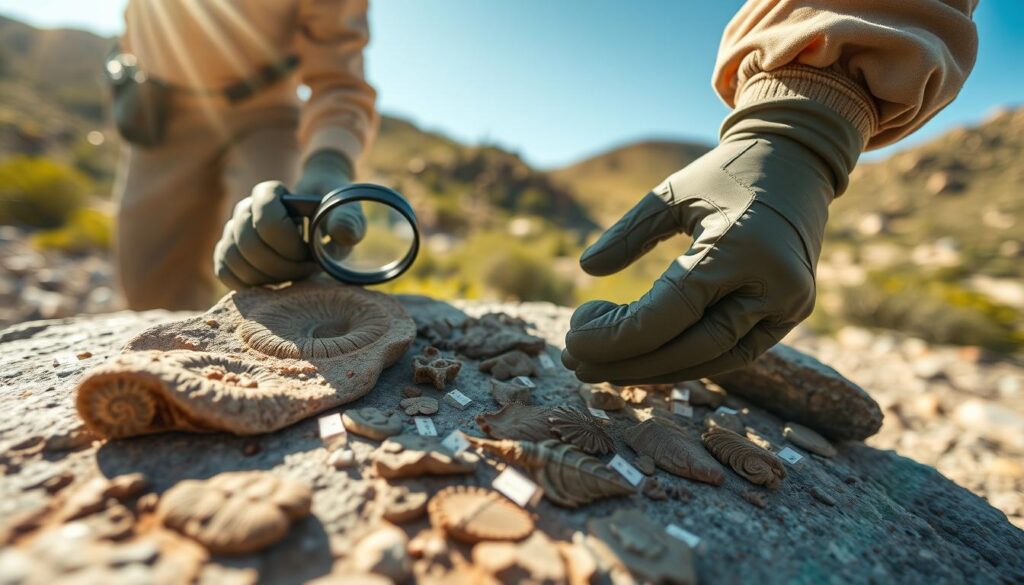
The first thing to do is look closely at the fossil. Check its shape, pattern, color, and texture.
Shape and Pattern Recognition
It’s important to notice the fossil’s shape and pattern. These can tell you what it is. For example, trilobite fossils have a special three-lobed shape. You can learn more about how fossils get shaped on the National Park Service’s educational resource.
Color and Texture Analysis
The color and texture of a fossil can also give clues. Fossils might keep their original color or change due to minerals. Texture can be smooth or very detailed, depending on how it was fossilized.
Testing Physical Properties
After looking at it, you can test the fossil’s physical properties. This helps confirm what it is.
Hardness and Density Tests
Hardness and density tests are useful. Fossils can be harder or softer than the rock around them. Their density can also vary, like fossils with more iron being denser.
Chemical Reactions
Some fossils react to chemicals, which helps identify them. For example, fossils with calcium carbonate react to hydrochloric acid.
Identifying Specific Fossil Groups
Fossils are grouped into invertebrate, vertebrate, and plant fossils.
Invertebrate Fossils
Invertebrate fossils, like shells and trilobites, have unique shapes and structures. These help identify them.
Vertebrate Fossils
Vertebrate fossils, like dinosaur bones, are more complex. They need a closer look to identify.
Plant Fossils
Plant fossils, from leaves to tree trunks, are identified by their shape and structure.
Common Misidentifications to Avoid
It’s easy to mistake rocks or other objects for fossils. Avoiding mistakes like this is key. Knowing these common errors helps ensure you identify fossils correctly.
Where to Search for Fossils
To find fossils, you need to know where to look. Their presence is often tied to specific geological formations. Fossil hunting is not just about searching randomly; it’s about knowing the right places to look.
Geological Formations Most Likely to Contain Fossils
Fossils are commonly found in sedimentary rocks like limestone, shale, and sandstone. These rocks are formed through the accumulation of sediment over millions of years. They often contain the remains of ancient plants and animals.
Sedimentary basins and areas around former bodies of water are great for fossil hunting. The layers of sediment in these areas can preserve fossils, making them accessible for discovery.
Best Conditions for Fossil Hunting
The best conditions for fossil hunting include areas with minimal vegetation and significant erosion. This exposes underlying rock layers. Riverbanks, cliffs, and quarries are often rich in fossils due to erosion and exposure of new surfaces.
Notable Fossil-Rich Locations in the United States
The United States is home to many fossil-rich locations. Some of the most notable sites can be found in both the eastern and western parts of the country.
Eastern United States Sites
The Chesapeake Bay region is known for its rich fossil deposits, from the Miocene epoch. Fossils of sharks, rays, and mollusks are commonly found here.
Western United States Sites
Morrison, Colorado, is famous for its Jurassic-era dinosaur fossils. It’s a significant site for paleontologists and fossil hunters alike.
| Location | Fossil Type | Geological Era |
|---|---|---|
| Chesapeake Bay | Sharks, Rays, Mollusks | Miocene |
| Morrison, Colorado | Dinosaur Fossils | Jurassic |
| Badlands, South Dakota | Mammal Fossils | Oligocene |
Conclusion
Finding fossils takes patience, practice, and the right tools. Knowing what to look for and where to search helps uncover ancient secrets. It’s important to recognize different types of fossils.
Effective fossil identification mixes knowledge with fieldwork. This article’s guide helps you learn to identify fossils well. Whether you’re new or experienced, finding fossils is a fun journey of discovery.
FAQ
What are the most common types of fossils found in the field?
In the field, you often find body fossils like shells, bones, and leaves. Track fossils, such as footprints and burrows, are also common. These fossils tell us a lot about Earth’s past and the creatures that lived here.
How can I distinguish fossils from ordinary rocks?
Fossils have unique textures, shapes, and patterns. They often show shell impressions or bone structures. Fossils are usually found in certain types of rocks, like sedimentary ones.
What are the essential tools for fossil identification?
For identifying fossils, you need a hand lens, a rock hammer, and a geological pick. A camera and notebook are also key for documenting your finds.
How do I properly document and record fossils in the field?
To document fossils well, take clear photos and make detailed notes. Record precise measurements too. This helps identify the fossils and tells us where they were found.
What are some common misidentifications to avoid when identifying fossils?
Avoid mistaking concretions or other rocks for fossils. Also, be careful of weathering or erosion, which can change a fossil’s look.
Where are the best places to search for fossils in the United States?
Look for fossils in areas with exposed sedimentary rocks. The Badlands of Montana, Wyoming’s fossil beds, and California’s coastal cliffs are great spots.
What are the best conditions for fossil hunting?
For fossil hunting, look for areas with little vegetation and exposed rock. Places with a history of fossil finds are also good.
How can I improve my fossil identification skills?
To get better at identifying fossils, practice and gain experience. Study fossil collections, get advice from experts, and use reference materials to learn more.

Subscribe to Our Newsletter