
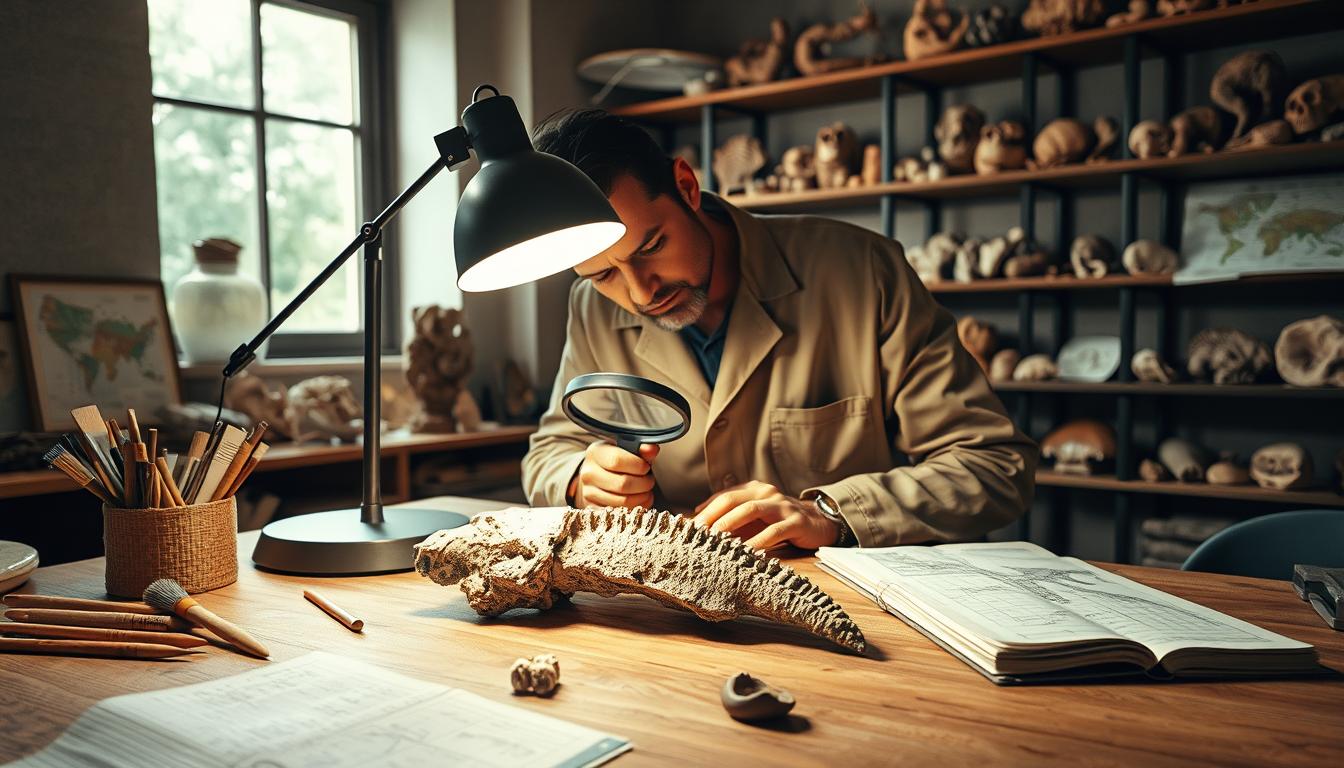
Fossils give us a peek into Earth’s past. They show us how life evolved and what ancient worlds were like. The fossil identification process is detailed and uses many techniques. By learning how to identify fossils, we can better understand history and the work of paleontologists.
Paleontologists check the weight, color, surface texture, and porosity of fossils. For instance, fossil bones are often heavier and have unique textures. These methods help paleontologists figure out if something is a fossil. For more details, check out the Academy of Natural Sciences guide.
Key Takeaways
- Fossils are identified by their weight, color, surface texture, and porosity.
- A fossil bone is typically heavier than a normal bone.
- Fossils may have a distinct texture or pattern.
- Paleontologists use a range of methods to identify fossils.
- Fossil identification is a complex process that requires careful examination and analysis.
The Science Behind Fossil Formation and Preservation
Fossils are made through complex geological steps. These steps include permineralization, petrification, and making molds, casts, and impressions.
Types of Fossilization Processes
Fossilization happens in a few ways. Permineralization and petrification are key. Minerals fill in the organism’s spaces, replacing the original material.
Permineralization and Petrification
Permineralization lets minerals fill the organism’s spaces. Petrification replaces the original material with minerals. This keeps the organism’s shape and details.
Molds, Casts, and Impressions
Molds are left when the original material breaks down. Casts are when sediment or minerals fill these molds. Impressions are the organism’s surface details left on the sediment.
Factors Affecting Fossil Preservation
Many things affect how fossils are preserved. Oxygen levels, sediment type, and pressure are important. Low oxygen and quick burial help fossils form.
Geological Context and Stratigraphic Dating
Knowing the geological setting and dating is key. Stratigraphic dating looks at rock layers to figure out when fossils were formed.
Initial Field Identification Techniques
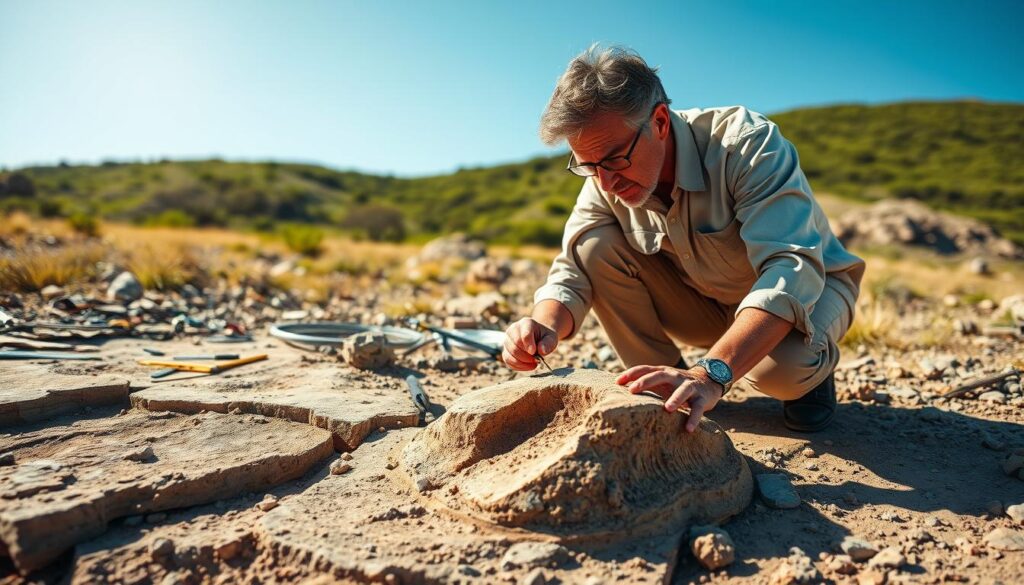
Paleontologists use many ways to find fossils in the field. They start by looking and recognizing patterns. This first step helps them know if it’s a fossil or not.
Visual Assessment and Pattern Recognition
They carefully check the specimen’s shape and feel. They search for signs of life, like shell marks or bone pieces.
Distinguishing Fossils from Rocks
Finding fossils among rocks is a big challenge. Fossils often have special textures or patterns that rocks don’t have.
For example, fossils might have:
- Strange shapes or structures
- Patterns of growth or segmentation
- Textures that look like living tissues
Identifying Biological Structures
Spotting biological signs in a fossil is key. This means looking for:
- Cell or tissue signs
- Features unique to certain groups
- Signs of growth or development stages
Field Testing Methods
Paleontologists also do simple tests in the field. These tests help confirm if it’s a fossil. They might scratch or use acid to check what it’s made of.
Documentation and Collection Protocols
After finding a fossil, it’s important to document and collect it right. They record where it was found, how it’s positioned, and any geological details.
Good documentation and collection keep the fossil’s scientific value safe.
How Paleontologists Identify Fossils in Laboratory Settings
Paleontologists use many methods to study fossils in labs. Labs offer a safe place to examine fossils closely. They use different techniques to learn about them.
Cleaning and Preparation Procedures
The first step is cleaning and preparing the fossil. This means removing rock or dirt that hides the fossil. Specialized tools and techniques help avoid damaging it.
- Mechanical cleaning using brushes and picks
- Chemical cleaning using acids and solvents
Microscopic Examination Techniques
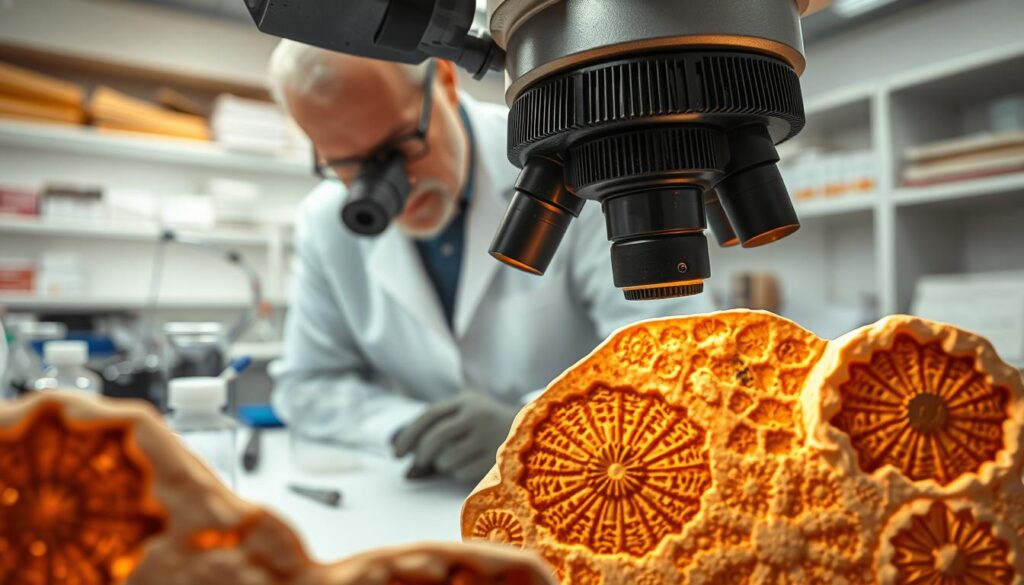
After preparation, scientists look at the fossil under a microscope. This helps them see details about the fossil’s identity and past.
Surface Features and Microstructures
Microscopic study shows texture and pattern on the fossil’s surface. It also reveals tiny structures like cells.
Growth Patterns and Cellular Details
Studying growth patterns and cells gives clues about the fossil’s life and evolution.
Chemical Analysis Methods
Chemical tests help figure out what the fossil is made of. This tells us about its age and where it came from.
Elemental Composition Tests
Methods like X-ray fluorescence (XRF) and energy-dispersive spectroscopy (EDS) check the fossil’s makeup.
Isotope Analysis for Age and Environment
Isotope analysis, like radiocarbon dating, tells us when the fossil was formed. It also shows the environment it lived in.
| Analysis Technique | Information Provided |
|---|---|
| XRF | Elemental composition |
| Stable Isotope Analysis | Environmental conditions |
Taxonomic Classification Systems
Taxonomic classification helps us understand life on Earth, including fossils. It groups fossils into categories. This lets paleontologists learn about evolution, ancient ecosystems, and Earth’s history.
Morphological Identification Criteria
Morphological identification looks at a fossil’s shape and structure. It compares these with known fossils. This helps figure out what kind of fossil it is.
Comparative Anatomy Approaches
Comparative anatomy is key in classifying fossils. It helps scientists find similar structures. This shows how different creatures are related.
Reference Collections and Type Specimens
Type specimens are important in classification. They are the main example of a species. Other fossils are compared to them.
Evolutionary Relationships
Knowing how fossils are related is vital. Scientists study their shapes and structures. This helps build family trees of fossils.
Handling Fragmentary and Incomplete Specimens
Working with broken fossils is tough. But, new methods like CT scans help. They let scientists study and analyze these fossils.
Advanced Technologies in Modern Fossil Identification
Advanced technologies are changing how we find and study fossils. New tools and methods make it easier to look at fossils closely. This helps us learn more about ancient life.
CT Scanning and 3D Modeling
CT scanning and 3D modeling are key in fossil study. They let us see inside fossils without touching them. This makes detailed digital models for study.
DNA and Protein Residue Analysis
Studying DNA and protein residues in fossils is new. It helps us understand how life evolved. Even though DNA breaks down, new ways can find and study it in fossils.
AI and Machine Learning Applications
AI and machine learning help in fossil study. They can look at lots of data to find patterns. This helps researchers who might miss these patterns.
Automated Pattern Recognition
AI is great for finding patterns in fossils. It can learn to spot certain features. This makes finding fossils faster.
Big Data in Paleontological Research
Big data is changing fossil study. It lets us see trends and patterns. This gives us insights into ancient life and ecosystems.
Thanks to these new technologies, we can learn more about fossils. This helps us understand Earth’s history better.
[link-whisper-related-posts]Conclusion: The Evolving Science of Fossil Identification
The science of finding fossils is always changing. New tech and methods help us learn more about Earth’s past. Fossils show us life on Earth long ago.
At first, we find fossils in the field. Then, we study them in labs. This process is very detailed.
New tools like CT scans and DNA tests help us understand fossils better. These tools show us how life has changed over time. They help us see the history of life on Earth.
As we keep learning, we’ll know more about fossils. By looking at fossil resources, we can appreciate this science more. It helps us understand our planet’s history.
FAQ
What is the first step in identifying a fossil?
The first step is to look at the fossil. Paleontologists check its shape and compare it to known fossils.
How do paleontologists distinguish fossils from rocks?
They look for signs of life. This includes texture, pattern, and structure that show it’s biological.
What is the role of geological context in fossil identification?
Knowing the rock type and where it’s found helps. It tells us the fossil’s age and importance.
What are some common techniques used in laboratory fossil identification?
In the lab, they use microscopes, chemical tests, and cleaning. These help reveal the fossil’s details.
How do paleontologists handle fragmentary or incomplete fossils?
They use what they can see to guess the fossil’s identity. They try to imagine what it looked like whole.
What is the significance of CT scanning in fossil identification?
CT scans let them see inside fossils without touching. It shows their inner structure and what they’re made of.
Can DNA analysis be used to identify fossils?
Yes, for recent fossils. But DNA breaks down over time, so it’s not always possible.
How do AI and machine learning contribute to fossil identification?
AI helps by looking at lots of data. It finds patterns that help identify fossils and discover new species.
What is the importance of reference collections in fossil identification?
They help by comparing fossils to known ones. This helps paleontologists figure out what a fossil is.
How do paleontologists determine the age of a fossil?
They use rock layers and fossils found with it. This method helps figure out when the fossil lived.

Subscribe to Our Newsletter