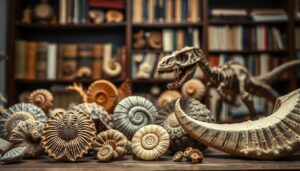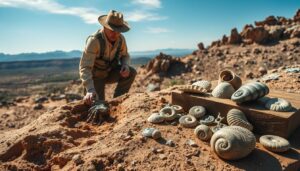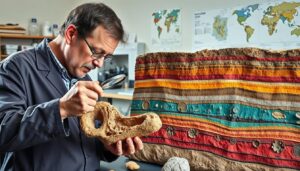
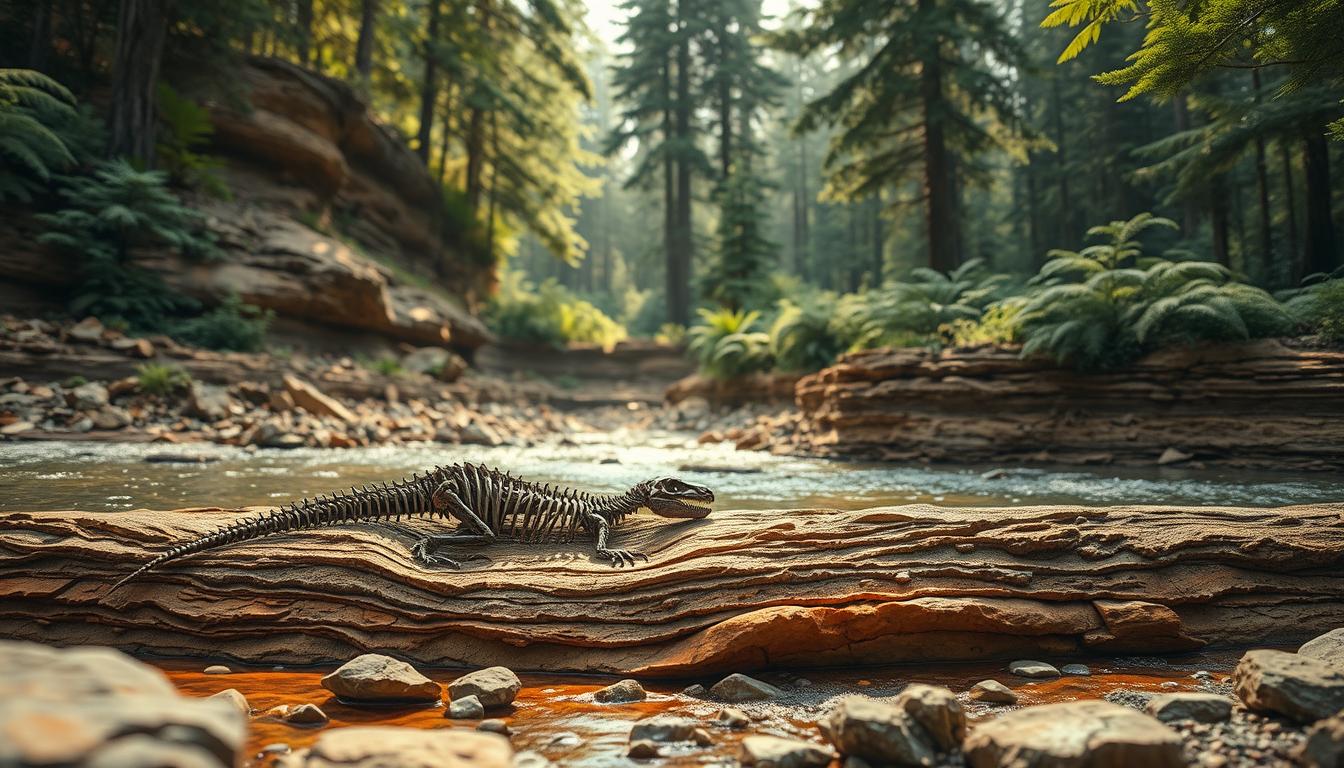
The fossilization process is complex and has many stages. It keeps the remains or traces of past life in the Earth’s rocks.
The fossilization process starts with an organism’s death and burial. Then, minerals replace the original tissues. This creates fossils through different ways, like permineralization and impression.
Key Takeaways
- Fossils are the remains or traces of past life preserved in the Earth’s geological record.
- The fossilization process involves multiple stages, including death, burial, and mineral replacement.
- Fossils can be formed through various mechanisms, such as permineralization and impression.
- The fossil record is incomplete and biased toward certain organisms, such as shelled invertebrates.
- Fossils provide a window into the history of life on Earth, showing us evolution and past ecosystems.
The Science Behind Fossilization
Fossilization is a complex process that involves many geological and biological steps. It’s a rare event that gives us a peek into Earth’s past.
Defining Fossils and Their Significance
Fossils are the remains or traces of ancient life, like plants, animals, and tiny organisms. They can be shells, teeth, bones, or even bacteria. Fossils are important because they let us see how life on Earth has changed over time.
Types of Fossil Evidence
Fossil evidence can take many forms, including:
- Body fossils: remains of organisms, such as bones or leaves
- Track fossils: impressions or tracks left by organisms
- Chemical fossils: chemical signs of past life
The Rarity of Fossil Formation
Fossil formation is rare because it needs specific conditions for fossilization to happen. Most organisms break down or get eaten, leaving no trace.
Why Most Organisms Never Fossilize
| Condition | Description |
|---|---|
| Rapid Burial | Organisms must be quickly buried to prevent scavenging and decomposition. |
| Low Oxygen Environment | A low oxygen environment slows down decomposition. |
| Presence of Minerals | Minerals are necessary for the replacement of original organic material. |
Knowing these conditions makes us appreciate fossils and the fossilization process more. It helps us understand Earth’s history better.
How Fossils Form Over Time: The Basic Process
Fossilization is a complex process with several stages. These stages transform organic remains into fossils. Knowing these stages helps us understand how fossils are formed over time.
Death and Rapid Burial
The first step is when an organism dies and is quickly buried. This fast burial protects the remains from scavengers and decay.
Protection from Scavengers and Decomposition
Quick burial keeps the organism safe from scavengers and oxygen. These are key to decay. Being buried fast boosts the fossilization chances.
Compaction and Cementation
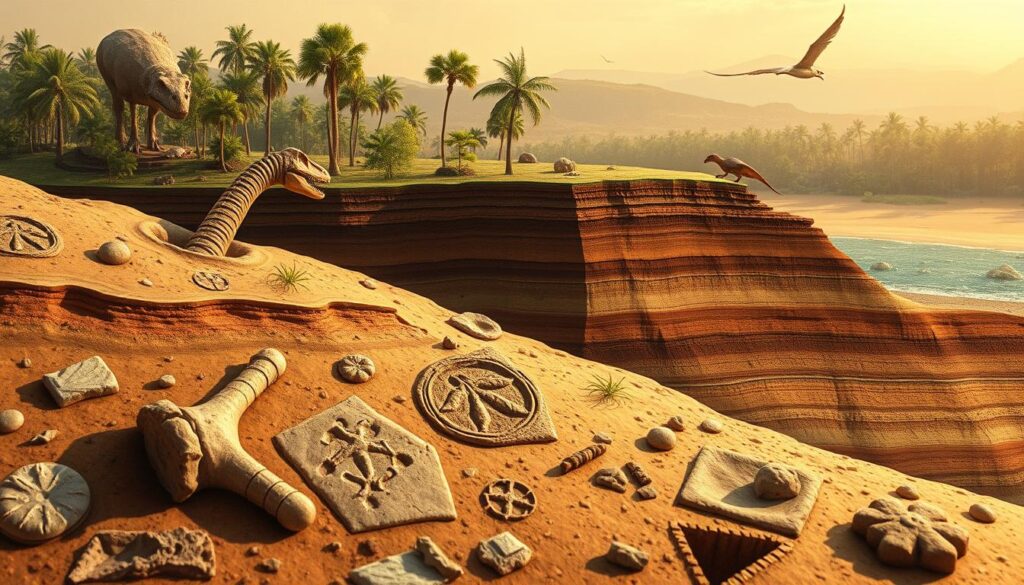
More sediment layers pile up, compacting the lower ones. Cementation happens when minerals fill the gaps between grains. These steps help keep the fossil intact.
Mineralization and Replacement
Mineralization happens when mineral-rich groundwater flows through. These minerals can replace the original material, making a fossil that looks like the organism.
The Role of Groundwater
Groundwater is vital in mineralization. It carries minerals that can fill in and preserve the organism’s structure.
The fossilization process, from death to mineralization, can take thousands to millions of years. Learning about these stages helps us understand the fossilization timeline and how fossils are part of sedimentary rock formation.
Types of Fossilization Processes
Fossilization isn’t just one thing. It’s many processes that keep ancient life forms alive. These processes show how different conditions can preserve life.
Permineralization
Permineralization happens when mineral-rich water flows through sediment. It fills the tiny spaces in an organism’s remains with minerals. This makes detailed, three-dimensional fossils.
Carbonization and Compression
Carbonization turns organic material into a thin carbon film. It’s common in plants and high-carbon organisms. Compression flattens the remains, keeping the original shape.
Molds and Casts
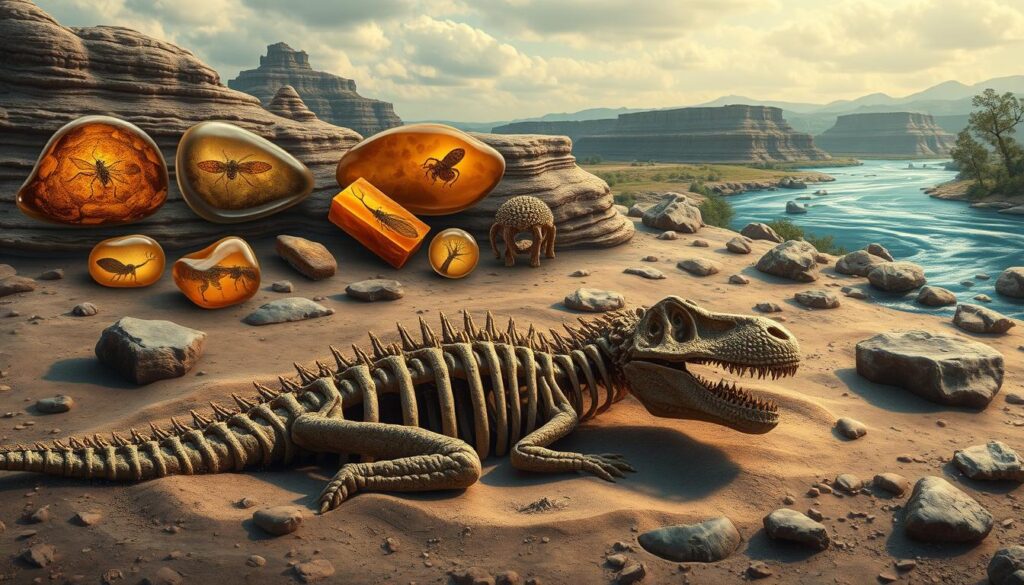
Molds form when the original material dissolves, leaving a shape. If sediment fills this shape, it becomes a cast. This gives a three-dimensional view of the organism. For more on fossils and evolution, visit evidence for evolution.
Trace Fossils
Trace fossils aren’t the remains of organisms. They show what organisms did. This includes footprints, burrows, and more.
Footprints, Burrows, and Other Evidence
Footprints and burrows tell us about ancient life. They show how organisms lived and interacted with their world.
The many fossilization processes and fossils they create are key to understanding Earth’s history. By studying these, scientists learn about the past’s conditions and environments.
The Timeline of Fossil Formation
Learning about fossil formation is key to understanding how fossils are made. Fossils don’t form quickly. Their creation takes a series of steps that happen over different times.
Short-Term Processes (Decades to Centuries)
In rare cases, fossils can form fast. This happens when landslides or floods quickly cover organisms. This quick burial helps protect them from decay and oxygen.
Medium-Term Processes (Thousands of Years)
After thousands of years, remains change a lot. This is because of compaction and cementation. These changes help turn sediment into rock. During this time, the original material might be replaced, leaving a fossil behind.
Long-Term Processes (Millions of Years)
Most fossils take millions of years to form. This long time lets geological processes slowly replace the original material with minerals. This slow process is why some fossils are so well-preserved.
Tectonic Activity and Fossil Exposure
Tectonic activity is important for finding fossils. As the Earth’s crust changes, fossils buried deep can be uncovered.
The timeline of fossil formation shows how complex and varied geological processes are. By studying these processes, we learn about Earth’s history and life.
Environmental Factors Affecting Fossilization
The conditions around an organism’s death are key to fossilization. Many environmental factors influence this process.
Where an organism dies and is buried affects its chance of fossilization. Different places have unique features that help or hinder fossilization.
Sedimentary Environments
Sedimentary environments are key for fossilization. These include places where sediments settle.
Lakes, Rivers, and Marine Settings
Lakes, rivers, and seas are major sedimentary environments. They help with quick burial, which is vital for fossilization. For example, river deltas and seas have lots of sediment, making fossilization more likely.
Chemical Conditions
Chemical conditions are also important. Minerals and the environment’s pH level can preserve or damage organic remains. Low oxygen levels can slow decay, helping fossils form.
Biological Activity
Biological activity is another key factor. Microorganisms can break down or preserve fossils. They can slow decay, helping fossils last longer.
Impact of Microorganisms
Microorganisms can help or harm fossilization. They can break down matter, but also change the environment to help fossils form.
Knowing these environmental factors helps us understand fossilization. By studying them, paleontologists learn about the conditions that create fossils worldwide.
Exceptional Fossil Preservation Methods
For fossils to last millions of years, special conditions are needed. Certain places have created unique ways to keep fossils intact. This lets us see even the smallest details.
Amber Preservation
Amber, a sticky tree resin, is great for keeping fossils safe. It catches small creatures like insects. This keeps them from rotting away.
Tar Pits and Asphalt Seeps
Tar pits and asphalt seeps trap animals in oil. This has helped keep many fossils of big animals well-preserved.
Permafrost and Ice
Permafrost and ice help keep fossils safe, like in Siberia and Alaska. The cold slows down decay. This lets soft tissues stay intact.
Anoxic Environments
Places without oxygen help fossils last longer. This is because there’s less decay. You can find these places at the bottom of deep water.
Lagerstätten: Extraordinary Fossil Sites
Lagerstätten are special places with lots of fossils. They give us a deep look into Earth’s past. They show us how life has changed over time.
[link-whisper-related-posts]Conclusion: What Fossils Tell Us About Earth’s History
Fossils give us a peek into Earth’s past. They show how life has changed over time. Learning about fossilization and how sites form is key to understanding history.
Studying fossils helps us see how life has evolved. It also shows us how the environment has changed. The process of fossil formation is complex, involving many factors.
Fossils are important for learning about Earth’s history. They help us understand ancient species and past ecosystems. By studying fossils, we can uncover more about our planet’s past.
FAQ
What is the fossilization process?
The fossilization process is how life from the past gets preserved in Earth’s rocks. It needs quick burial, pressing down, and minerals to happen.
Why is fossil formation a rare occurrence?
Fossil formation is rare because it needs special conditions. These include quick burial, little oxygen, and minerals. Most life gets eaten or breaks down.
What is the role of groundwater in the fossilization process?
Groundwater is key in fossil formation. It brings minerals that fill in the original material, making a fossil. These minerals also help keep the fossil details.
What are the different types of fossilization processes?
There are many fossilization ways, like permineralization and carbonization. Each happens under different conditions and keeps different kinds of evidence.
How do sedimentary environments affect fossilization?
Places like rivers and oceans help fossils form. They provide the right conditions for burial and mineralization. The type of sediment and environment’s energy level matter too.
What are Lagerstätten, and why are they significant?
Lagerstätten are special fossil sites. They have rare and important fossils under unique conditions. They let scientists study life’s evolution and Earth’s history in detail.
How do tectonic activities affect the exposure of fossils?
Earthquakes and mountain building can uncover fossils. They lift and erode rocks, making fossils easier to find and study.
What can fossils tell us about Earth’s history?
Fossils show us life’s evolution on Earth. They help scientists understand our planet’s history. They also tell us about past environments and climates.

Subscribe to Our Newsletter