Geologists need to know the Earth’s history, and fossil dating methods are key. Fossils show us what life was like long ago.
Dating and classifying fossils helps us learn about Earth’s past. Geologists use relative dating fossils and absolute dating fossils to figure out how old they are.
Key Takeaways
- Fossil dating methods help geologists understand the Earth’s history.
- Relative dating fossils determine the age of fossils relative to other fossils.
- Absolute dating fossils provide a precise age of the fossils.
- Fossil classification techniques help in understanding the evolution of species.
- Fossils are typically found in sedimentary rocks.
The Science Behind Fossil Preservation
Fossils are preserved through geological processes. This helps us learn about life on Earth.
Types of Fossil Preservation
Fossils are preserved in different ways. Each method gives us special insights into the past.
Permineralization and Petrification
Permineralization happens when minerals fill the spaces in an organism’s remains. This creates a detailed picture of the original structure. Petrification is when the original material is replaced with minerals, turning it into stone. For more on dating rocks and fossils, check out Nature’s Scitable.
| Process | Description |
|---|---|
| Permineralization | Minerals fill the spaces within the organism’s remains. |
| Petrification | Original material is replaced with minerals. |
Fossils can also be preserved as molds, casts, or impressions. These give us important info about ancient life forms.
Principles of Relative Dating in Paleontology
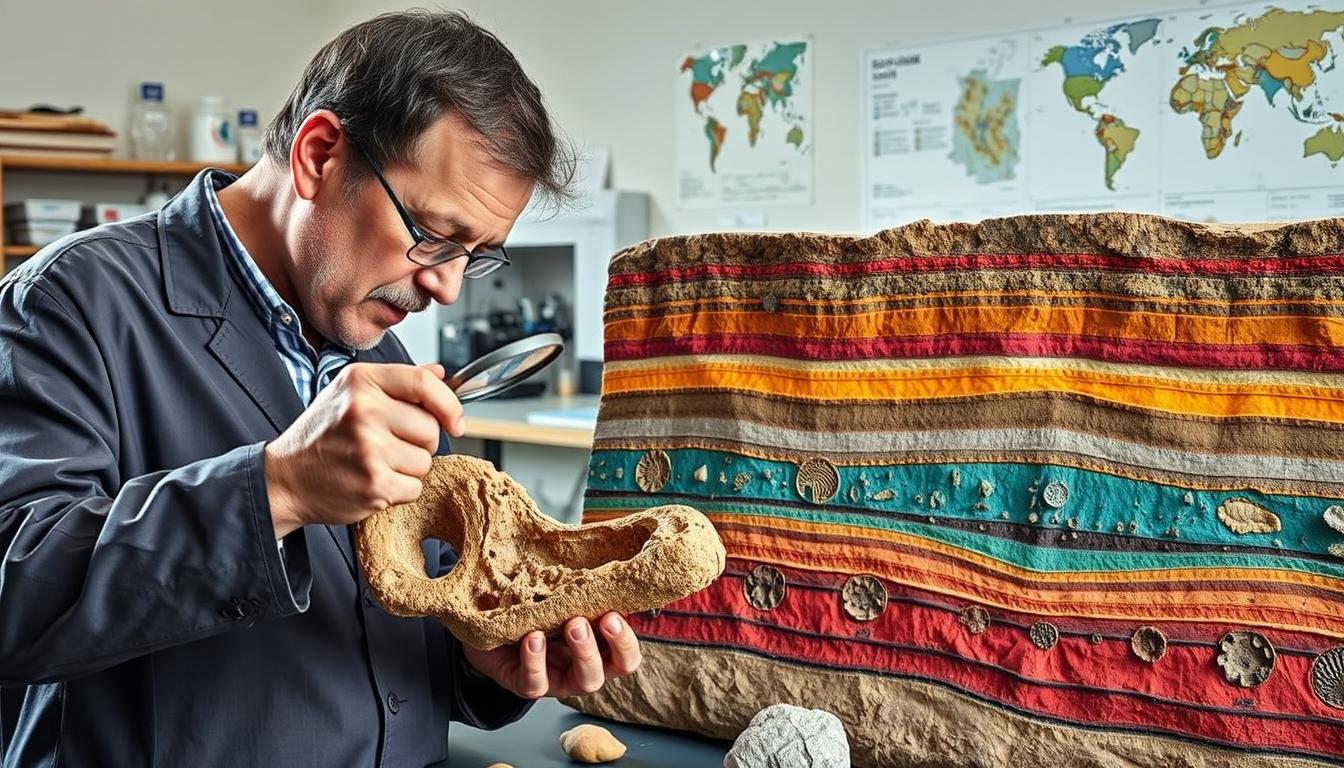
For paleontologists, knowing how to date fossils is key. They use relative dating to figure out when fossils lived. This method compares the age of a fossil to others in the same or nearby rocks.
The law of superposition is a big deal. It says that in any rock layer, the oldest is at the bottom and the youngest is at the top. This helps paleontologists arrange fossils in order of age.
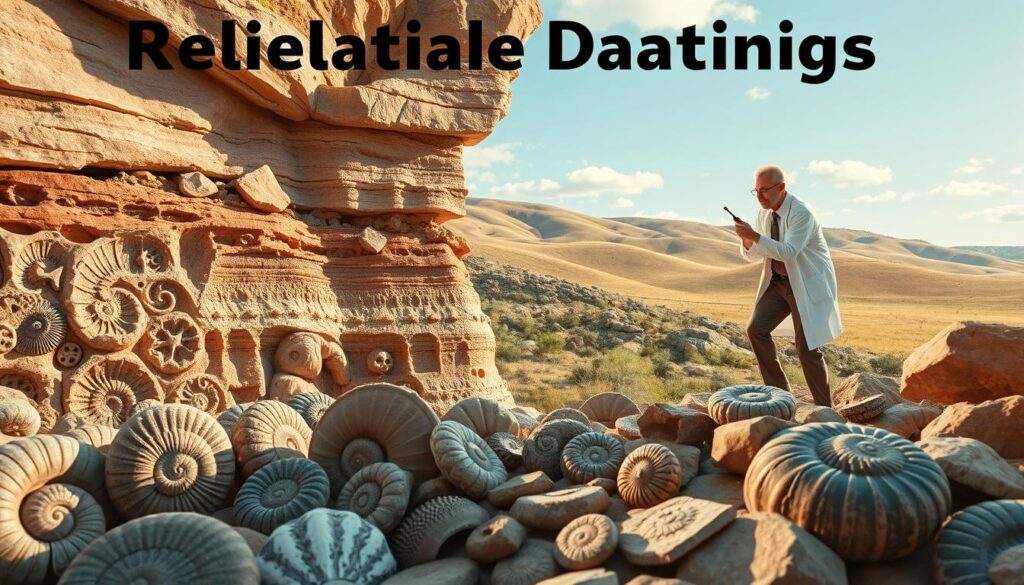
Fossil succession is also important. Certain fossils only lived during specific times. These fossils help date the rock layers they’re found in.
| Method | Description | Application |
|---|---|---|
| Stratigraphy | Study of rock layers | Determining the age of fossils relative to the layer they are found in |
| Fossil Succession | Using fossils as markers for specific time periods | Correlating rock layers across different locations |
| Biostratigraphy | Dating rock layers based on the fossils they contain | Establishing a timeline of fossilized organisms |
Biostratigraphy uses fossil succession to date rocks. By finding the fossils in a rock layer, scientists can tell when it was formed. This helps them create a timeline of when different fossils lived.
Absolute Dating Methods for Fossils
Fossils can be dated in years using different methods. Radiometric dating is a main way to figure out how old fossils are. It looks at how radioactive isotopes change into stable ones.
Radiocarbon dating is for organic remains up to 50,000 years old. It tracks the change of carbon-14 into nitrogen-14.
Potassium-Argon dating is for older rocks and minerals with potassium. It sees how potassium-40 turns into argon-40. This helps date fossils from long ago.
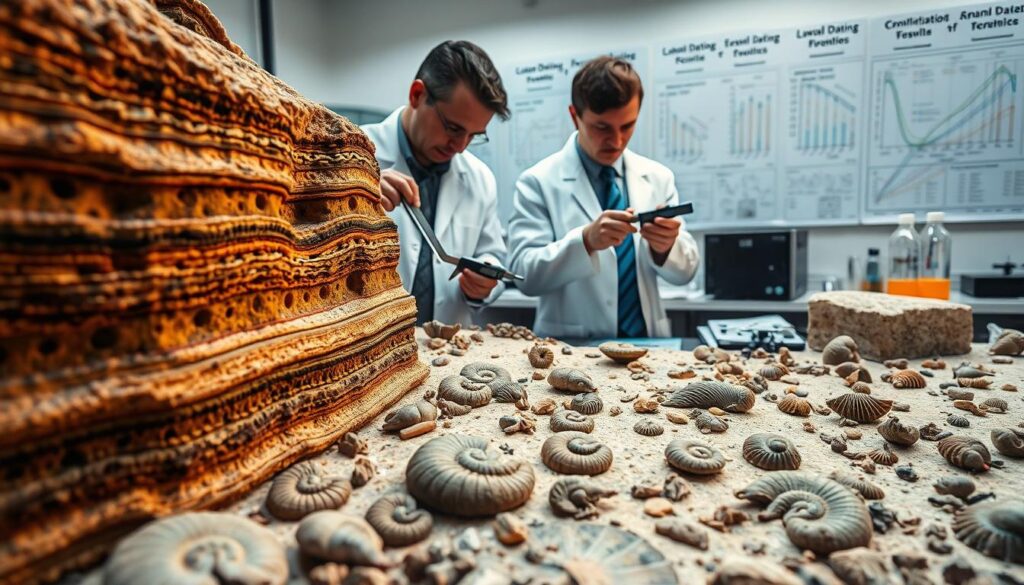
These methods have really helped us learn about Earth’s history. They give fossils exact ages. This lets scientists build timelines of life’s changes and understand Earth’s past better.
Now, absolute dating is key in modern paleontology. It makes studying fossils more precise and detailed.
How Fossils Are Dated and Classified in Modern Paleontology
In modern paleontology, we use many dating and classification methods. These help us understand Earth’s history better. They let us see how life on Earth has changed over time.
Fossil dating methods have gotten better. Now, we use radiometric dating, potassium-argon dating, and uranium-lead dating. These methods help us know the age of fossils more accurately.
Classifying fossils is also key. We use taxonomic classification systems to group them by their evolutionary ties. Today, we use computers and big databases to classify fossils quickly and accurately.
| Dating Method | Application | Age Range |
|---|---|---|
| Radiometric Dating | Determining the age of rocks and fossils | 10,000 to 4.5 billion years |
| Potassium-Argon Dating | Dating volcanic rocks and minerals | 10,000 to 2.5 billion years |
| Uranium-Lead Dating | Dating zircon crystals and other minerals | 1 million to 4.5 billion years |
By mixing these dating methods with advanced classification, modern paleontology keeps improving our knowledge. We learn more about Earth’s history and how life evolved.
Taxonomic Classification Systems for Fossils
Taxonomic systems for fossils have changed a lot. They use new methods and tech to better understand fossils. Classifying fossils is complex. It groups organisms by their shared traits, like shape and body structure.
TheLinnaean systemis a common way to classify. It puts organisms into groups like kingdom, phylum, and species. This helps us see how different life forms are related and their history.
Cladisticsis also key in classifying fossils. It groups organisms by their unique traits. This shows how they evolved together.
Using these systems helps a lot. They let us identify and sort fossils. They also help us see how life evolved over time. By using these systems, scientists learn more about Earth’s past.
Practical Applications of Fossil Dating and Classification
Fossil dating and classification help in many areas like geology, biology, and conservation. They are key in building pictures of ancient ecosystems. This helps scientists see how life on Earth has changed over time.
Classifying fossils is also very important. It helps researchers understand how different species are related. They can make trees showing how species evolved.
Fossil dating and classification also help in today’s conservation work. Scientists learn from the fossil record how ecosystems have changed before. This knowledge helps in making better conservation plans.
Also, studying fossils has taught us a lot about Earth’s history. It shows how landscapes formed and how big events affected the planet.
[link-whisper-related-posts]Conclusion: The Future of Fossil Dating and Classification
Technology keeps getting better, and so does fossil dating and classification. Scientists will learn more about Earth’s history.
The future looks bright for studying fossils. New methods will change how we see the past.
Geochemistry and computer simulations will help a lot. They will make dating fossils more accurate.
Classification will also get a boost. New ideas in taxonomy and systematics will help us understand ancient life better.
As we learn more, we’ll value Earth’s history more. We must keep this history safe for those who come after us.
FAQ
What is the difference between relative and absolute dating methods?
Relative dating finds a fossil’s age by comparing it to other fossils in the same layer. Absolute dating gives a fossil’s exact age in years.
How does stratigraphy help in dating fossils?
Stratigraphy studies rock layers. It uses the law of superposition to date fossils. This law says older layers are buried under younger ones.
What is permineralization and how does it preserve fossils?
Permineralization fills an organism’s remains with mineral-rich water. Over time, it replaces the original material, making a detailed fossil.
What is the role of biostratigraphy in fossil dating?
Biostratigraphy looks at fossil layers. It helps date fossils by linking specific fossils to certain time periods.
How does radiocarbon dating work?
Radiocarbon dating checks the carbon-14 in organic remains. It decays at a steady rate. This lets researchers figure out the sample’s age.
What is the Linnaean system of classification?
The Linnaean system groups organisms by shared traits. It starts with the most general category (domain) and ends with the most specific (species).
How is cladistics used in fossil classification?
Cladistics groups organisms by their evolutionary ties. It uses shared traits to build phylogenetic trees.
What are the practical applications of fossil dating and classification?
Fossil dating and classification help us understand ancient ecosystems and evolution. They also guide conservation efforts.
How do paleontologists integrate multiple dating methods?
Paleontologists use both relative and absolute dating. This gives a clearer picture of a fossil’s age and importance.
What is the significance of fossil succession in biostratigraphy?
Fossil succession is the order of fossils in rock layers. It lets researchers link fossils to time periods, helping us understand Earth’s history.

Subscribe to Our Newsletter