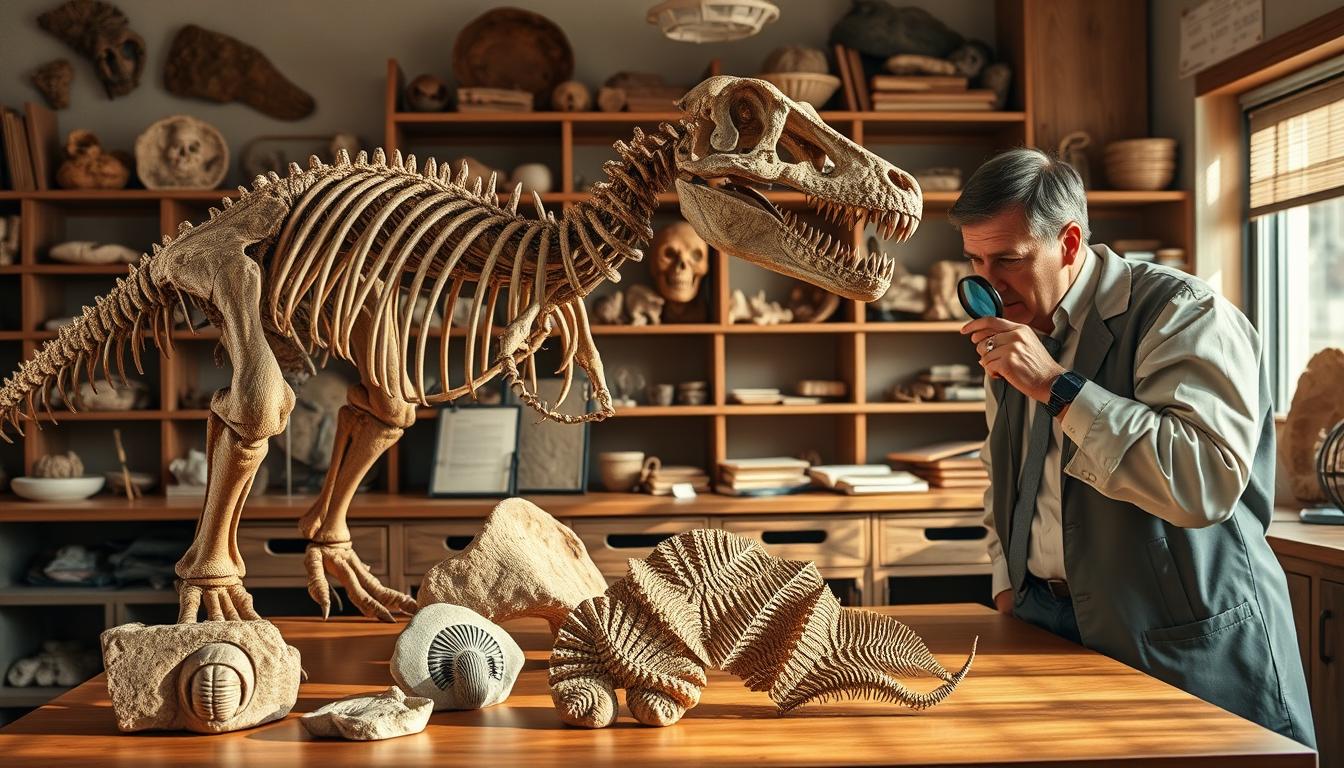
Fossils are the remains or traces of ancient life. They give us a peek into the past. We can learn about life and ecosystems long gone.
Fossil discoveries have greatly helped us understand Earth’s past. By studying fossils, we see how life on our planet evolved.
Paleontology, the study of fossils, is key to knowing our planet’s history. It shows us the variety of ancient life and their habitats.
Key Takeaways
- Fossils are the remains or traces of ancient life forms.
- They provide insights into Earth’s history and ancient ecosystems.
- The study of fossils is known as paleontology.
- Fossil discoveries have contributed significantly to our understanding of the past.
- Paleontology helps us learn about the evolution of life on Earth.
The Science of Fossils: How Ancient Life Became Stone
Fossils are the remains or traces of ancient life. They help us understand Earth’s history. We can learn about the evolution and diversity of life through fossils.
What Exactly Is a Fossil?
A fossil is the remains or impression of an ancient organism. The fossilization process is complex. It involves replacing the original material with minerals from the environment. For more info, check Wikipedia’s Fossil page.
The Fossilization Process Simplified
The fossilization process has several stages. These include permineralization, replacement, and impression. Permineralization happens when minerals fill the organism’s remains.
Replacement occurs when the original material is replaced with minerals. Impression fossils are made when the original material dissolves. This leaves a cavity that can be filled with sediment.
| Fossilization Method | Description | Outcome |
|---|---|---|
| Permineralization | Minerals fill spaces within the organism | Detailed, three-dimensional fossil |
| Replacement | Original material dissolved and replaced with minerals | Fossil retains original structure |
| Impression | Original material dissolves, leaving a cavity | Mold or impression of the organism |
Learning about the science of fossils is key. It helps us understand Earth’s ancient past. By studying fossils, we uncover the secrets of life’s evolution and Earth’s history.
Famous Fossil Discoveries: Milestones in Paleontology
The world of paleontology has seen many key fossil finds. These discoveries have greatly helped us understand Earth’s history. They have also caught the public’s interest and given scientists important insights into life’s evolution.
The First Recognized Dinosaur Fossils
The first dinosaur fossil was found in 1676 by Robert Plot. He was an English naturalist. Though he didn’t know it was a dinosaur, his find was a big step forward.
In the early 19th century, the discovery of Megalosaurus and Iguanodon really helped us understand dinosaurs.
Lucy: Our Ancient Human Ancestor
In 1974, “Lucy,” a 3.2 million-year-old Australopithecus afarensis skeleton, was found. Donald Johanson and his team discovered her in Hadar, Ethiopia. Lucy showed us that early humans walked on two legs.
Archaeopteryx: The Missing Link Between Dinosaurs and Birds
The discovery of Archaeopteryx in 1861 was a big find. It had features of both dinosaurs and birds, like feathers and a wishbone. This fossil helped us see how birds evolved from dinosaurs.
Sue, the T. Rex: Most Complete Tyrannosaurus Ever Found
“Sue,” the most complete Tyrannosaurus rex skeleton, was found in 1990. Sue Hendrickson discovered her in South Dakota. Sue’s skeleton has given scientists a lot of information about T. rex.
Tiktaalik: The Fish That Walked on Land
Tiktaalik was found in 2004 on Ellesmere Island, Canada. It’s a 375 million-year-old fossil that shows the transition from fish to tetrapods. Tiktaalik has helped us understand how vertebrates moved from water to land.
Controversial and Surprising Fossil Discoveries
Some fossil finds have caused debate among scientists. For example, Ardipithecus ramidus and the “Hobbit” (Homo floresiensis) have challenged old theories. They have also shown us more about human evolution and diversity.
| Fossil Discovery | Year Found | Significance |
|---|---|---|
| First Dinosaur Fossils | 1676 | Laid groundwork for understanding dinosaurs |
| Lucy | 1974 | Evidence of bipedalism in early human ancestors |
| Archaeopteryx | 1861 | Link between dinosaurs and birds |
| Sue, the T. Rex | 1990 | Most complete T. rex skeleton, insights into T. rex biology |
| Tiktaalik | 2004 | Transitional fossil between fish and tetrapods |
What Fossils Tell Us About Prehistoric Life
Fossils are more than just old bones. They help us understand how life evolved on Earth. By studying fossils, scientists learn about ancient life, how species changed, and big extinctions.
Reading the Story of Earth’s Past
Fossils tell us about Earth’s history. They help scientists reconstruct the past. By looking at fossils, researchers figure out how old rocks are and what the Earth was like long ago. For more info on paleontology, check out National Geographic’s Paleontology Resource.
Reconstructing Ancient Ecosystems
The fossil record lets scientists build pictures of old ecosystems. They learn about the plants and animals that lived there. This helps them understand how ecosystems have changed and how they might change in the future.
Tracking Evolution Through the Fossil Record
The fossil record shows how life has changed over time. By studying fossils, scientists see how different species evolved. They learn about the changes that led to these developments.
Lessons from Mass Extinctions
Fossils also teach us about big extinctions. These events greatly affected life on Earth. By studying fossils, scientists can figure out why these extinctions happened and what they mean for the future.
| Mass Extinction Event | Time Period | Impact on Life |
|---|---|---|
| Ordovician-Silurian Extinction | 443-485 million years ago | 85% of species eliminated |
| Cretaceous-Paleogene Extinction | 65 million years ago | Dinosaur extinction, 75% of species affected |
Modern Fossil Hunting: Tools and Techniques
Fossil hunting today uses old and new methods. This mix makes finding fossils more precise and quick. It’s a big step forward in paleontology.
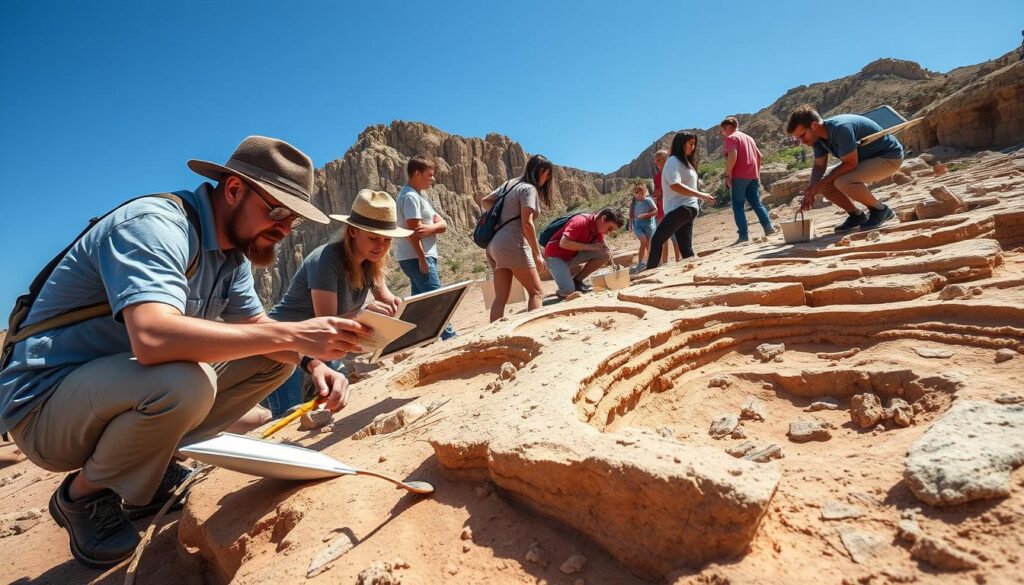
From Pickaxes to CT Scans: How Technology Has Changed Paleontology
Fossil hunting tools have changed a lot. Now, we use CT scans and 3D printing along with pickaxes and shovels. CT scans let us see inside fossils without harming them. 3D printing makes exact copies for study.
- CT scans for internal analysis
- 3D printing for replica creation
- Digital mapping for excavation planning
Where the Best Fossils Are Found
Fossils are found all over the world. But some places are better because of their history. Places with exposed rocks like badlands and deserts have lots of fossils. The Badlands of Montana, the Jurassic Coast in England, and Australia’s deserts are famous for this.
- Badlands of Montana, USA
- Jurassic Coast, England
- Fossil-rich deserts of Australia
The Process of Excavation and Preservation
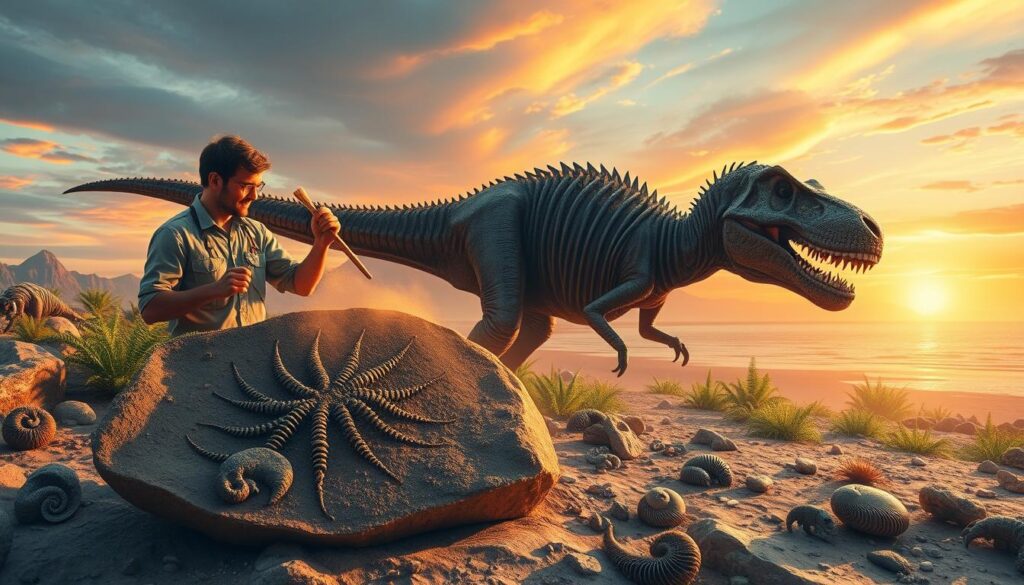
Excavation is about carefully finding fossils. It needs patience and care to not hurt the fossils. After finding them, special methods are used to keep them safe. This includes using chemicals and storing them in the right places.
Fossil Laws and Ethics: Who Owns the Past?
Fossil ownership is a big issue. Laws differ by country. Some say fossils found on public land must stay in museums. Others let collectors keep them. It’s important to make sure important finds are used for science and teaching.
| Country | Fossil Ownership Laws |
|---|---|
| United States | Fossils on public land are generally owned by the government |
| Canada | Similar to the U.S., with a focus on preservation in museums |
| China | Strict regulations on fossil excavation and export |
Conclusion: Why Fossil Discoveries Matter Today
Fossil discoveries keep us all excited and teach us about Earth’s past. The importance of fossil discoveries is huge. They show us how life on Earth has changed over time.
Fossils are very important. They tell us about the past 3.5 billion years of life changes. They also help us understand ancient environments, climates, and life forms. By studying fossils, scientists can piece together Earth’s history and learn about species evolution.
Fossil discoveries are also inspiring and educational. They connect us to the past, teaching us from ancient life. As we find and study fossils, we see how our planet is always changing. This reminds us of the need to protect our world for those who come after us.
FAQ
What is a fossil?
A fossil is the preserved remains or traces of ancient life. This includes plants, animals, or microorganisms from the past.
How are fossils formed?
Fossils form through fossilization. This process includes permineralization, replacement, and impression. It preserves the remains or traces of ancient life over time.
What is the significance of dinosaur fossils?
Dinosaur fossils give us insights into these prehistoric creatures. They help us understand Earth’s history and the diversity of life.
What can we learn from the fossil record about prehistoric life?
The fossil record lets us reconstruct ancient ecosystems. It tracks evolution and mass extinctions. It gives us a glimpse into the past and how life has changed.
How has technology impacted the field of paleontology?
Technology, like CT scans and digital imaging, has changed paleontology. It lets researchers study fossils in more detail. This gives new insights into ancient life.
Where are the best places to find fossils?
You can find fossils worldwide. Look in sedimentary rocks, badlands, and areas with tectonic activity. The American West and the Jurassic Coast in England are good spots.
Who owns fossils?
Fossil ownership is complex. Laws vary by country and region. Often, fossils are owned by both the public and private sectors. Some are seen as national treasures or cultural heritage.
Why are fossil discoveries important today?
Fossil discoveries are key today for science and public interest. They offer new insights into Earth’s history and life’s evolution. They inspire wonder and curiosity globally.

Subscribe to Our Newsletter