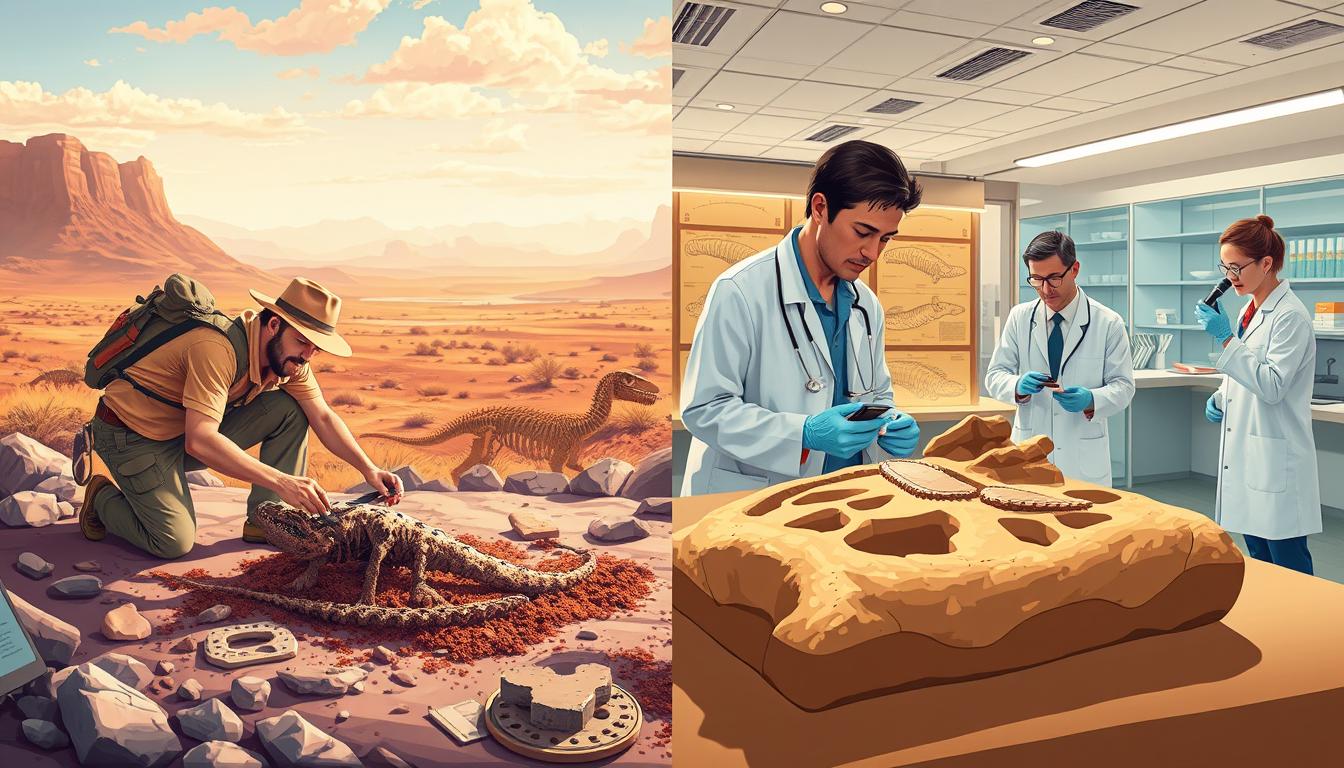
For those who love ancient history, fossil hunting and paleontology might seem the same. But they are not.
Fossil hunting is about finding fossils. It’s driven by a love for discovery and collecting. Paleontology, though, is a science that studies fossils to learn about Earth’s past.
Fossil hunting can be a fun hobby or a job. But paleontology is serious research. It uses fossils to piece together history.
Key Takeaways
- Fossil hunting is mainly about finding fossils.
- Paleontology is the science of studying fossils to understand Earth’s history.
What Are Fossils? The Ancient Records of Life
Fossils are the remains of life from long ago. They show us what the Earth was like in the past. They are the preserved parts of plants, animals, and other living things from long times back.
Fossils can be bones, shells, leaves, or even footprints. The process of making fossils is rare and complex. It needs special conditions to keep the remains. Over time, minerals replace the original material, making a lasting copy of the organism.
Fossils are key to knowing life’s history on Earth. They prove evolution and help scientists build pictures of old ecosystems. They show how life has changed over time.
By looking at fossils, scientists learn about the Earth’s past climates and geography. They also see how diverse life was. This knowledge helps us understand our planet’s history and how it has changed.
Fossil Hunting: The Recreational Pursuit
Fossil hunting is a fun adventure that mixes exploration and discovery. It’s about searching for fossils in different places. These places are known for their rich fossil history.
People who love fossil hunting, or amateur paleontologists, have many ways to find fossils. They look at geological maps and search in areas with exposed rocks. They also use tools like rock hammers and chisels.
Key Locations for Fossil Hunting
| Location | Fossil Type | Geological Age |
|---|---|---|
| Morrison Formation, USA | Dinosaur fossils | Jurassic |
| Solnhofen, Germany | Archaeopteryx fossils | Jurassic |
| Badlands, USA | Mammal and reptile fossils | Oligocene |
Fossil hunting connects us to the Earth’s past. It helps us understand life on Earth. Many important discoveries have been made by amateur fossil hunters. This shows how valuable this hobby is.
Paleontology: The Scientific Discipline
Paleontology helps us learn about the Earth’s past life and how it changed. It combines geology, biology, and ecology. This way, we can see how life evolved on Earth.
Paleontologists use many methods to study fossils. They look at them under microscopes and do chemical tests. This helps them figure out old environments and how life changed over time.
This science is key to knowing the Earth’s history. It tells us about past climates, big events, and life’s evolution. It helps scientists understand today and predict tomorrow.
Paleontology is about collecting, sorting, and understanding fossils. It lets researchers paint a detailed picture of the past. They learn about ancient life and the places it lived.
The Difference Between Fossil Hunting and Paleontology
It’s important to know the difference between fossil hunting and paleontology. They help us learn about ancient life in different ways. Fossil hunting and paleontology have their own goals and ways of working.
Fossil hunting is about finding fossils for fun or as a hobby. It’s about looking for and collecting fossils. Paleontology, on the other hand, is a science that studies fossils to learn about Earth’s history. Paleontologists use fossils to understand ancient life, how life evolved, and what the Earth was like long ago.
Key differences between fossil hunting and paleontology include:
- Purpose: Fossil hunting is for fun or collecting, while paleontology aims to learn more about science.
- Methodology: Fossil hunting is about finding fossils. Paleontology is about studying and understanding them.
- Expertise: Anyone can go fossil hunting, but paleontology needs special skills and training.
| Aspect | Fossil Hunting | Paleontology |
|---|---|---|
| Purpose | Recreational or personal collection | Scientific research and education |
| Methodology | Searching for fossils | Analysis and interpretation of fossils |
| Expertise | Basic knowledge | Advanced scientific training |
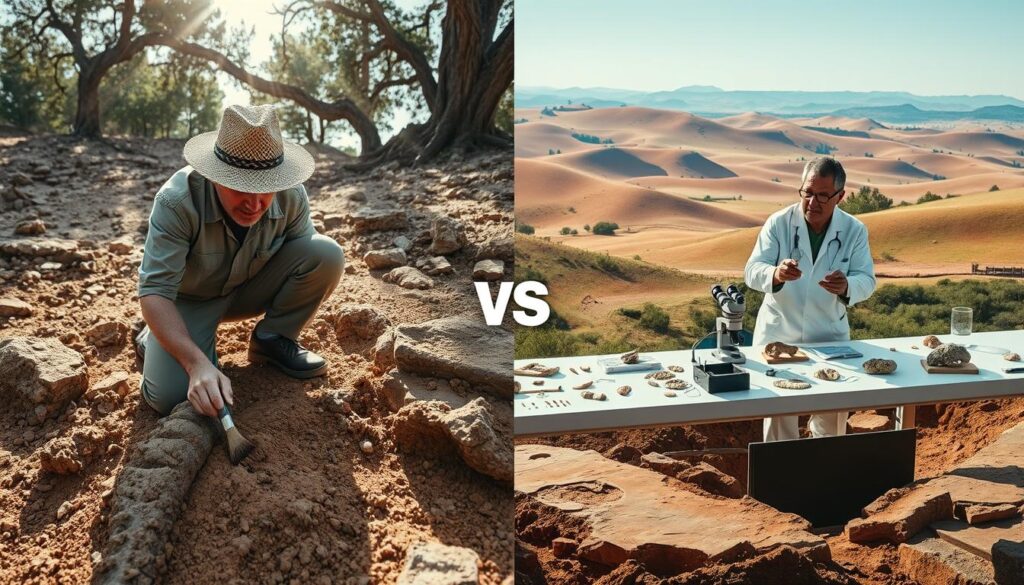
In conclusion, fossil hunting and paleontology are connected but different. They help us learn about the past in special ways. By understanding these differences, we can support both the fun and scientific sides of fossils.
Scientific Methods in Paleontological Research
Paleontology uses many research methods to study fossils. It’s not just about finding old bones. It’s about learning about life’s history on Earth through careful science.
Key Methods in Paleontological Research
- Fossil excavation and collection
- Laboratory analysis, including cleaning and preparation of fossils
- Comparative anatomy to understand evolutionary relationships
- Biostratigraphy for dating rock formations
- Geochemical analysis to determine the composition and age of fossils
For more info on fossils, check out the National Park Service’s Fossil Day FAQ.
| Method | Description | Application |
|---|---|---|
| Fossil Excavation | Careful removal of fossils from the earth | Fieldwork in paleontology |
| Laboratory Analysis | Detailed examination of fossils in a controlled environment | Understanding fossil morphology and composition |
| Comparative Anatomy | Studying the structure of fossils in comparison to known species | Reconstructing evolutionary histories |
These methods are key to paleontological research. They help scientists understand the fossil record and the Earth’s biological past.
Fossil Identification and Preservation
Finding and keeping fossils right is key for science and learning. It takes many steps, from finding it to studying it in a lab.
When a fossil is found, the first thing is to figure out where it came from and how old it is. This is done by looking at the rock it’s in and the fossil itself. Experts use many methods, like comparing it to other fossils and studying its chemical makeup, to know its identity and importance.
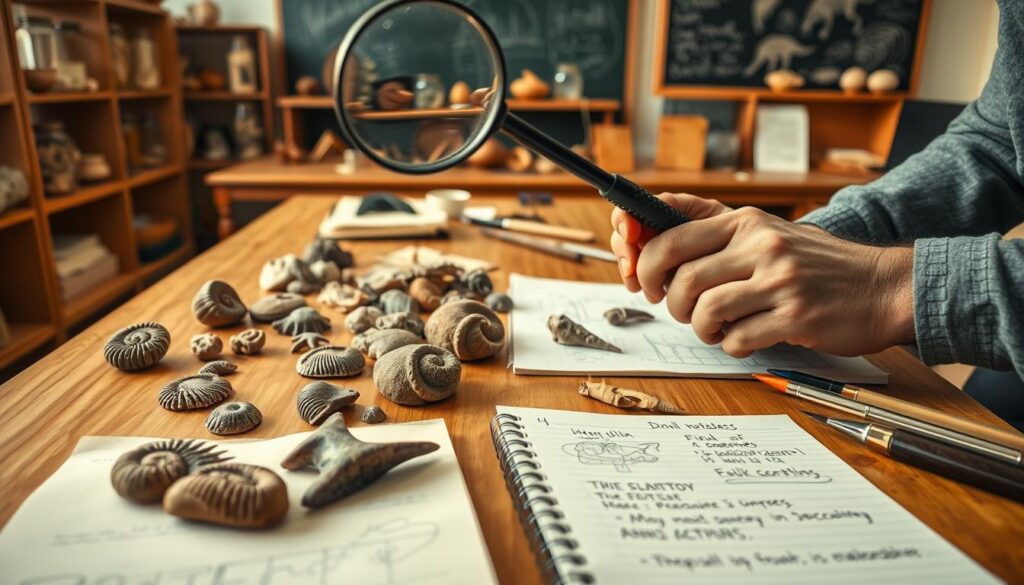
Keeping fossils safe is also very important. This means they stay good for studying later. Ways to do this include using special materials to hold them together, digging carefully, and keeping them in places with the right conditions. For more on why fossils matter, check out the National Park Service’s page on fossils.
How to keep a fossil safe depends on what it is and how it’s found. For example, fossils in rock might need different care than those in amber. Using the right ways to preserve fossils is key to keeping them good for study and teaching.
In short, finding and keeping fossils right is very important for studying the past. By using careful methods, scientists can learn a lot from fossils. This helps us understand the Earth’s history and how life evolved.
The Ethical Considerations and Legal Regulations
Ethical and legal rules are key in fossil hunting and paleontology. As more people get into it, knowing the laws and ethics is vital.
Fossil hunting must follow local, national, and international laws. Rules differ a lot from one country to another. Even within a country, laws about collecting, selling, and exporting fossils can change.
Here’s a look at some important legal points about fossil hunting in different places:
| Country | Fossil Collection Laws | Export Regulations |
|---|---|---|
| United States | Fossils can be collected on public lands for personal use, but commercial collection requires permits. | Export of significant fossils is regulated and often requires special permits. |
| Canada | Similar to the U.S., with an emphasis on preserving fossils of scientific significance. | Export is controlled, specially for fossils important to Canada’s heritage. |
| United Kingdom | Fossil collection is generally allowed on certain public lands, but significant finds must be reported. | Export controls are in place, specially for fossils of historical or scientific importance. |
Ethics are also very important. Many scientists think fossils should stay in public places for study and learning. This way, fossils help us learn about Earth’s past.
In short, both laws and ethics are very important in fossil hunting and paleontology. Knowing and following these rules helps protect our planet’s fossil history.
[link-whisper-related-posts]Conclusion: Bridging the Gap Between Hobby and Science
Fossil hunting and paleontology are closely linked. They help us learn about Earth’s past. Fossil hunting is fun for many, while paleontology gives it a scientific edge.
Knowing the difference between these two activities is key. Fossil hunting lets us explore and find new things. Paleontology makes sure we understand these finds in a bigger context.
This understanding shows us how valuable fossils are. It also teaches us about collecting fossils right and the role of science in learning from the past.
## FAQ
### Q: What is the main difference between fossil hunting and paleontology?
A: Fossil hunting is for fun, about finding fossils. Paleontology is science, studying fossils and ancient life. It includes identifying, classifying, and understanding them.
### Q: What is the significance of fossil identification in paleontological research?
A: Identifying fossils correctly is key in science. It helps us understand ancient life, their evolution, and past environments.
### Q: How do paleontologists excavate fossils?
A: They use tools and machines to dig up fossils. They also use acid to reveal fossils from rock.
### Q: What are some common methods used in fossil identification?
A: They use shape, anatomy, and biochemical tests. They also use CT scans and X-rays.
### Q: How do paleontologists preserve fossils for future study?
A: They stabilize, coat, and store fossils. This keeps them safe from damage.
### Q: What are the ethical considerations in collecting fossils?
A: Collectors must respect property and follow rules. They should collect and preserve fossils responsibly.
### Q: How does paleontology contribute to our understanding of the natural world?
A: It lets us see life’s history. We learn about evolution, diversity, and past environments.
### Q: What is the role of paleontologists in fossil hunting?
A: They are experts in finding and understanding fossils. They ensure fossils are found and kept safely.
### Q: What are some of the challenges facing paleontologists today?
A: They face site destruction, illegal trade, and balancing research with preservation. They must protect fossils for the future.

Subscribe to Our Newsletter