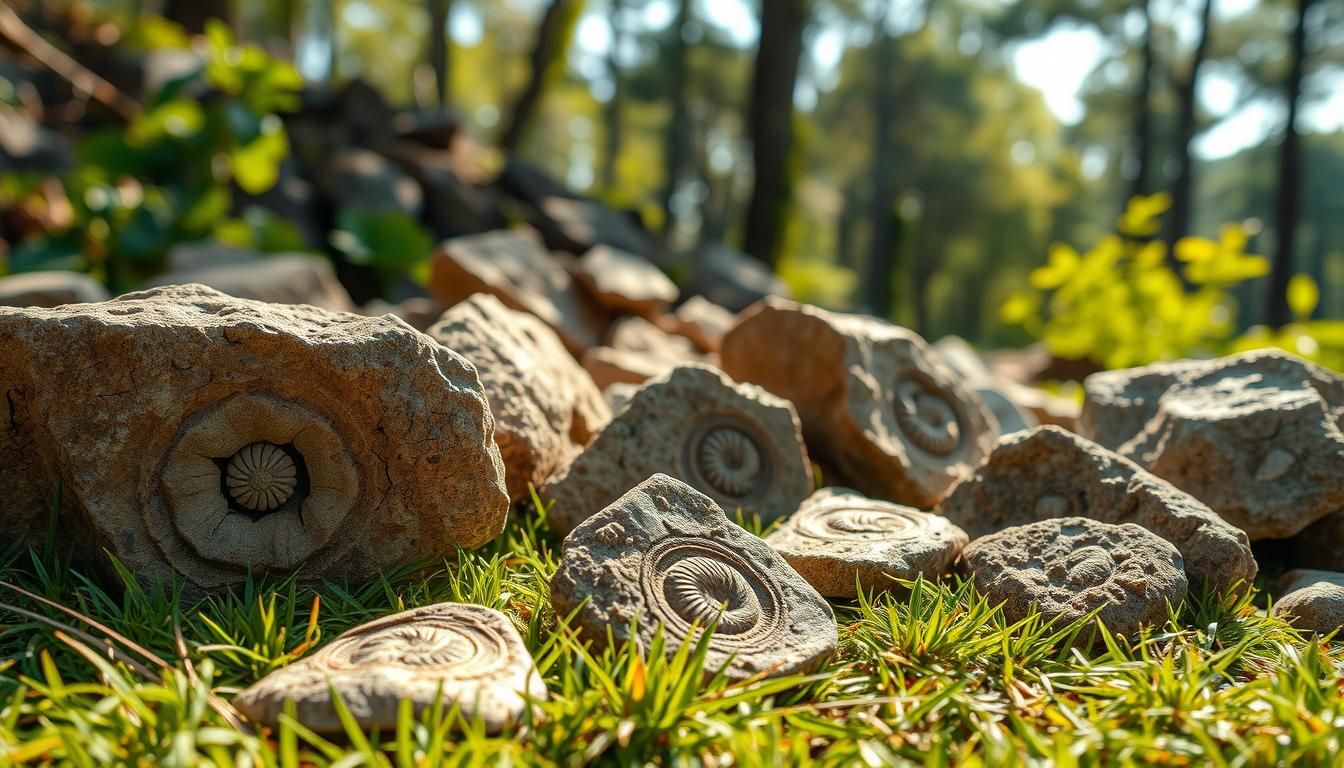
Fossils are pieces of ancient life. They tell us a lot about Earth’s past. Some rocks are more likely to have fossils, giving us a peek into history.
Sedimentary rocks like limestone, sandstone, and shale are fossil-bearing rocks. They form from layers of sediments that get pressed together. This often includes the remains of plants and animals.
Fossilization is a complex process. It involves quick burial and being replaced by minerals. The British Geological Survey says fossils are mostly found in sedimentary rocks. Sometimes, they can be in fine-grained, low-grade metamorphic rocks too.
Key Takeaways
- Sedimentary rocks like limestone and sandstone are common fossil-bearing rocks.
- Fossils provide significant insights into the Earth’s history and ancient life forms.
- Rapid burial by sediments is key for fossilization.
- Fossils can be preserved through petrification, compression, and other methods.
- The type of rock and conditions determine the likelihood of finding fossils.
The Fascinating World of Fossil-Bearing Rocks
The study of fossil-bearing rocks is key to understanding Earth’s history. These rocks show us the past. They contain fossils that help us learn about life’s evolution.
What Makes a Rock Suitable for Fossil Preservation
Sedimentary rocks like shale and limestone are the best fossil rocks. They form from sediment that can keep organic matter safe. The rock’s texture and makeup are important for fossil identification in rocks.
The Importance of Fossil-Bearing Rocks in Paleontology
Fossil-bearing rocks are essential in paleontology. They hold the remains or signs of ancient life. By studying these fossils, scientists learn about Earth’s life history, including species evolution and past environments.
How Fossils Form Within Rocks
Fossils are the remains of ancient life, found in rocks. They form through complex geological processes. It’s a rare event that needs specific conditions.
The Process of Fossilization
Fossilization happens in a few ways, like permineralization, compression, and making moulds and casts. Permineralization fills spaces with minerals. Compression squishes remains into fossils. For more on fossilization, check out this resource on fossils.
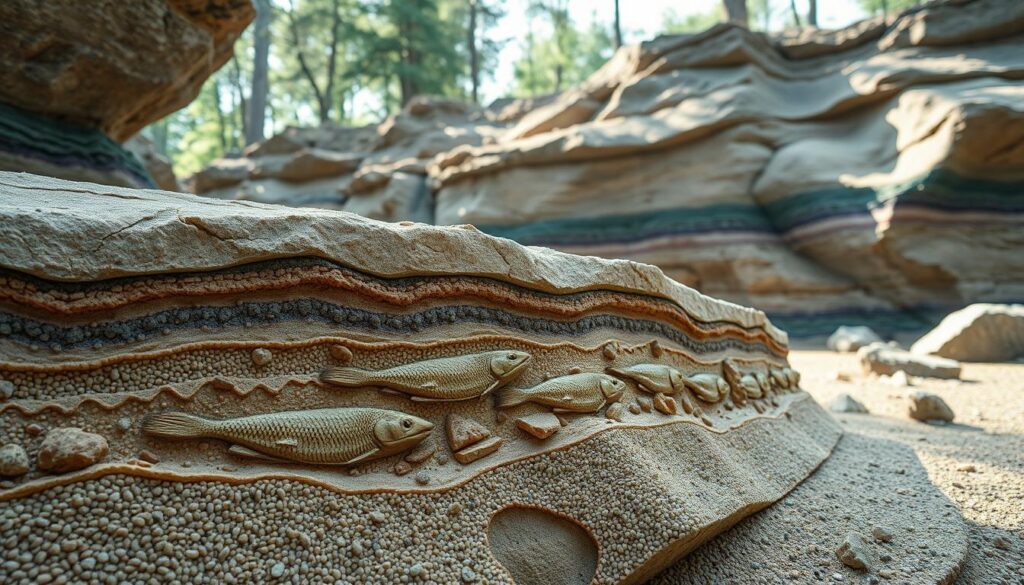
Conditions Necessary for Fossil Formation
For fossils to form, certain things must happen. Quick burial is key to avoid decay. Mineral-rich fluids help with permineralization. Also, a stable area is important to keep fossils intact.
| Condition | Description | Importance |
|---|---|---|
| Rapid Burial | Protects remains from scavengers and oxygen | High |
| Mineral-Rich Fluids | Facilitates permineralization | High |
| Stable Tectonic Environment | Prevents destruction of fossils | Medium |
These conditions and processes create prized fossil-rich rocks. They hold ancient rocks with fossils. These rocks give us a peek into Earth’s past.
Best Rocks That Often Contain Fossils
Fossil-bearing rocks are full of secrets about Earth’s past. Limestone, sandstone, and shale are common rocks with fossils. These rocks form through geological processes that help fossils stay preserved.
Limestone is made mostly of calcium carbonate from sea creatures. It has fossils of sea life like shells and skeletons. Sandstone, made from sand, holds fossils of plants and animals from old rivers and deserts.
Shale, a fine-grained rock, is great for preserving delicate fossils. Its fine texture helps keep fossils intact, giving us clues about ancient life. Knowing about these rocks helps us understand Earth’s history.
Studying these rocks shows us how our planet has changed over time. Fossils in these rocks are key to paleontology. They let us see how life on Earth has evolved.
FAQ
What types of rocks are most likely to contain fossils?
Sedimentary rocks like limestone, sandstone, and shale often have fossils. These rocks form from compressed sediments, which can include ancient life remains.
What is the process of fossilization, and how do fossils form within rocks?
Fossilization happens when ancient life remains are quickly buried. This protects them from scavengers and oxygen. Over time, minerals replace the original material, creating a fossil.
Permineralization and compression are common ways fossils form.
Why are limestone, sandstone, and shale conducive to fossil formation?
These rocks are good for fossil formation because of their makeup. Limestone, for example, has calcium carbonate that helps preserve fossils. Sandstone and shale can hold fossils of plants and animals from water environments.
What are some examples of fossils that have been found in sedimentary rocks?
Sedimentary rocks have fossils like ancient shells, leaves, and dinosaur bones. Limestone often has fossils of marine life. Sandstone and shale can have fossils of plants and fish.
How do scientists identify fossils in rocks, and what can they learn from them?
Scientists look at the fossil’s shape and the rock it’s in to identify it. Studying fossils helps them understand life’s history and evolution. It also gives insights into ancient environments.
What is the significance of fossil-bearing rocks in paleontology?
Fossil-bearing rocks are key in paleontology. They let scientists peek into the past. By studying fossils, they learn about life’s history, evolution, and ancient environments.
How can I identify fossil-rich rocks in the field?
Look for sedimentary rocks with visible fossils or unusual textures. Limestone, sandstone, and shale are good to check, where fossils are often found.
What are some prized fossil-rich rocks that collectors seek out?
Collectors want rocks with well-preserved fossils like trilobites or dinosaur bones. Limestone, sandstone, and shale from certain places are highly sought after.

Subscribe to Our Newsletter